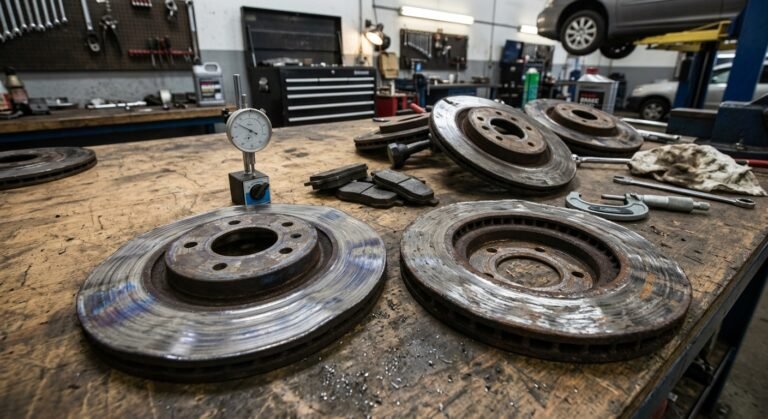
The most common bad brake calliper symptoms include pulling to one side, one wheel becoming unusually hot, uneven brake-pad wear, brake drag, a burning smell, and persistent squeaking or grinding.
A brake calliper doesn’t always fail by completely stopping brake operation. More often, the problem is that the caliper doesn’t apply or release the brake correctly. A corroded slide pin, sticking piston, damaged seal, restricted brake hose, or parking-brake mechanism can all create similar symptoms.
That’s why a sticking brake shouldn’t automatically be treated as a reason to replace the calliper. The actual cause needs to be identified first.
What Does a Brake Calliper Do?
A brake calliper is the component that applies the brake pads to the rotor on a disc-brake system.
When you press the brake pedal, the master cylinder creates hydraulic pressure in the brake fluid. That pressure reaches the calliper, which moves its piston and pushes the brake pads against the rotor. Friction between the pads and rotor slows the wheel.
When you release the pedal, the brake needs to release enough for the pads to stop dragging against the rotor.
There are two common calliper designs:
- Floating or sliding callipers, which move on guide pins as the brake is applied.
- Fixed callipers, which stay in position while pistons on both sides apply the pads.
A problem with either design can affect braking performance.
8 Bad Brake Calliper Symptoms

1. Your Car Pulls to One Side
A vehicle that pulls left or right when braking may have uneven braking force between the two sides.
A sticking calliper can cause one brake to remain partially applied or apply differently from the opposite brake. That imbalance can make the vehicle move toward one side when you brake.
The direction of the pull doesn’t reliably tell you which caliper has failed. Tire condition, road crown, suspension geometry, and other factors can affect the result.
If the car pulls specifically under braking, see our guide on why your car pulls to one side when braking.
2. One Wheel Is Much Hotter Than the Others
This is one of the strongest clues that a brake may be dragging.
If the calliper doesn’t release properly, the brake pad can remain against the rotor. Continuous friction creates heat even when you aren’t actively braking.
The affected wheel may then be significantly hotter than the others.
You might also notice:
- Burning smell
- Brake dust
- Rotor discoloration
- Reduced fuel economy
- Vehicle pulling
- Persistent brake noise
Never touch the brake rotor or calliper to check its temperature. A dragging brake can become extremely hot and cause serious burns.
Temperature measurements should be made with appropriate equipment or by a technician.
3. Burning Smell From One Wheel
A sharp burning or chemical smell from one wheel can indicate excessive brake heat.
A normally functioning brake generates heat during braking, but the system should release that friction once you release the pedal. A sticking calliper can keep generating heat continuously.
The smell is particularly concerning when it appears during ordinary driving rather than after prolonged heavy braking.
Smoke, severe odour, or visible heat from one wheel means you shouldn’t continue driving.
4. Uneven Brake-Pad Wear
Inspecting brake-pad thickness can provide another useful clue.
One pad may be significantly thinner than its counterpart on the same wheel, or the pads on one side of the axle may wear much faster than the other side.
Possible causes include:
- Sticking calliper piston
- Corroded guide pins
- Binding pads
- Damaged hardware
- Restricted brake hose
A manufacturer service bulletin on abnormal brake-pad wear lists calliper piston binding, guide-pin problems, pad binding, and brake-hose restrictions among possible causes.
Uneven pad wear therefore tells you that something needs investigation. It doesn’t automatically prove the calliper body itself has failed.
5. The Brake Stays Engaged After You Release the Pedal
A brake that remains partially applied is experiencing brake drag.
You may notice that the vehicle feels slightly harder to roll, doesn’t coast as freely, or seems to resist acceleration.
Common signs include:
- Continuous squeaking
- Burning smell
- Rapid pad wear
- Excessive wheel heat
- Reduced fuel economy
- Vehicle pulling
A sticking piston or seized slide mechanism can cause the problem, but a restricted hydraulic hose can produce similar residual braking force.
If the brake remains applied, simply replacing the pads won’t solve the underlying problem.
6. Squeaking or Grinding From One Wheel
Brake noise from one wheel can occur when a pad is constantly contacting the rotor.
A dragging brake can produce persistent squeaking, while grinding is more serious and may indicate severe pad wear or metal-to-metal contact.
Our article on why your brakes are squeaking covers the broader range of causes behind brake noise.
Don’t assume the calliper is the culprit based on noise alone. Brake pads, rotors, hardware, wheel bearings, and debris can all produce unusual sounds.
7. Reduced Braking Performance
A defective calliper may not apply its brake pad with the expected force.
That can change braking balance and make the vehicle feel different when you stop.
You may notice:
- Increased stopping distance
- Uneven braking
- Vehicle pulling
- Inconsistent pedal response
- Greater braking effort
Severe calliper problems can also produce excessive heat, which can contribute to brake fade and component damage.
Any noticeable reduction in braking performance deserves prompt attention.
8. Soft or Spongy Brake Pedal
A calliper isn’t the most common cause of a spongy brake pedal, but calliper problems can occur alongside hydraulic issues.
A calliper may leak brake fluid, a hose may be damaged, or air may enter the hydraulic system during brake service.
A genuinely soft pedal therefore needs broader hydraulic diagnosis rather than automatically pointing to the caliper.
For more information, see why your brake pedal feels soft or spongy.
Why Does a Brake Calliper Stick?
A brake calliper can stop moving correctly for several reasons.
Corroded Slide Pins
Floating callipers need to move along their guide pins.
Corrosion, dirt, moisture, or incorrect lubrication can make those pins difficult to move. The result can be uneven pad pressure or a brake that doesn’t fully release.
A vehicle exposed to road salt and winter moisture is particularly vulnerable to corrosion.
Seized or Corroded Calliper Piston
The piston normally moves inside the calliper body and applies force to the pad.
If the piston boot is torn, moisture and contamination can enter the piston area and contribute to corrosion. The piston may then bind instead of moving smoothly.
Damaged Piston Seal or Calliper
A deteriorated seal can affect piston movement and may also allow brake fluid to escape.
A damaged calliper body can similarly interfere with correct piston operation.
Collapsed Brake Hose
A flexible brake hose can deteriorate internally.
In some cases, the damaged inner lining can restrict hydraulic fluid flow. Pressure may reach the calliper but fail to release normally, leaving the brake partially applied.
This can produce symptoms that look exactly like a sticking calliper.
Contaminated Brake Fluid
Brake fluid absorbs moisture over time. Contamination can contribute to internal corrosion and other hydraulic problems. Following the manufacturer’s brake-fluid service recommendations helps reduce these risks.
See our article on how often you should change brake fluid for more information.
Sticking Parking-Brake Mechanism
Some rear disc-brake callipers incorporate the parking-brake mechanism.
If that mechanism doesn’t fully release, the rear brake can remain partially engaged. The resulting heat and wear can resemble a conventional calliper problem.
Sticking Brake Calliper vs. Stuck Brake Pad
A brake that stays engaged doesn’t necessarily mean the calliper piston has seized.
The pad itself can bind in its mounting hardware.
Possible causes include:
- Corrosion under the pad abutment clips
- Rust in the calliper bracket
- Incorrectly fitted pads
- Damaged anti-rattle hardware
- Contaminated or damaged contact surfaces
A recent Maserati service bulletin instructs technicians to inspect pad seating, corrosion, guide movement, and residual brake torque before deciding which components need repair.
This distinction matters because replacing a calliper won’t fix a pad that’s physically binding in the bracket.
Can a Bad Brake Calliper Cause a Car to Pull?
Yes.
A sticking caliper can create unequal braking force between the left and right sides.
The basic relationship is:
Uneven calliper operation → unequal braking force → vehicle pulls.
A dragging caliper can also cause the vehicle to pull while driving normally, even when the brake pedal isn’t pressed.
Other clues can include a hot wheel, burning smell, uneven pad wear, and reduced braking efficiency.
However, pulling can also come from tyre pressure, tyre defects, alignment, suspension, or other brake problems. The direction of the pull alone isn’t enough to identify the bad calliper.
Can a Bad Calliper Cause Brake Vibration?
Yes, but often indirectly.
A sticking caliper can cause continuous pad contact and excessive heat. Over time, that can contribute to uneven pad or rotor wear and brake judder.
The chain can look like this:
Sticking caliper → excessive heat → uneven wear or pad deposits → rotor variation → brake vibration.
That’s why a new rotor may not solve a vibration permanently if the calliper causing the heat problem is left untouched.
Our guide explains why your car vibrates when braking, while our article on warped brake rotors explains why rotor vibration isn’t always caused by a literally warped disc.
How to Tell Which Brake Calliper Is Bad
Don’t rely only on the direction the vehicle pulls.
Instead, look for several clues pointing toward the same wheel.
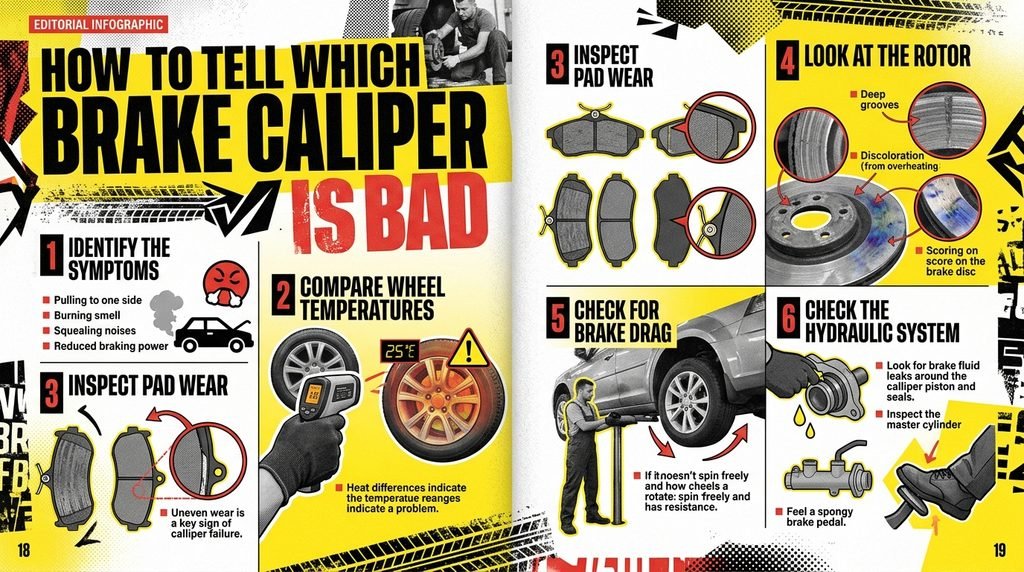
1. Identify the symptoms
Determine whether the vehicle pulls, drags, squeaks, or develops a burning smell.
2. Compare wheel temperatures
A significantly higher temperature at one wheel can indicate brake drag.
Use an appropriate infrared thermometer or professional brake-temperature equipment. Don’t touch the brake components by hand.
3. Inspect pad wear
Compare the inner and outer pads. Major differences can suggest piston, slide-pin, pad-hardware, or hydraulic problems.
4. Look at the rotor
A rotor that shows abnormal discolouration, scoring, or heat damage can indicate prolonged brake drag.
5. Check for brake drag
If the vehicle seems reluctant to roll or one wheel remains partially braked after releasing the pedal, investigate that corner.
6. Check the hydraulic system
A technician can determine whether residual hydraulic pressure is being created by the calliper or by an upstream component such as the brake hose.
The important point is to identify why the wheel is staying braked, not simply which wheel is hot.
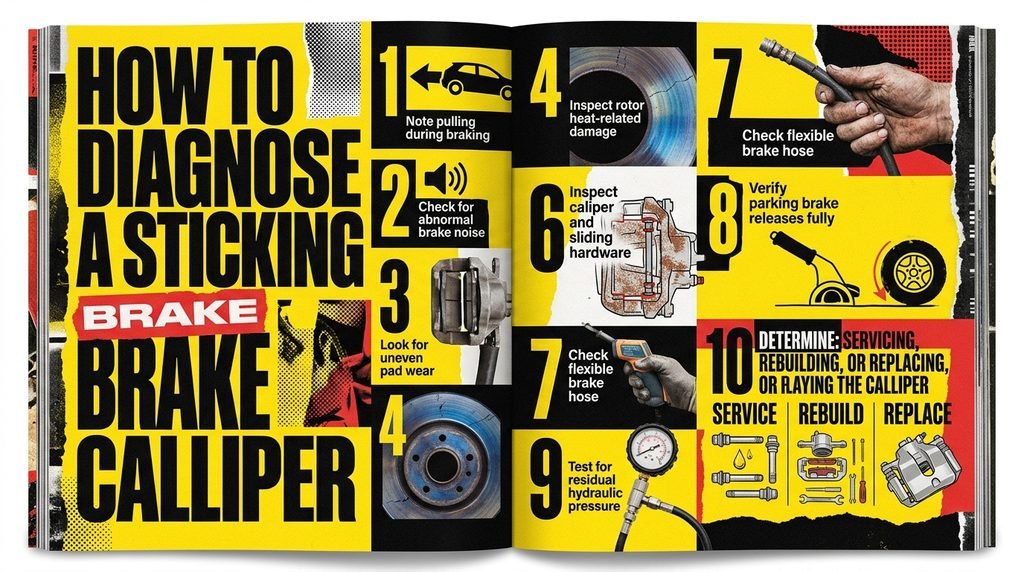
How to Diagnose a Sticking Brake Calliper
A logical diagnosis starts with the symptoms and moves toward the affected wheel.
- Note whether the vehicle pulls during braking or normal driving.
- Check for abnormal brake noise.
- Look for uneven pad wear.
- Inspect the rotor for heat-related damage.
- Compare wheel temperatures using appropriate equipment.
- Inspect the calliper and sliding hardware.
- Check the flexible brake hose.
- Verify that the parking-brake mechanism releases fully where applicable.
- Test for residual hydraulic pressure when necessary.
- Determine whether servicing, rebuilding, or replacing the calliper is appropriate.
Brake systems are safety-critical. Inexperienced owners shouldn’t open hydraulic lines or dismantle a calliper simply to locate the problem.
Can You Drive With a Sticking Brake Calliper?
Driving with a confirmed sticking calliper isn’t advisable.
A dragging brake continues generating heat while you’re driving. That can damage the brake pad, rotor, caliper, hose, wheel bearing, and other nearby components. Severe overheating can also affect braking performance.
Stop driving and arrange an inspection if you notice:
- Smoke from a wheel
- Strong burning smell
- Severe pulling
- Rapidly rising wheel temperature
- Significant loss of braking performance
- Grinding
- Brake warning light
- A wheel that appears to be dragging badly
A brake that is only slightly noisy but otherwise normal still deserves inspection if the symptom persists, because a developing calliper problem can become more expensive when ignored.
How Is a Bad Brake Calliper Fixed?
The appropriate repair depends on what has actually failed.
Possible solutions include:
- Cleaning and servicing sliding hardware
- Replacing corroded guide pins
- Replacing damaged pad hardware
- Servicing a rebuildable calliper
- Replacing the calliper
- Replacing a damaged brake hose
- Repairing the parking-brake mechanism
- Bleeding the hydraulic system after opening it
- Replacing pads or rotors damaged by overheating
A technician should also inspect the rest of the brake assembly.
If a calliper has been dragging long enough to overheat the rotor, installing a new calliper alone may not be enough. Heat-damaged pads or a damaged rotor may need replacement as well.
Should You Replace One Brake Calliper or Both?
A failed calliper doesn’t automatically mean both callipers on the axle must be replaced.
The decision depends on:
- Condition of the opposite calliper
- Vehicle age
- Corrosion
- Similarity of component condition
- Manufacturer recommendations
- Overall brake-system condition
If one calliper fails on an older vehicle and the opposite side shows significant corrosion or wear, replacing both may make practical sense. On another vehicle, replacing only the failed component may be appropriate.
Brake pads should generally be replaced as an axle set when replacement is required, while calliper replacement is more dependent on the individual component’s condition and the manufacturer’s recommendations.
How to Prevent Brake Calliper Problems
Regular brake maintenance can catch many calliper problems early.
Inspect the brake pads and rotors periodically and pay attention to uneven wear, brake noise, pulling, or unusual heat.
Follow the manufacturer’s brake-fluid service recommendations. Corrosion and contamination inside hydraulic components can contribute to problems over time.
During brake service, make sure calliper guide mechanisms and pad hardware are cleaned and serviced according to the correct procedure. Don’t substitute random grease or lubricants for products specified for brake components.
Also pay attention after winter driving. Road salt and moisture can accelerate corrosion around callipers, guide pins, brackets, and other brake hardware.
FAQ
What are the symptoms of a bad brake calliper?
Common symptoms include pulling to one side, one wheel becoming unusually hot, uneven pad wear, burning smell, brake drag, persistent squeaking or grinding, and reduced braking performance.
How do I know if my brake calliper is sticking?
Look for a brake that remains partially engaged, one wheel that becomes significantly hotter, uneven pad wear, burning smell, persistent brake noise, or the vehicle pulling. A technician can confirm the fault by inspecting the calliper and hydraulic system.
Can a bad calliper cause pulling?
Yes. A sticking or malfunctioning calliper can create unequal braking force between the two sides and cause the vehicle to pull. A dragging calliper can also make the car pull while driving without braking.
Can a bad calliper cause vibration?
Yes. A dragging calliper can create excessive heat and uneven pad or rotor wear, which can eventually contribute to brake judder and vibration.
Why is one wheel hotter than the others?
A significantly hotter wheel can indicate a dragging brake. A sticking calliper piston, seized guide mechanism, restricted brake hose, or parking-brake problem can keep the brake partially applied.
Can a sticking calliper cause a burning smell?
Yes. Continuous friction between the pad and rotor generates heat, and severe overheating can produce a burning odour. Don’t ignore a strong burning smell from one wheel.
Can you drive with a sticking brake calliper?
It’s not advisable. A dragging brake can overheat the braking system, accelerate wear, and potentially reduce braking performance. Smoke, severe heat, burning smell, strong pulling, or major braking changes require immediate attention.
Can a brake hose cause a calliper to stick?
Yes. An internally deteriorated brake hose can restrict hydraulic-fluid return and leave residual pressure at the wheel, creating symptoms similar to a sticking calliper.
How much does a brake calliper replacement cost?
The cost varies significantly by vehicle, calliper design, parts quality, labour rates, and whether pads, rotors, hoses, or other components also need replacement. Confirm the failed component before estimating the repair.
Should I replace one calliper or both?
Not necessarily. One calliper can be replaced when only that component has failed, and the opposite side is in good condition. The age and condition of both sides and the manufacturer’s recommendations should be considered.
Can a bad calliper damage the rotor?
Yes. A sticking calliper can keep the pad against the rotor, creating excessive heat and uneven wear. Severe or prolonged dragging can damage the rotor enough to require replacement.
Can a sticking calliper affect fuel economy?
Yes, although the effect depends on how severe the brake drag is. A brake that remains partially engaged creates additional rolling resistance, forcing the engine to work harder. It can also generate excessive heat and accelerate brake wear.