
If your car pulls to one side when braking, the brake system is the first place to investigate. Uneven braking force between the left and right sides can make the vehicle veer as soon as you press the brake pedal.
A sticking brake calliper, unevenly worn brake pads, a restricted brake hose, or another hydraulic problem can cause this behaviour. Tires, wheel alignment, steering, and suspension problems can also contribute, especially when the vehicle pulls even when you’re not braking.
The most useful diagnostic clue is simple: does the car pull only during braking, or does it pull while driving normally too?
Why Does a Car Pull to One Side When Braking?
When you press the brake pedal, the braking system should produce reasonably balanced braking force at the wheels.
If one side generates more or less braking force than the other, the vehicle can move toward one side.
For example, a brake that is dragging on one wheel can create a directional pull, while a brake that isn’t applying enough force can create an imbalance in stopping force. The exact direction isn’t always predictable, though, because tyre grip, road conditions, suspension geometry, and road crown can affect the vehicle’s movement.
So don’t diagnose a specific failed component simply by observing whether the car pulls left or right.
7 Common Causes of a Car Pulling When Braking
1. Sticking or Seized Brake Calliper
A sticking brake calliper is one of the first things to investigate when a vehicle pulls during braking.
The calliper presses the brake pads against the rotor. If its piston or slide mechanism doesn’t move correctly, one brake can apply differently from the others or remain partially engaged.
Possible symptoms include:
- Pulling during braking
- Pulling while driving
- Burning smell
- Uneven brake-pad wear
- One wheel becoming unusually hot
- Brake drag
- Squeaking or grinding
A sticking calliper can also keep generating heat even after you release the brake pedal. That heat can damage the pad and rotor and make the pulling progressively worse.
Our guide on why your brakes are squeaking covers several symptoms that can accompany a dragging or sticking brake.
2. Uneven Brake-Pad Wear
Brake pads should normally wear in a reasonably consistent pattern. Significant differences between the pads on the same axle can indicate a calliper, guide-pin, hydraulic, or hardware problem.
Uneven pad wear can affect the braking force generated on each side and make the vehicle pull when you apply the brakes.
However, unevenly worn pads are often a symptom rather than the original cause.
A manufacturer service bulletin, for example, lists calliper piston binding, binding pads or guide pins, and brake-hose restriction among possible causes of abnormal pad wear and brake drag.
Replacing the pads without finding the reason they wore unevenly may only postpone the problem.
3. Restricted or Damaged Brake Hose
Flexible brake hoses connect the rigid brake lines to the moving wheel assemblies.
A damaged or internally restricted hose can interfere with normal hydraulic operation at one brake. Depending on the failure, pressure may not reach the brake correctly or may not release normally.
Look for:
- Cracking
- Swelling
- Abrasion
- Damaged fittings
- Signs of leakage
- Unusual brake drag
Brake-hose problems aren’t the most common cause of every pulling complaint, but they should be considered when one brake behaves differently from the others.
4. Brake Fluid or Hydraulic Problem
A problem somewhere in the hydraulic system can produce uneven braking.
Potential causes include:
- Brake-fluid leak
- Air in the hydraulic system
- Damaged brake line
- Master-cylinder problem
- ABS hydraulic-unit issue
Not every hydraulic fault produces a directional pull, but a pressure difference between braking circuits can affect braking balance.
A soft or spongy pedal occurring together with the pulling is another important clue. Our article explains why your brake pedal feels soft or spongy.
5. Tire Pressure or Tire Condition
The brakes aren’t always responsible.
A tyre with significantly different pressure from the tyre on the opposite side can affect the vehicle’s tracking and grip. Tire wear, internal damage, or differences in tyre construction can also contribute to pulling.
Check all four tyre pressures against the vehicle manufacturer’s recommended values, preferably when the tyres are cold.
Also inspect for:
- Uneven tread wear
- Bulges
- Cuts
- Damage
- Unequal tread depth
- Evidence of a tyre problem
If the vehicle pulls without using the brakes, tyres should move higher on your diagnostic list.
6. Wheel Alignment Problems
Incorrect wheel alignment can cause a car to drift or pull while driving.
Alignment can change after:
- Hitting a large pothole
- Striking a curb
- Suspension repairs
- An accident
- Wear in steering or suspension components
A vehicle with an alignment problem may pull during normal driving and feel more unstable when braking because braking transfers weight toward the front axle.
If the car pulls exclusively when you apply the brakes, alignment may not be the primary cause. The brake system should be checked first.
7. Suspension or Steering Problems
Worn suspension and steering components can alter how the wheels move under braking.
Potential sources include:
- Control-arm bushings
- Ball joints
- Tie rods
- Shocks or struts
- Wheel bearings
- Other steering components
Braking transfers substantial weight onto the front axle. A worn component may therefore become much more noticeable when you slow down.
Suspension problems can also amplify a brake-related problem and make the vehicle feel less stable.
Car Pulls Left When Braking vs. Pulls Right
The direction of the pull can provide a clue, but it shouldn’t be treated as a definitive diagnosis.
If a car pulls left under braking, there may be an imbalance in braking force between the two sides. The same applies to a car that pulls right.
The problem is that other variables affect vehicle direction, including:
- Road crown
- Tire grip
- Tire pressure
- Alignment
- Suspension condition
- Brake drag
- Weight distribution
A common mistake is assuming that “pulls left = right brake is bad” in every case. Real-world brake diagnosis isn’t that simple.
Use the direction as a clue, then inspect the complete braking and chassis systems.
Car Pulls When Braking but Drives Straight Normally
This is one of the strongest patterns for a brake-related problem.
If the car tracks straight while cruising but immediately starts moving left or right when you apply the brakes, prioritise:
- Brake calipers
- Brake-pad condition
- Brake hoses and lines
- Hydraulic system
- Rotor and brake condition
- Brake hardware
A tyre or alignment problem can still contribute, but the fact that the symptom appears only under braking makes an uneven brake force a stronger starting point.
Car Pulls to One Side While Driving and Braking
If the vehicle pulls both when you’re driving normally and when you’re braking, broaden the diagnosis.
Start with:
- Tire pressure
- Tire condition
- Wheel alignment
- Suspension
- Steering
- Brake calipers
- Wheel bearings
A sticking calliper deserves particular attention because it can keep one brake partially applied even when you’re not pressing the pedal.
The distinction between pulling all the time and pulling only under braking can save a lot of unnecessary part replacement.
How to Diagnose a Car That Pulls When Braking
Start with the simplest checks, then move toward component-level diagnosis.
1. Check tyre pressure
Make sure the tyres are inflated to the pressures specified by the vehicle manufacturer.
Don’t use the maximum pressure printed on the tyre sidewall as the normal vehicle setting.
2. Inspect the tyres
Look for uneven wear, damage, bulges, or significant differences in tread condition.
3. Determine whether the car pulls without braking
On a safe, appropriate road, notice whether the vehicle tracks straight when you’re simply maintaining speed.
If it only pulls under braking, prioritise the brakes.
4. Note the direction
Record whether the vehicle consistently pulls left or right. This gives the technician useful information, although it doesn’t identify the failed component by itself.
5. Check for warning lights
A brake or ABS warning light can indicate an electronic or hydraulic fault that requires additional diagnosis.
6. Inspect brake-pad wear
Look for substantial differences in pad thickness from side to side or between the inner and outer pads.
Uneven wear can point toward a sticking calliper, restricted hose, guide-pin problem, or other fault.
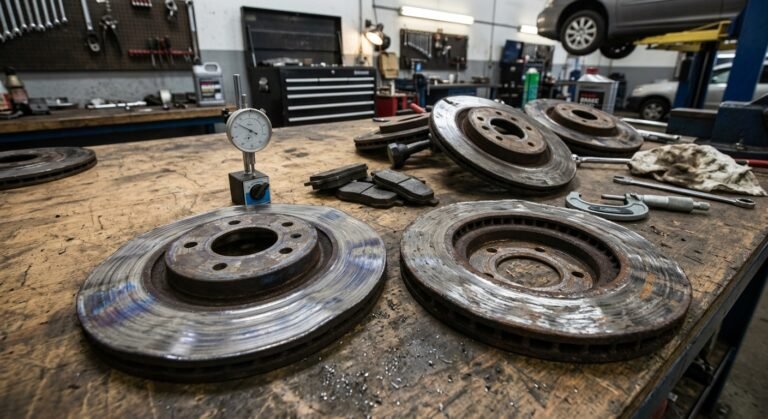
7. Inspect the rotors and callipers
Look for abnormal corrosion, scoring, discolouration, or signs of overheating.
Don’t touch brake components immediately after driving. They can become extremely hot.
8. Inspect hoses and brake lines
Look for leaks, physical damage, corrosion, or evidence that a flexible hose is restricting normal brake operation.
9. Check the suspension and alignment
If the brake system appears normal, investigate alignment and suspension components.
The correct diagnostic order matters. An alignment won’t fix a sticking brake calliper, and replacing a calliper won’t correct an underinflated tyre.
One Wheel Is Hot After Driving: Is That Related?
Yes. A significantly hotter wheel can be an important clue.
If one brake is dragging, the brake pad can remain in contact with the rotor after you release the pedal. That generates heat and may produce:
- Burning smell
- Brake squeaking
- Uneven pad wear
- Rotor discoloration
- Reduced fuel economy
- Vehicle pulling
A sticking calliper is one possible cause, but a restricted brake hose, seized guide pins, or other brake problems can create similar behaviour.
Never touch the rotor, calliper, or wheel near the brake assembly immediately after driving. A brake that has been dragging can become extremely hot.
Can Warped Brake Rotors Cause a Car to Pull?
Rotor problems are more commonly associated with brake vibration and pedal pulsation than with a strong directional pull.
Disc thickness variation, runout, or uneven friction-material deposits can cause the vehicle to shudder during braking. Our article on signs of warped brake rotors explains these conditions in more detail.
A severe brake imbalance can involve the rotor, but a strong pull should prompt you to investigate the callipers, pads, hydraulic system, tyres, and suspension as well.
In other words, don’t replace the rotors simply because the car pulls.
Can a Bad Brake Calliper Cause Pulling?
Yes. A sticking or seized calliper is one of the most important causes to consider.
The basic mechanism is:
Uneven calliper operation → unequal braking force → vehicle pulls during braking.
A calliper can also remain partially engaged, which can cause the vehicle to pull while driving normally. Other symptoms may include a hot wheel, burning smell, uneven pad wear, squeaking, and reduced braking performance.
If the calliper is the underlying problem, replacing the pads or rotors alone won’t necessarily solve the issue.
Can You Drive With a Car That Pulls When Braking?
Persistent pulling during braking should be inspected promptly.
The problem becomes more concerning when it’s accompanied by:
- Reduced braking performance
- Strong directional pull
- Burning smell
- One wheel becoming very hot
- Brake warning light
- Soft or abnormal brake pedal
- Grinding
- Severe vibration
Brake imbalance can affect vehicle control and stopping behaviour. Don’t repeatedly accelerate and brake hard on public roads to determine which side is causing the problem.
If the vehicle pulls strongly whenever you apply the brakes, have the braking system inspected before continuing normal driving.
How Is a Pulling Brake Problem Fixed?
The correct repair depends on the confirmed cause.
Possible repairs include:
- Servicing or replacing a sticking calliper
- Replacing unevenly worn brake pads
- Replacing a restricted brake hose
- Repairing a hydraulic leak
- Servicing the brake-fluid system
- Replacing damaged brake components
- Correcting wheel alignment
- Repairing worn suspension or steering components
- Correcting tyre pressure
- Replacing a damaged tyre
The important point is to repair the cause, not just the symptom.
For example, if a sticking calliper caused one pad to wear rapidly and damaged the rotor through excessive heat, replacing only the pad won’t address the problem.
How to Prevent Your Car From Pulling When Braking
Regular brake and tyre maintenance can prevent many of the conditions that lead to uneven braking.
Keep tyre pressures at the manufacturer’s recommended levels and inspect tyres for uneven wear or damage.
During brake service, check pad wear on both sides of the axle and inspect calliper pistons, guide pins, hoses, and hardware. A manufacturer service bulletin recommends inspecting brake-pad wear and calliper movement when abnormal or uneven wear is present.
Don’t ignore brake drag, overheating, unusual smells, or new pulling behaviour.
If the vehicle hits a significant pothole or curb, or steering and suspension components are replaced, an alignment check may also be appropriate.
FAQ
Why does my car pull to one side when braking?
A car can pull to one side when braking because the left and right brakes aren’t producing equal braking force. Common causes include a sticking calliper, uneven pad wear, restricted brake hoses, hydraulic problems, and tyre or suspension issues.
Why does my car pull left when braking?
A leftward pull can indicate uneven braking force, but the direction alone doesn’t identify the faulty component. Tire pressure, road crown, alignment, suspension, and brake condition can all affect which way the vehicle moves.
Why does my car pull right when braking?
The same diagnostic principles apply to a rightward pull. Start by determining whether the car pulls only while braking and then inspect the brake system, tyres, suspension, and alignment as appropriate.
Why does my car pull only when I brake?
When the vehicle drives straight normally but pulls as soon as you apply the brakes, an uneven braking-force problem becomes more likely. A sticking calliper, uneven pad wear, restricted hydraulic component, or brake hardware problem should be investigated first.
Can a bad brake calliper cause pulling?
Yes. A sticking or seized calliper can apply braking force unevenly or remain partially engaged, causing the vehicle to pull during braking. It can also create heat and uneven pad wear.
Can bad brake pads cause a car to pull?
Yes, particularly when the pads wear unevenly, or one brake isn’t applying normally. Uneven pad wear can also indicate a calliper, guide-pin, hose, or hydraulic problem rather than being the original fault.
Can a bad alignment cause pulling when braking?
Yes. Incorrect alignment can make a vehicle pull while driving and can become more noticeable when braking as weight transfers forward. However, a vehicle that tracks straight until the brakes are applied should have its brake system investigated first.
Can low tyre pressure cause a car to pull when braking?
Yes. Significant pressure differences can affect tyre grip and vehicle tracking. Check tyre pressure before assuming the brake system is responsible.
Can warped rotors cause a car to pull?
Rotor problems are more commonly associated with vibration and brake-pedal pulsation. A strong directional pull should also prompt inspection of the callipers, pads, hydraulic system, tyres, and suspension.
Why is one wheel hotter than the others?
A significantly hotter wheel can indicate brake drag. A sticking calliper, restricted brake hose, seized guide mechanism, or another brake problem can keep the brake partially engaged and generate excess heat.
Is it safe to drive a car that pulls when braking?
Persistent pulling during braking isn’t something to ignore. If the vehicle has reduced braking performance, strong pulling, overheating, grinding, a warning light, or an abnormal pedal, stop driving and have the brake system inspected.
How do I fix a car that pulls when braking?
The repair depends on the cause. Possible solutions include servicing a sticking calliper, replacing unevenly worn pads, repairing a brake hose or hydraulic leak, correcting tyre pressure, repairing suspension components, or performing an alignment when appropriate.


2 Comments