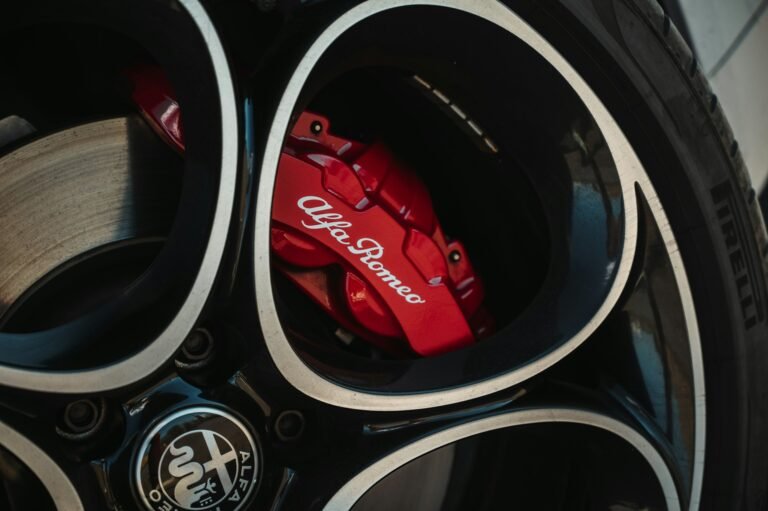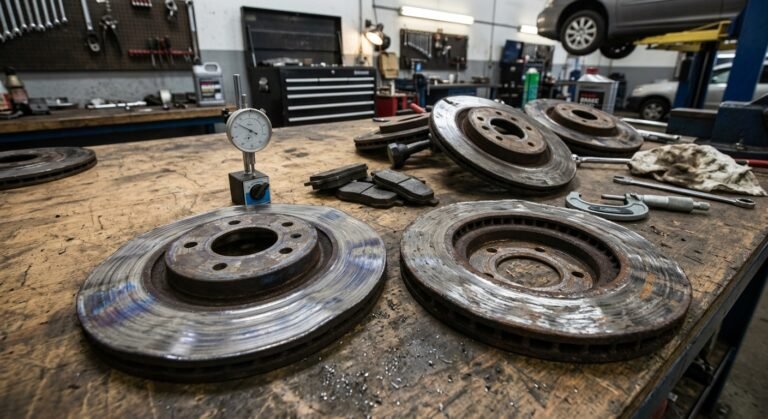

So, how long do brake pads and rotors last? There isn’t one mileage figure that applies to every car.
Brake pads commonly last somewhere around 25,000 to 65,000 miles (40,000 to 105,000 km), but actual life can vary dramatically with driving style, traffic, vehicle weight, terrain, and brake design. Firestone notes that quick starts, frequent short trips, and city driving can wear brake pads much faster than steady highway driving.
Brake rotors generally last longer than pads, but mileage is an even less useful way to decide when to replace a rotor. Key measurements include rotor thickness, thickness variation, runout, surface condition, and the manufacturer’s specified minimum thickness.
How Long Do Brake Pads Last?
For many passenger vehicles, a reasonable general range is 25,000 to 65,000 miles, but some brake pads can wear out sooner while others can last considerably longer.
Your driving conditions matter more than the odometer.
A vehicle used almost entirely for highway commuting may go much longer between brake-pad replacements than the same model used for short urban trips with constant stops.
Front and rear pads don’t necessarily wear at the same rate either. Vehicle weight transfer, brake-system design, regenerative braking on hybrids, and the front-to-rear brake balance all affect wear.
That’s why a maintenance schedule that says “replace pads at 50,000 miles” would be misleading. Brake-pad thickness should be measured rather than replaced purely because the car has reached a particular mileage.
How Long Do Brake Rotors Last?
Brake rotors generally last longer than brake pads. Brembo notes that, under normal conditions, a set of brake pads can last roughly half as long as the corresponding brake discs, although actual service life varies.
A broad mileage estimate of around 50,000 to 70,000 miles is sometimes used as a rough reference, but it should not be treated as a replacement interval.
A rotor may need replacement earlier because of:
- Excessive wear
- Deep grooves
- Cracks
- Severe corrosion
- Overheating
- Excessive runout
- Disc thickness variation
- Damage from worn brake pads
More importantly, the manufacturer specifies a minimum allowable rotor thickness, often marked as “MIN TH.” If the measured rotor thickness reaches or falls below that limit, the disc needs replacement.
What Affects Brake Pad Lifespan?
Stop-and-Go City Driving
Frequent acceleration followed by braking creates much more brake wear than steady-speed highway driving.
Traffic lights, intersections, congestion, and short trips all increase the number of brake applications.
Highway Driving
Highway driving generally involves fewer brake applications, so friction material tends to last longer.
That doesn’t mean highway vehicles never wear pads quickly. Heavy vehicles, aggressive driving, mountain roads, and frequent high-speed braking can still produce substantial wear.
Driving Style
Hard braking creates more heat and friction.
If you frequently brake late and aggressively, expect shorter pad life than someone who anticipates traffic and brakes progressively.
Vehicle Weight
A heavy SUV, pickup, or fully loaded family vehicle has more kinetic energy to dissipate during braking than a small hatchback.
That additional energy puts greater demands on the brake system.
Towing and Heavy Loads
Towing increases the total mass the brakes have to slow.
Repeated braking while towing can also generate substantial heat, especially on downhill roads.
Terrain
Mountain roads are particularly demanding. Repeated braking on long descents can keep the brakes hot for extended periods.
Using appropriate lower gears and engine braking where suitable can reduce unnecessary brake loading.
Brake Pad Material
Different friction compounds have different wear, noise, temperature, and performance characteristics.
Two pads designed for the same vehicle can therefore have different service lives.
Brake Drag
A sticking calliper, seized slide pin, or another brake problem can keep the pad partially against the rotor.
That can dramatically accelerate pad wear.
Our guide to the signs of a sticking brake calliper explains how to recognise this problem before it destroys additional brake components.
What Affects Brake Rotor Lifespan?
Rotors are affected by many of the same conditions as pads, but their condition can also deteriorate independently.

Important factors include:
- Brake-pad wear
- Heat cycles
- Vehicle weight
- Towing
- Aggressive braking
- Corrosion
- Rotor thickness
- Pad-material deposits
- Caliper condition
- Installation quality
- Driving environment
A rotor can reach the end of its usable life even if the mileage seems relatively low.
For example, severe corrosion can make a disc unsuitable for further service, while a sticking calliper can create excessive heat and uneven wear.
Deep grooves, cracks, severe overheating, and abnormal surface wear are also reasons to inspect the disc rather than relying on mileage.
How Do You Know When Brake Pads Need Replacing?
The most reliable way to determine brake-pad life is to measure the remaining friction material.

Other warning signs include:
- Brake-pad wear indicator
- Persistent squealing
- Grinding
- Uneven pad wear
- Reduced braking performance
- Brake warning light
- Visible damage
Noise can provide a clue, but it isn’t a substitute for measuring pad thickness. A squeaking brake can have several causes, including moisture, pad material, hardware, and surface conditions.
Our article explains why your brakes are squeaking and when the noise deserves attention.
Uneven wear is particularly important. If one pad is substantially thinner than another, investigate the calliper, guide pins, hardware, or hydraulic system instead of simply installing a new set of pads.
How Do You Know When Brake Rotors Need Replacing?
A rotor should be evaluated based on its measured condition and manufacturer specifications.
Replacement may be necessary when the rotor has:
- Reached its minimum thickness
- Excessive thickness variation
- Excessive lateral runout
- Cracks
- Severe corrosion
- Deep grooves
- Significant heat damage
- Structural damage
The manufacturer’s minimum thickness is the critical wear limit. HELLA recommends measuring rotor thickness at several points and comparing the lowest measurement with the specified minimum. If the rotor is at or below that limit, it must be replaced.
Don’t estimate rotor thickness from the visible lip around its outer edge. A rotor can appear thick enough while already being below specification.
Can Brake Pads Damage Rotors?
Yes.
Brake pads are designed to wear gradually. If the friction material becomes excessively thin and the vehicle continues to be driven, the backing plate can eventually contact the rotor.
That metal-to-metal contact can create:
- Deep scoring
- Severe noise
- Excessive heat
- Rotor damage
- Reduced braking efficiency
Replacing brake pads before they reach this stage is considerably cheaper than replacing pads and damaged rotors together.
Other pad-related problems can also affect rotor condition. Uneven friction-material deposits, contamination, overheating, and poor bedding can contribute to rotor vibration and abnormal surface wear.
Do Brake Pads and Rotors Need to Be Replaced Together?
No, not automatically.
Worn brake pads can sometimes be replaced while the existing rotors remain in service, provided the rotors have adequate thickness and their surface condition is suitable.
Brembo specifically notes that pads can be replaced without changing discs when the discs remain above their minimum thickness and aren’t excessively worn or otherwise unsuitable.
When the rotors themselves are replaced, however, new brake pads should generally be installed as well. Brembo states that new pads should be fitted when new discs are installed because the two friction surfaces need to work together correctly.
The exact service procedure should always follow the vehicle and component manufacturer’s recommendations.
Should You Replace Brake Pads in Pairs?
Brake pads should generally be replaced as an axle set.
For example, if the front pads are worn, replace the pads on both front wheels rather than installing a new pad on only one side.
This keeps braking characteristics more consistent across the axle.
Brake rotors should likewise generally be replaced as a pair on the same axle. HELLA explicitly recommends replacing brake discs in pairs.
Callipers are different. A defective calliper doesn’t automatically require replacement of the calliper on the opposite side, although its condition should be inspected.
Can Brake Rotors Be Resurfaced Instead of Replaced?
Sometimes.
Rotor resurfacing can be appropriate when the disc still has sufficient material, and its condition allows machining.
The critical question is whether the rotor can remain above its manufacturer’s minimum thickness after machining.
Replacement is generally the better option when the rotor is:
- Already below minimum thickness
- Cracked
- Severely corroded
- Structurally damaged
- Excessively heat-damaged
- Too badly scored for acceptable resurfacing
A rotor shouldn’t be machined simply because it has developed a vibration. The actual source of the vibration should be diagnosed first.
For more information about brake vibration and rotor problems, see our guide to warped brake rotors.
What Happens If You Wait Too Long to Replace Brake Pads?
Brake-pad wear usually progresses gradually, but the consequences can become much more expensive near the end of the pad’s life.
The progression can look like this:
Thin friction material → worn pad → metal backing contact → rotor damage → reduced braking performance.
You may first notice a squeal or wear indicator. Eventually, grinding can occur if the friction material has been exhausted.
At that point, you’re no longer dealing with a simple pad replacement. The rotor may also need to be replaced.
A dragging calliper creates another problem because it can keep wearing the pad even when you’re not actively braking.
How Can You Make Brake Pads and Rotors Last Longer?
A few habits can make a noticeable difference.
Avoid unnecessary hard braking and maintain an appropriate following distance so you can slow down progressively.
On long descents, use an appropriate lower gear and engine braking where suitable instead of keeping constant pressure on the brake pedal.
Don’t ignore brake drag, pulling, unusual heat, or burning smells. A sticking calliper can destroy pads and rotors long before their expected service life.
When installing new brake components, follow the recommended bedding procedure. Correct installation also matters. The wheel-hub and rotor mating surfaces should be clean, and wheel fasteners should be tightened to the specified torque. HELLA notes that uneven hub contact can contribute to rotor runout.
Using the correct compatible pads and rotors for the vehicle is equally important.
What Is a Good Brake Pad and Rotor Inspection Schedule?
There isn’t one universal inspection interval that works for every vehicle.
Inspect the brakes:
- During scheduled maintenance
- When rotating tyres, if practical
- Before long trips
- After severe braking or overheating
- Whenever braking behaviour changes
- According to the vehicle manufacturer’s maintenance schedule
Brembo recommends regular brake checks and suggests inspection around 15,000–20,000 km, while also recommending prompt inspection when symptoms such as vibration appear. This is a useful general reference, but the manufacturer’s schedule for your specific vehicle takes priority.
The most useful inspection isn’t simply “how many miles are left.” It’s the actual condition of the pads, rotors, callipers, hardware, and hydraulic system.
FAQ
How long do brake pads last?
Brake pads can commonly last around 25,000 to 65,000 miles, but actual life varies considerably with driving style, traffic, vehicle weight, brake-pad material, and operating conditions.
How long do brake rotors last?
Brake rotors generally last longer than pads, but their service life varies widely. Mileage is only a rough reference. Rotor thickness, surface condition, runout, corrosion, and the manufacturer’s minimum thickness are more important when deciding whether replacement is necessary.
How many miles should brake pads last?
There is no guaranteed mileage. A broad range of roughly 25,000 to 65,000 miles is commonly cited, but aggressive city driving can shorten pad life considerably, while steady highway driving can extend it.
How many miles should brake rotors last?
Some rotors may last around 50,000 to 70,000 miles or considerably longer, but there is no universal replacement mileage. A rotor should be replaced when its measured condition or minimum thickness requires it.
Do front brake pads wear faster than rear?
They often do, but not universally. Brake-system design, vehicle weight distribution, electronic brake control, and regenerative braking can change the wear pattern.
How do I know when brake pads need replacing?
Check the remaining friction-material thickness and look for uneven wear or a brake-pad wear indicator. Persistent grinding, reduced braking performance, warning lights, or other abnormal symptoms also require inspection.
How do I know when rotors need replacing?
Measure rotor thickness and compare the lowest measurement with the manufacturer’s minimum thickness specification. Cracks, severe corrosion, deep scoring, excessive runout, thickness variation, and major heat damage can also require replacement.
Should I replace brake pads and rotors together?
Not always. Pads can be replaced without changing the rotors when the existing discs remain within specification and are in suitable condition. When new discs are installed, new pads are generally recommended.
How often should I check brake pads?
Check them during routine maintenance and whenever you notice changes in braking behaviour. The exact inspection interval should follow the vehicle manufacturer’s maintenance schedule.
Can worn brake pads damage rotors?
Yes. Once friction material is exhausted, the pad backing plate can contact the rotor and cause severe scoring and damage.
Can brake rotors be resurfaced?
Sometimes. Resurfacing is possible when the rotor has enough remaining thickness, and its condition is suitable. If machining would take it below the manufacturer’s minimum thickness or the disc has severe damage, replacement is required.
Should brake rotors be replaced in pairs?
Yes, brake rotors on the same axle are generally replaced as a pair. HELLA specifically recommends replacing brake discs in pairs.
Can you replace just one brake pad?
Brake pads should generally be replaced on both sides of the same axle so braking performance and wear remain consistent. Replacing only one pad can create an imbalance.
Why do my brake pads wear so quickly?
Rapid pad wear can result from frequent city driving, aggressive braking, heavy loads, towing, steep terrain, incorrect pad selection, a sticking calliper, dragging brakes, or other mechanical problems. If one pad wears much faster than another, the brake system should be inspected rather than simply replacing the pads.