How often should you change brake fluid? For many cars, brake fluid is replaced about every 2 to 3 years, but there’s no universal interval that applies to every vehicle. Some manufacturers specify a longer or shorter period, while certain vehicles have additional requirements based on the type of brake fluid and braking system.
Brake fluid can absorb moisture over time even when the brake system appears to work normally. As moisture content increases, the fluid’s boiling point can fall, and corrosion can develop inside components of the hydraulic brake system.
That’s why brake-fluid service belongs on the maintenance schedule rather than being treated as something you only do when the brake pedal starts feeling different.
How Often Should You Change Brake Fluid?
The manufacturer’s maintenance schedule is the first place to look.
A common recommendation for passenger vehicles is every 2 to 3 years, although some manufacturers specify different intervals. Certain European manufacturers, for example, may recommend a brake-fluid change every two years regardless of mileage.
Brake fluid doesn’t wear out based only on miles driven. Time matters because the fluid is exposed to moisture and repeated temperature cycles.
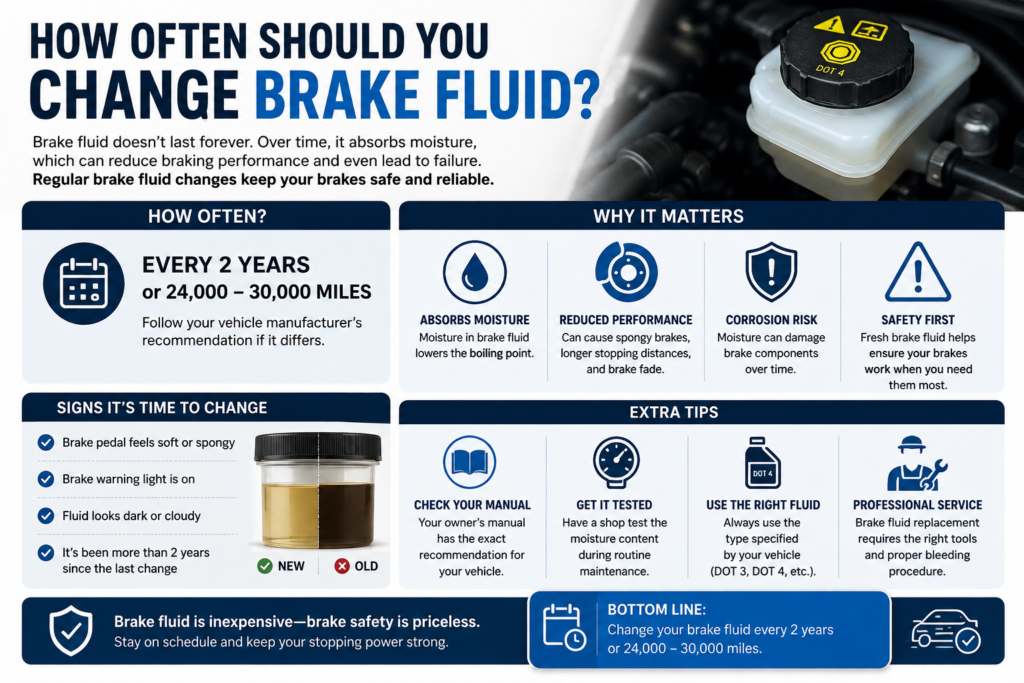
A car driven 5,000 miles a year can still need its brake fluid replaced on schedule. Low annual mileage doesn’t stop the fluid from absorbing moisture.
If you bought a used car and have no record of when the brake fluid was last changed, replacing it can be a sensible way to establish a baseline for maintenance.
Your owner’s manual should also specify the required fluid type. Don’t assume that any bottle labeled “brake fluid” is suitable.
Why Does Brake Fluid Need to Be Replaced?
Most conventional automotive brake fluids, including DOT 3 and DOT 4, are glycol-based and hygroscopic. That means they naturally absorb moisture from the surrounding environment.
The fluid is contained within a hydraulic system, but the reservoir still needs to breathe as the fluid level changes. Moisture can enter over time through the reservoir and other parts of the system.
That creates several problems.
Lower boiling point
Brake components can become extremely hot during heavy braking.
Fresh brake fluid has a high boiling point, but water contamination lowers it. If the fluid becomes hot enough to boil, vapor bubbles can form in the hydraulic system.
Liquid transmits hydraulic pressure effectively. Gas doesn’t.
That means a severely overheated system can produce a soft or spongy brake pedal and reduce braking performance.
Corrosion
Moisture can also contribute to corrosion inside the braking system.
Brake lines, calipers, wheel cylinders, ABS components, and other hydraulic parts can be affected. Replacing old fluid helps remove contaminated fluid and reduces the amount of moisture circulating through the system.
Contamination
Brake fluid can also become contaminated with dirt, degraded rubber material, or other particles.
The reservoir may look relatively clean while the fluid deeper in the system is considerably older.
This is one reason simply looking at the reservoir isn’t enough to determine whether the fluid is still within specification.
7 Signs Your Brake Fluid Needs Changing
Brake fluid can deteriorate without producing an obvious symptom, so the service interval remains the primary reference.
Still, these signs deserve attention.
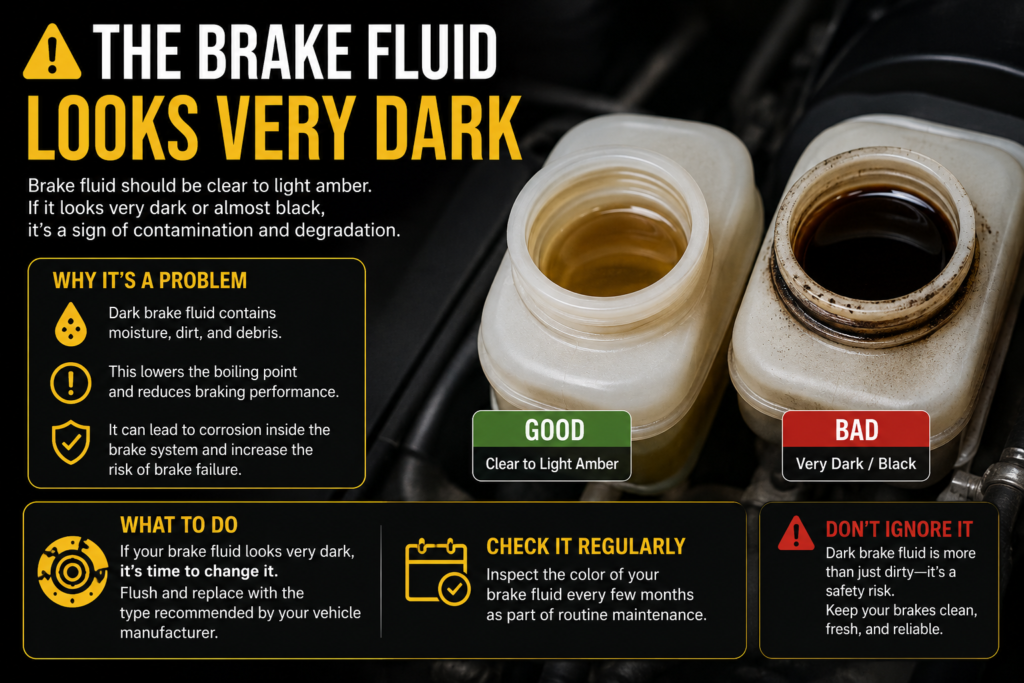
1. The Brake Fluid Looks Very Dark
Fresh brake fluid is generally clear to amber, depending on the type and manufacturer.
As it ages, it can become darker.
Very dark or dirty-looking fluid can indicate that the fluid is old or contaminated. However, color isn’t a reliable way to measure moisture content.
If the fluid looks significantly different from what you would expect and you don’t know its service history, have it inspected.
2. The Brake Pedal Feels Soft or Spongy
A brake pedal should feel reasonably firm and consistent.
If it suddenly feels softer than usual or travels farther toward the floor, don’t assume that old brake fluid is the only explanation.
Possible causes include:
- Air in the hydraulic system
- A brake-fluid leak
- Moisture-contaminated fluid
- Worn components
- A problem with the master cylinder
- Other hydraulic-system faults
A soft brake pedal requires investigation. It isn’t something to solve by simply scheduling a routine fluid change weeks later.
3. The Brakes Fade During Repeated Heavy Braking
Brake fade can happen when braking components become extremely hot.
If the pedal remains firm but the car doesn’t slow as effectively after repeated hard braking, the problem may involve overheated brake pads, rotors, calipers, or other components.
Moisture-contaminated brake fluid can also contribute to problems when fluid temperatures become high enough.
Don’t automatically blame the fluid. Brake fade has several possible causes.
4. Your Brake Fluid Hasn’t Been Changed for Years
This is the least dramatic sign, but arguably the most useful one.
If you check your maintenance records and discover that the brake fluid hasn’t been replaced within the manufacturer’s recommended interval, it’s time to schedule the service.
You don’t need to wait for a warning light or a soft pedal.
Preventive maintenance exists precisely because some problems develop before the driver notices a change.
5. The Brake or ABS Warning Light Comes On
A dashboard warning light doesn’t automatically mean the brake fluid needs replacing.
A brake warning light can indicate low fluid, a parking-brake condition, or another braking-system problem depending on the vehicle. ABS warnings can indicate faults with the anti-lock braking system.
Check the owner’s manual to identify the warning.
If the brake pedal feels abnormal at the same time as a warning light appears, treat the situation more seriously and have the vehicle inspected.
6. The Fluid Level Keeps Dropping
Brake fluid doesn’t normally disappear quickly from a healthy sealed hydraulic system.
A gradually lower level can be related to brake-pad wear, but a sudden or significant drop can indicate a leak.
Check the reservoir and look around the brake system for signs of fluid.
Don’t keep topping up a reservoir without finding out why the level is falling.
If you also notice that your car has started pulling, vibrating, squeaking, or behaving differently during braking, check our guide to common brake problems and warning signs only if relevant to your maintenance cluster. More specifically, brake-related symptoms should be investigated independently rather than attributed to old fluid.
7. You Don’t Know What Fluid Is in the System
This situation is common with used cars.
If the previous owner can’t provide maintenance records and you don’t know when the brake fluid was replaced, you don’t have a reliable service history.
A brake-fluid flush can establish a known baseline, provided the correct fluid is used and the system is serviced properly.
Brake Fluid Flush vs. Brake Bleeding
These terms are often used interchangeably, but they aren’t exactly the same thing.
Brake bleeding removes air from the hydraulic system. It’s commonly performed after opening the system, replacing certain components, or when air has entered the lines.
Brake-fluid flushing involves replacing old fluid throughout the hydraulic system with fresh fluid.
A flush normally includes bleeding the system as part of the process, but the objective is different. One focuses on removing air, while the other focuses on replacing old fluid.
If you’re having routine brake-fluid service performed, ask the shop whether they’re replacing the old fluid throughout the system rather than simply removing fluid from the reservoir and adding fresh fluid.
Does Brake Fluid Expire?
Brake fluid stored in a sealed container has a much longer usable life than fluid that’s been opened and exposed to moisture.
Once a bottle has been opened, moisture from the atmosphere can contaminate the fluid. That’s why keeping an old, partially used bottle in the garage for years isn’t a good idea.
Brake fluid should remain in a properly sealed container and be stored according to the manufacturer’s instructions.
Don’t pour questionable old fluid into your braking system simply because it looks clean.
Can You Drive With Old Brake Fluid?
If your brake fluid is simply overdue for its scheduled replacement but the braking system works normally, this is generally a maintenance issue rather than an immediate emergency.
That doesn’t mean you should keep postponing it.
The situation changes if you notice:
- A soft or spongy brake pedal
- A rapidly falling brake-fluid level
- Visible brake-fluid leakage
- Reduced braking performance
- A brake warning light
- An ABS warning accompanied by braking problems
- The pedal moving unusually close to the floor
If braking performance has changed, don’t treat the problem as a routine fluid-change appointment. Have the braking system inspected before continuing to drive.
How to Check Your Brake Fluid
The brake-fluid reservoir is usually located in the engine compartment near the brake master cylinder.
Most reservoirs are translucent, so you can check the level without removing the cap.
Look for MIN and MAX markings.
The level should normally sit between them.
Before adding anything, check your owner’s manual or the marking on the reservoir cap for the required brake-fluid specification.
A visual inspection can tell you whether the level is low and may reveal obvious contamination, but it can’t reliably tell you how much moisture the fluid contains.
Professional shops can use brake-fluid testers to measure moisture content or boiling point, depending on the equipment and testing method.
Don’t open the reservoir unnecessarily. Brake fluid can absorb moisture from the air, and contamination can work against the reason you’re checking it in the first place.
What Brake Fluid Should You Use?
There are several common DOT classifications, including DOT 3, DOT 4, DOT 5, and DOT 5.1.
They aren’t all interchangeable.
DOT 3 and DOT 4 are glycol-based fluids. DOT 5 is silicone-based and is used in specific applications. DOT 5.1 is glycol-based but has different performance characteristics.
The correct choice is the one specified by the vehicle manufacturer.
Don’t choose brake fluid because it has a higher number and therefore sounds “better.” A vehicle designed for a particular specification should receive the fluid specified for its braking system.
The same applies when topping up. If you’re unsure which fluid your car uses, check the owner’s manual before opening the reservoir.
What Happens If You Never Change Brake Fluid?
Old brake fluid can accumulate moisture and contamination over time.
The resulting problems can include a lower boiling point, corrosion inside hydraulic components, and reduced performance under severe braking conditions.
The most expensive consequence isn’t necessarily the fluid itself. Moisture and corrosion can contribute to damage in components such as brake calipers, wheel cylinders, brake lines, and ABS components.
Replacing brake fluid at the recommended interval is relatively simple compared with repairing a neglected hydraulic system.
And if you’re already checking your car’s fluids as part of routine maintenance, our guide on how to check car fluid levels covers the correct approach for engine oil, coolant, brake fluid, washer fluid, and other systems.
Should You Change Brake Fluid After Replacing Brake Pads?
Not automatically.
Replacing brake pads doesn’t necessarily mean the brake fluid needs to be changed at the same time. The correct decision depends on the fluid’s age, condition, and the manufacturer’s maintenance schedule.
However, brake service can be a convenient time to check the fluid and inspect the entire braking system.
If the fluid is already overdue, replacing it during related brake work can make sense.
Brake Fluid FAQ
How often should you change brake fluid?
Many vehicles call for brake-fluid replacement about every two years, but the correct interval depends on the manufacturer and vehicle. Check the maintenance schedule rather than applying a universal mileage rule.
How do I know if my brake fluid is bad?
Very dark fluid, an overdue service interval, moisture contamination, or braking symptoms can indicate a problem. Color alone isn’t enough to determine fluid condition.
Can old brake fluid make the brake pedal soft?
It can contribute to poor pedal feel under certain conditions, particularly if moisture contamination allows the fluid to boil during heavy braking. However, a soft pedal can also indicate air, a leak, or another hydraulic problem.
Can I just add new brake fluid instead of flushing it?
Adding fluid isn’t the same as replacing old fluid throughout the braking system. If the fluid is due for replacement, a proper flush is the appropriate service.
Can you mix DOT 3 and DOT 4 brake fluid?
Both are glycol-based and can be compatible in some applications, but you should follow the vehicle manufacturer’s specification rather than mixing fluids based solely on their DOT numbers.
Is DOT 5 the same as DOT 5.1?
No. Despite the similar names, they use different base chemistry. DOT 5 is silicone-based, while DOT 5.1 is glycol-based.
Does brake fluid need to be changed if I don’t drive much?
Yes, if the manufacturer specifies a time-based replacement interval. Moisture absorption occurs over time, not only as a result of mileage.