
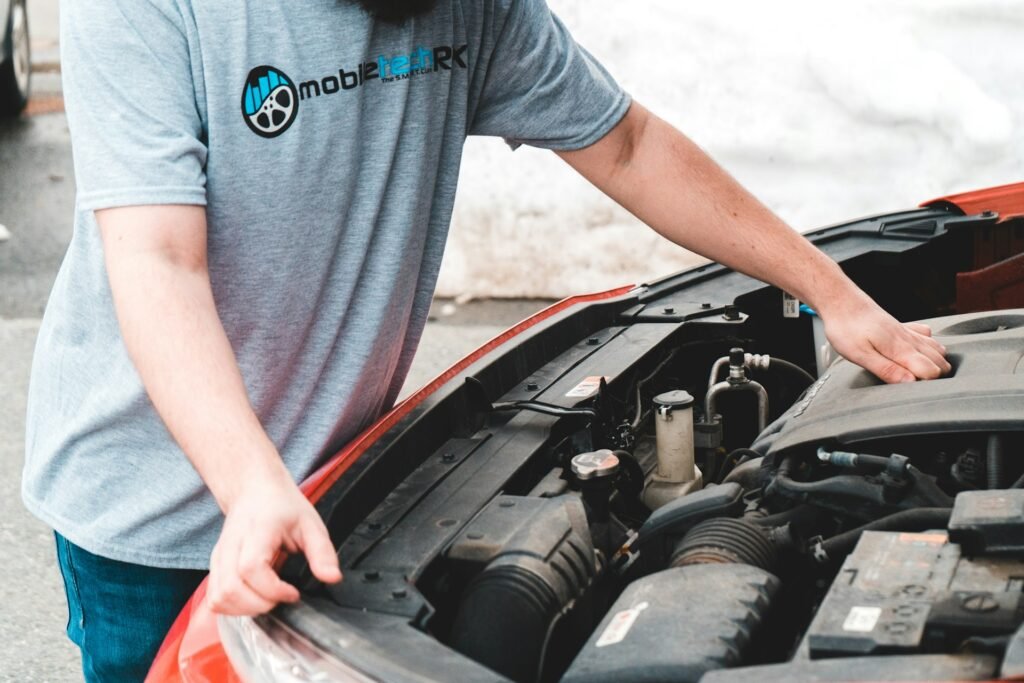
Learning how to check car fluid levels takes only a few minutes, and you don’t need to be a mechanic to do it. Engine oil, coolant, brake fluid, and windshield washer fluid are easy to inspect on most vehicles. Some cars also have power steering or transmission fluid that can be checked, although modern systems increasingly use sealed components or electronic monitoring.
The exact procedure varies between vehicles, so your owner’s manual should always take priority. It tells you where each reservoir is located, what fluid to use, and whether the level should be checked with the engine cold, warm, running, or switched off.
Why Should You Check Your Car’s Fluid Levels?
A fluid level that slowly drops can be an early warning that something is leaking or wearing out.
Engine oil protects moving components from excessive friction and also helps carry heat away from internal engine parts. Coolant controls engine temperature. Brake fluid transfers hydraulic pressure from the brake pedal to the braking system.
If one of these fluids becomes too low, the result can range from an inconvenient warning light to an overheated engine or loss of braking performance.
You also don’t need to wait for a warning light. A dashboard warning often appears after the fluid has already fallen below its normal level.
Checking the fluids yourself gives you another way to spot problems early.
What Fluids Should You Check?
The fluids found in your car depend on its engine, transmission, steering system, and other equipment.
Most vehicles have:
- Engine oil
- Engine coolant
- Brake fluid
- Windshield washer fluid
Some also have:
- Automatic transmission fluid
- Manual transmission or gear oil
- Power steering fluid
- Clutch fluid
- Differential fluid
- AdBlue on certain diesel vehicles
Electric vehicles don’t use engine oil, and many modern vehicles have electric power steering rather than a hydraulic system. Some automatic transmissions are sealed and don’t have a conventional dipstick either.
Don’t assume that because a fluid exists in another car, yours has the same reservoir or checking procedure.
How to Check Engine Oil
Engine oil is one of the easiest and most useful fluid checks.
If your car has a traditional dipstick, you’ll normally find it in the engine bay with a colored handle or a clearly marked loop. Some newer vehicles don’t have a dipstick and instead display the oil level electronically.
Check the oil level
- Park the car on level ground.
- Switch off the engine.
- Follow your owner’s manual for the required waiting time.
- Remove the dipstick.
- Wipe it clean with a lint-free cloth or paper towel.
- Insert it fully back into the tube.
- Remove it again.
- Check where the oil sits relative to the minimum and maximum marks.
The oil should normally be between the two markings. AAA recommends checking the level on a level surface and using only the oil specification required for the vehicle.
If the level is below the minimum mark, add the correct oil gradually and recheck it. Don’t pour in a large amount at once.
What should the oil look like?
Used engine oil usually becomes darker over time. Dark oil doesn’t automatically mean something is wrong.
More concerning signs include:
- Thick sludge
- Metallic particles
- A strong fuel smell
- Milky or creamy contamination
- A rapidly falling oil level
If you’re regularly adding oil between changes, don’t treat that as normal maintenance without finding out why. Our guide to why your car may be losing oil covers common leaks and internal oil consumption.
For the maintenance interval itself, see our guide on how often you should change your engine oil.
How to Check Engine Coolant
Coolant, also called antifreeze, keeps the engine within its intended operating temperature and protects the cooling system from freezing and corrosion.
Most vehicles have a translucent expansion tank with MIN and MAX markings. You can usually check the level without opening the system.
Check coolant safely
- Park on level ground.
- Switch off the engine.
- Let the engine cool completely.
- Locate the coolant expansion tank.
- Check the fluid level against the markings.
- Add the correct coolant if the level is low.
The critical rule is simple: don’t open a hot cooling system.
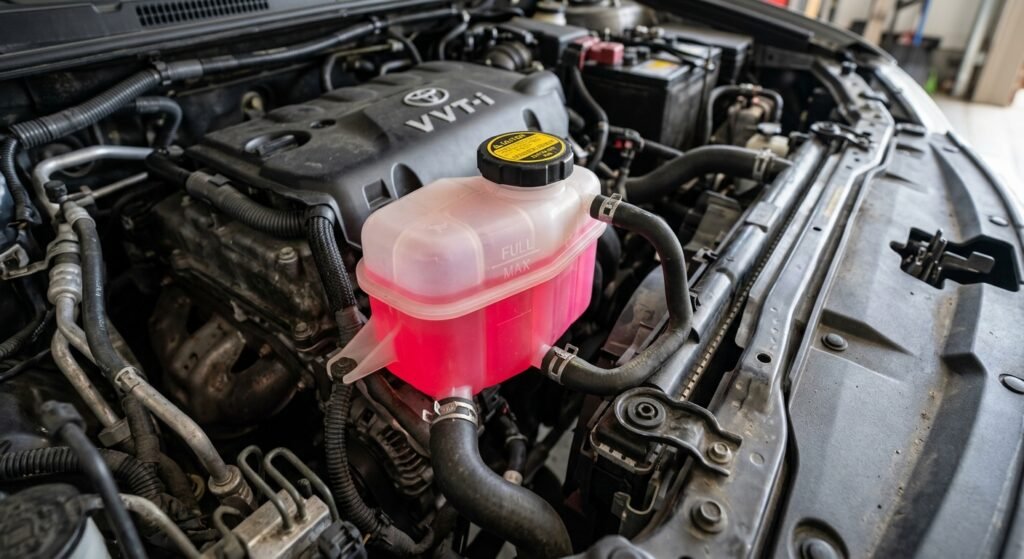
The cooling system can be pressurized while the engine is hot. Opening the cap can release hot coolant and steam, causing serious burns. Vehicle manufacturers specifically warn owners to exercise care when checking coolant because of the pressurized system.
What if the coolant level is low?
A small change may not indicate a major problem, but coolant shouldn’t continually disappear from a healthy sealed system.
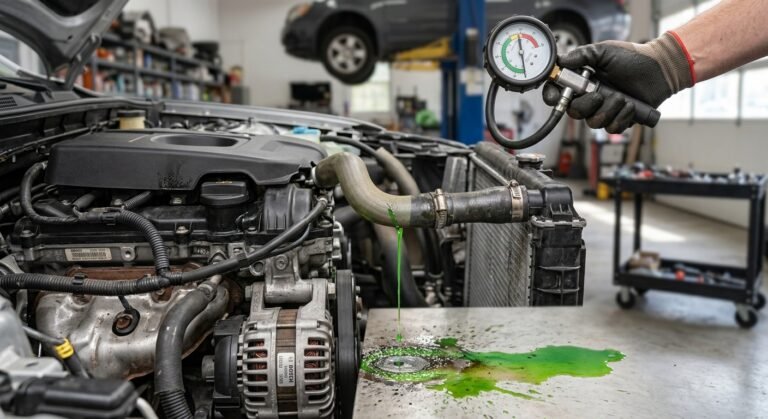
If you repeatedly have to add coolant, look for:
- Wet spots around hoses
- Coolant around the radiator
- A leaking water pump
- Cracks in the expansion tank
- A damaged radiator
- Coolant smell
- White or colored residue around connections
- Overheating
A persistent coolant leak can eventually leave the engine without enough coolant to control its temperature.
If you see the temperature gauge climbing, stop driving and investigate the problem rather than repeatedly topping up the reservoir.
How to Check Brake Fluid
Brake fluid is found in a reservoir connected to the brake master cylinder, usually toward the rear of the engine compartment.
The reservoir is often translucent, allowing you to see the fluid level without opening the cap.
Check the brake fluid level
- Park on level ground.
- Switch off the engine.
- Locate the brake fluid reservoir.
- Check the level against the MIN and MAX markings.
- Look for obvious contamination or discolouration.
- Check around the reservoir and nearby components for signs of leakage.
Brake fluid should generally remain between the specified markings.
Don’t add random brake fluid because the bottle happens to say “brake fluid.” Vehicles can require different specifications, such as DOT 3, DOT 4, or another approved type. Check the owner’s manual or reservoir cap.
Why is the brake fluid level low?
A falling brake-fluid level can indicate a leak, but brake-pad wear can also affect the reservoir level as the calliper pistons move farther to compensate for worn friction material.
If the level is suddenly very low, the brake pedal feels soft, or you see fluid around a wheel, don’t simply refill the reservoir and continue driving.
A brake-fluid leak can compromise the hydraulic braking system.
How to Check Windshield Washer Fluid
Washer fluid is the easiest one to check because running out doesn’t damage the engine or transmission. It does, however, leave you without an easy way to clean dirt, salt, insects, and road spray from the windshield.
The washer reservoir usually has a cap marked with a windshield symbol.
Open the cap and check the level visually. Some vehicles have a dipstick or translucent reservoir, while others don’t provide a precise level marking.
Top it up with the appropriate windshield washer fluid.
Don’t use plain water as your regular winter solution in a cold climate. It can freeze in the reservoir, lines, or pump.
How to Check Power Steering Fluid
First, find out whether your vehicle actually uses hydraulic power steering.
Many newer vehicles have electric power steering and don’t use power-steering fluid at all.
If your car does have a hydraulic system, you’ll usually find a small reservoir marked for power steering fluid.
Check the level according to the markings and the procedure in your owner’s manual. Some systems specify checking the fluid hot, while others specify a cold reading.
A low level can be caused by a leak. You may also hear whining or groaning when turning the steering wheel, or notice that the steering feels heavier than usual.
Don’t keep topping up a reservoir that repeatedly goes low. Find the leak.
How to Check Transmission Fluid
Transmission fluid is more complicated because there isn’t one universal checking procedure.
Some older automatic transmissions have a dipstick. Others require the transmission to be at a specific temperature, the engine to be running, and the selector to be in a particular position.
Many newer automatic transmissions are sealed and don’t provide a dipstick for routine owner checks.
If your car has a transmission dipstick, follow the exact procedure in the owner’s manual. Using the wrong temperature or checking procedure can give you an inaccurate reading.
If the transmission is sealed, don’t start removing plugs underneath the car just to see whether fluid comes out. Level checks may require the vehicle to be at a specific temperature and position, and incorrect servicing can cause problems.
What Does a Low Fluid Level Mean?
A low fluid level doesn’t always mean you simply need to add more fluid.
The key question is why the level is low.
| Fluid | Low level may indicate |
| Engine oil | Oil consumption, external leak, overdue maintenance |
| Coolant | Leak, evaporation from a fault, cooling-system problem |
| Brake fluid | Brake wear, hydraulic leak, service issue |
| Power steering fluid | Hydraulic leak or component problem |
| Transmission fluid | Leak or transmission-system problem |
| Washer fluid | Normal consumption |
This is why repeatedly topping up a fluid isn’t a substitute for diagnosis.
For example, if your engine oil is low every few weeks, adding another quart doesn’t fix the reason the oil is disappearing. The same applies to coolant, brake fluid, and hydraulic power-steering fluid.
If you’ve found an actual puddle underneath the vehicle, our guide to different fluid leaks under your car can help narrow down which system may be involved.
How Often Should You Check Your Car’s Fluid Levels?
There’s no single schedule that fits every vehicle.
A quick inspection of the engine oil, coolant, and washer fluid can be part of a regular maintenance routine. Haynes recommends regular checks of these fluids and notes that brake, clutch, and power-steering fluids can be checked less frequently, while any unexplained drop in level should be investigated.
It’s also worth checking the fluids before a long road trip.
You don’t need to turn this into a 30-minute ritual. Open the hood, check the obvious reservoirs, look for leaks, and pay attention to anything that has changed since the last inspection.
If the car has recently been serviced, check the levels again after a few days of normal driving. A newly appearing leak shouldn’t be dismissed as part of routine maintenance.
What You Shouldn’t Do When Checking Car Fluids
Most mistakes happen when someone is in a hurry.
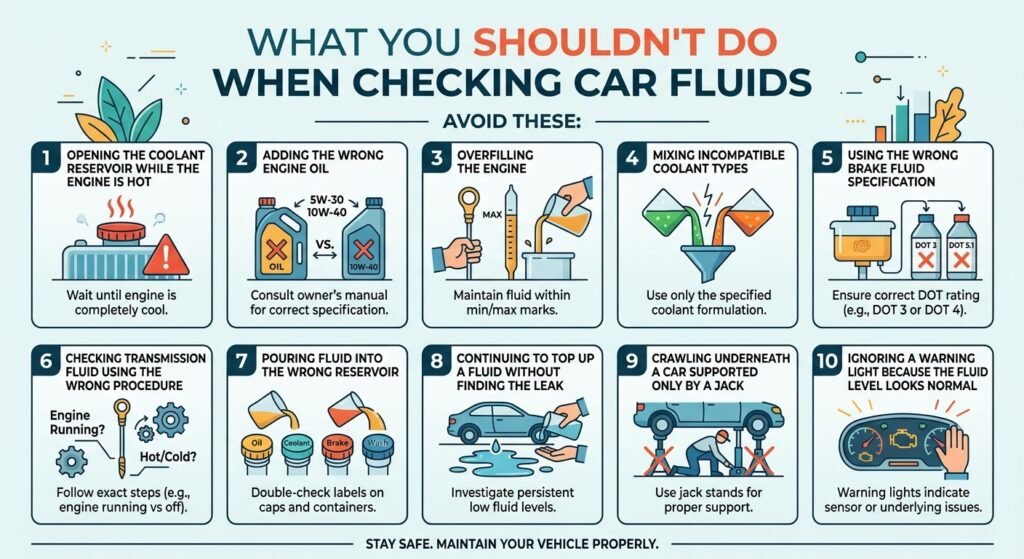
Avoid these:
- Opening the coolant reservoir while the engine is hot.
- Adding the wrong engine oil.
- Overfilling the engine.
- Mixing incompatible coolant types.
- Using the wrong brake-fluid specification.
- Checking transmission fluid using the wrong procedure.
- Pouring fluid into the wrong reservoir.
- Continuing to top up a fluid without finding the leak.
- Crawling underneath a car supported only by a jack.
- Ignoring a warning light because the fluid level looks normal.
Before adding anything, read the label on the reservoir and check the owner’s manual.
Kia’s maintenance guidance, for example, specifically recommends cleaning around filler plugs, drain plugs, and dipsticks before checking fluids so dirt doesn’t enter the engine or other components.
When Should You Stop Driving?
A low fluid level isn’t always an emergency, but some situations require immediate action.
Stop driving if the oil-pressure warning light comes on. Low oil pressure can cause severe engine damage.
Stop if the engine is overheating. Continuing to drive with inadequate coolant or a cooling-system failure can cause major engine damage.
Don’t continue driving with a serious brake-fluid leak or a soft brake pedal. The braking system needs to maintain hydraulic pressure to work correctly.
Don’t ignore a rapidly leaking transmission or power-steering system. The vehicle may continue to move normally for a while, but the fluid level can fall quickly.
And if you find an unknown fluid under the vehicle, identify it before assuming it’s harmless water.
A Simple Fluid Check Routine
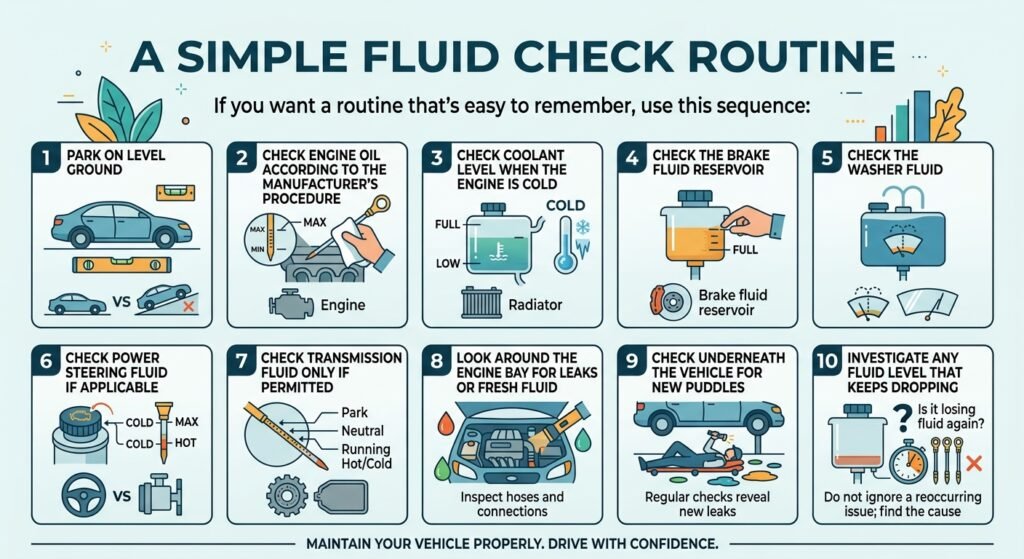
If you want a routine that’s easy to remember, use this sequence:
- Park on level ground.
- Check the engine oil according to the manufacturer’s procedure.
- Check the coolant level when the engine is cold.
- Check the brake fluid reservoir.
- Check the washer fluid.
- Check power steering fluid if your car has a hydraulic system.
- Check transmission fluid only if your vehicle provides a specified owner-check procedure.
- Look around the engine bay for leaks or fresh fluid.
- Check underneath the vehicle for new puddles.
- Investigate any fluid level that keeps dropping.
The goal isn’t to become your own mechanic. It’s to notice when something has changed before a small maintenance problem becomes a breakdown.
FAQ
How often should I check my car’s fluid levels?
Check the fluids according to your manufacturer’s maintenance recommendations. Engine oil, coolant, and washer fluid are good candidates for regular checks, while other fluids may have longer inspection intervals. Check them before long trips as well.
Should the engine be hot or cold when checking fluids?
It depends on the fluid and vehicle. Engine oil and coolant are commonly checked with the engine off, but the exact procedure varies. Coolant should be checked only when the system has cooled sufficiently. Transmission fluid can have a very specific temperature-dependent procedure.
Can I add water to my coolant?
Don’t assume that water is an acceptable long-term replacement for the specified coolant. In an emergency, the correct procedure depends on the vehicle and circumstances. Use the coolant type and mixture specified by the manufacturer.
Why does my coolant keep going down?
Repeated coolant loss usually deserves investigation. A leaking hose, radiator, water pump, expansion tank, or another cooling-system component may be responsible.
Why is my brake fluid level low?
Brake-pad wear can contribute to a lower reservoir level, but a leak is another possibility. A sudden or significant drop should be inspected rather than repeatedly topped up.
Do all cars have power steering fluid?
No. Many newer vehicles use electric power steering and don’t have hydraulic power-steering fluid.
Do all cars have a transmission dipstick?
No. Many modern automatic transmissions are sealed and don’t have a conventional dipstick. Follow the manufacturer’s procedure rather than trying to check the level using a generic method.

1 Comments