
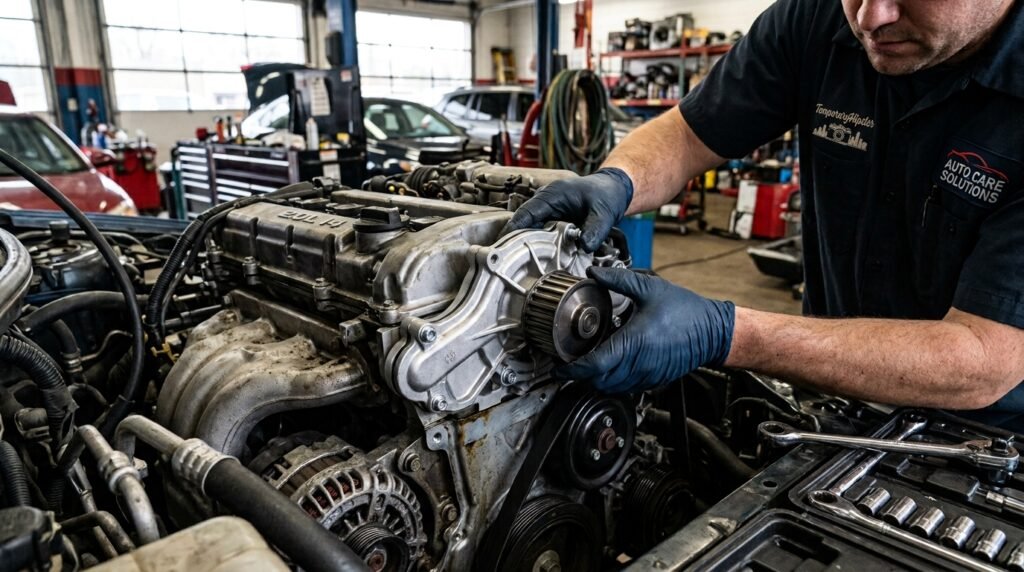
Bad water pump symptoms can start with something as subtle as a small coolant stain or an unusual whining noise. Later, the same problem can cause engine overheating and potentially severe engine damage.
The water pump is responsible for circulating coolant through the engine and radiator. When it can no longer move coolant effectively, the engine may struggle to control its temperature. A failing pump can also develop bearing problems or leak coolant through its seal.
The difficult part is that a bad water pump can look like several other cooling-system problems. A high temperature gauge, for example, can also be caused by a thermostat, radiator, cooling fan, low coolant level, or another fault.
Here are the symptoms worth paying attention to.
What Does a Water Pump Do?
The water pump circulates coolant through the engine and cooling system.
Coolant absorbs heat from the engine and carries it toward the radiator, where the heat is released before the coolant returns to the engine. The pump keeps this process moving while the engine is running.
Most conventional mechanical water pumps are driven by a belt, although the exact design varies by engine. Some newer vehicles use electrically driven coolant pumps instead.
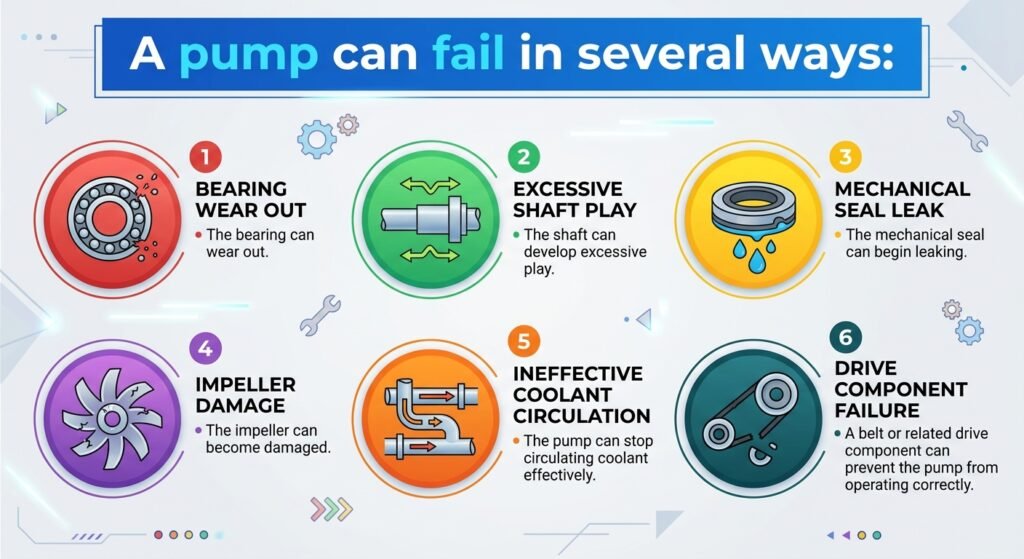
A pump can fail in several ways:
- The bearing can wear out.
- The shaft can develop excessive play.
- The mechanical seal can begin leaking.
- The impeller can become damaged.
- The pump can stop circulating coolant effectively.
- A belt or related drive component can prevent the pump from operating correctly.
That means there isn’t one universal water-pump failure pattern.
7 Bad Water Pump Symptoms to Watch For
1. The Engine Starts Overheating
An overheating engine is one of the most obvious signs of a cooling-system problem.
If the water pump isn’t circulating coolant properly, heat can build up inside the engine. A failed pump can cause coolant circulation to stop or become severely restricted, resulting in rapid overheating.
You might notice:
- The temperature gauge moving above its normal position
- An overheating warning light
- Steam or coolant vapour
- Reduced engine performance
- The engine temperature rising in traffic or under load
However, overheating does not prove the water pump is bad.
A faulty thermostat, blocked radiator, failed cooling fan, low coolant level, or damaged hose can produce similar symptoms.
If your vehicle is already overheating, don’t keep driving it while waiting to see whether the problem gets worse. Our guide to why a car overheats and what to check covers the other common causes.
2. Coolant Is Leaking Near the Water Pump
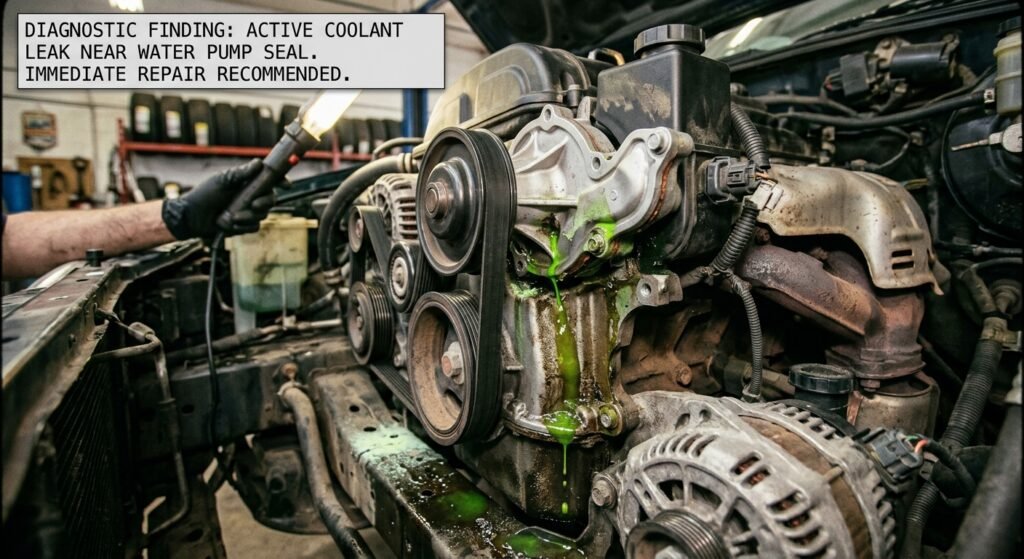
A damaged water-pump seal can allow coolant to escape.
Some mechanical water pumps have a small drain or weep hole designed to indicate seal failure. Coolant appearing around this area can be an important clue that the pump needs attention.
You may see:
- A colored or wet area around the pump
- Coolant residue or staining
- Drops underneath the front or side of the engine
- A gradually falling coolant level
The location depends heavily on the engine design.
If you’re finding an unexplained puddle, don’t assume it’s the water pump simply because the liquid looks like coolant. Check the location and other symptoms first. Our guide to different fluid leaks under your car explains how coolant can be distinguished from oil, brake fluid, transmission fluid, and other liquids.
3. A Grinding, Whining, or Rattling Noise
A worn water-pump bearing can produce an unusual noise.
A whining, grinding, or rumbling sound from the belt-drive area may become more noticeable as engine speed increases. Haynes identifies abnormal pump noise as one of the key signs of bearing wear.
You may hear the noise:
- Immediately after starting the engine
- At idle
- When accelerating
- When the engine is under load
Don’t assume every noise from the front of the engine is the water pump.
The same area can contain the alternator, idler pulleys, tensioner, air-conditioning compressor, and other belt-driven components. A mechanic may need to isolate the noise before identifying the failed component.
4. Coolant Level Keeps Dropping
If you’re repeatedly adding coolant, something is causing the cooling system to lose fluid.
A leaking water pump is one possibility, but it isn’t the only one. Radiators, hoses, thermostat housings, expansion tanks, and other components can also leak.
If your coolant reservoir keeps falling below its normal level, don’t treat topping it up as the repair.
Our guide on how to check your car’s fluid levels explains how to inspect coolant safely and what a falling level can tell you.
A cooling system in good condition shouldn’t require constant coolant top-ups.
5. Coolant Is Leaking From the Engine Area
Not every water-pump leak produces a puddle directly underneath the pump.
Coolant can run across engine components before reaching the lowest point. It may leave dried residue or staining around the source, making an old leak easier to identify than a fresh one.
A coolant leak can also become more obvious after the engine reaches operating temperature because the cooling system becomes pressurised.
This is one reason a leak may appear small when the vehicle is parked cold but become more significant during normal driving.
6. The Engine Temperature Behaves Erratically
A cooling-system problem doesn’t always mean the temperature gauge immediately goes into the red.
You may instead notice that the engine temperature behaves differently from normal.
For example:
- Temperature rises during traffic.
- Temperature rises during highway driving or climbing.
- The gauge fluctuates unexpectedly.
- The heater output changes from hot to cool.
- The engine takes unusually long to reach normal temperature.
These symptoms can indicate a coolant-circulation problem, but they can also point toward a thermostat, air trapped in the cooling system, low coolant, or another fault.
The pattern matters more than any single symptom.
7. The Water Pump or Pulley Has Excessive Play
A worn pump bearing can allow the pump shaft or pulley to develop excessive movement.
This isn’t something most drivers can diagnose reliably without knowing the specific pump design, and belt-driven components can be dangerous to inspect with the engine running.
If a mechanic finds excessive bearing play, grinding, or abnormal pulley movement, the pump may need replacement.
It’s also important to inspect the related belt, tensioner, and pulleys. Gates notes that problems in the belt-drive system can contribute to premature water-pump bearing or shaft failure.
Can a Bad Water Pump Cause an Overheating Engine?
Yes.
The pump’s job is to circulate coolant. If the pump fails mechanically or becomes unable to move coolant effectively, heat can accumulate inside the engine.
But this distinction matters:
A bad water pump can cause overheating, but an overheating engine does not automatically mean the water pump is bad.
Other possible causes include:
- Low coolant
- Coolant leak
- Failed thermostat
- Blocked radiator
- Cooling-fan failure
- Damaged radiator hose
- Head-gasket problems
- Air trapped in the cooling system
This is why replacing the water pump based solely on a high temperature gauge can lead to an unnecessary repair.
How Can You Tell If the Water Pump Is Actually Failing?
Diagnosis normally involves looking at several clues together.
A mechanic may inspect:
- Coolant level and condition.
- The pump and surrounding area for leaks.
- The pump bearing and pulley.
- Belt condition and alignment.
- Cooling-system pressure.
- Engine temperature behaviour.
- Thermostat operation.
- Radiator and cooling-fan operation.
- Evidence of coolant circulation problems.
Some pumps are difficult to access because they’re driven by the timing belt and located behind engine covers.
If the water pump is timing-belt driven, replacement may be performed together with the timing-belt service because much of the same labor is already required. Haynes lists this as a common service approach on engines where the pump is driven by the timing belt.
Can You Drive With a Bad Water Pump?
If the water pump is genuinely failing, continuing to drive can turn a relatively contained cooling-system repair into major engine damage.
The biggest concern is overheating.
If the temperature gauge reaches the danger zone, an overheating warning appears, or steam is coming from the engine bay, stop driving as soon as it is safe to do so.
Don’t remove the coolant cap while the engine is hot. The cooling system can be pressurised, and hot coolant can cause serious burns.
A short drive to a repair shop might be reasonable for a minor suspected issue in some circumstances, but an engine that is actively overheating should generally be transported rather than driven.
What Happens If You Ignore Water Pump Failure?
A water pump doesn’t necessarily fail completely the moment you notice the first symptom.
A bearing can become noisy before it fails. A seal can start leaking before coolant loss becomes severe. These early symptoms give you an opportunity to repair the problem before the engine overheats.
Ignoring the warning signs can eventually lead to:
- Severe overheating
- Cylinder-head damage
- Head-gasket failure
- Warped engine components
- Loss of coolant
- Engine failure
The water pump itself may not be the most expensive component involved. The consequences of driving an overheated engine can be.
How Long Does a Water Pump Last?
There isn’t a universal lifespan that applies to every water pump.
Service life depends on the engine design, pump quality, coolant condition, belt system, driving conditions, and maintenance history.
Some manufacturers specify replacement as part of scheduled timing-belt maintenance rather than giving the pump its own independent interval.
Poor coolant condition can also contribute to premature pump problems. Gates notes that corrosion and contaminants in the cooling system can damage water-pump seals and bearings.
This makes correct coolant maintenance more than a temperature-control issue. It can also affect the components responsible for circulating the coolant.
What Should You Do If You Suspect a Bad Water Pump?
Start by looking for multiple symptoms rather than relying on one clue.
Check:
- Coolant level when the engine is cold.
- Visible coolant leaks.
- Unusual noises from the belt area.
- Temperature-gauge behaviour.
- Coolant residue around the engine.
- Recent cooling-system repairs.
- Timing-belt service history, where applicable.
If you find a coolant leak, investigate it promptly. If the engine is overheating, stop driving and allow it to cool before further inspection.
A water pump is part of a larger cooling system, so proper diagnosis should consider the thermostat, radiator, hoses, fan, belt system, and coolant condition as well.
FAQ
What are the most common bad water pump symptoms?
The most common signs include engine overheating, coolant leakage near the pump, unusual grinding or whining noises, recurring coolant loss, and abnormal engine-temperature behavior.
Can a bad water pump make a noise?
Yes. A worn water-pump bearing can produce grinding, whining, rumbling, or other unusual noises, particularly as engine speed changes.
Will a bad water pump always leak coolant?
No. A pump can develop bearing or circulation problems without immediately producing an obvious external leak.
Can a bad water pump cause an overheating car?
Yes. If the pump cannot circulate coolant properly, engine temperature can rise rapidly. However, several other cooling-system faults can also cause overheating.
How do I know if my water pump is leaking?
Look for coolant residue or wetness around the pump area and check whether the coolant level is falling. Some pumps have a weep hole that can reveal seal failure.
Should I replace the water pump with the timing belt?
If the water pump is driven by the timing belt, replacing the pump during timing-belt service is commonly recommended because access to the pump already requires much of the same work. The exact recommendation depends on the vehicle and engine.
Can I drive with water pump problems?
If the engine is overheating or rapidly losing coolant, you should not continue driving. Overheating can cause severe engine damage.


1 Comments