
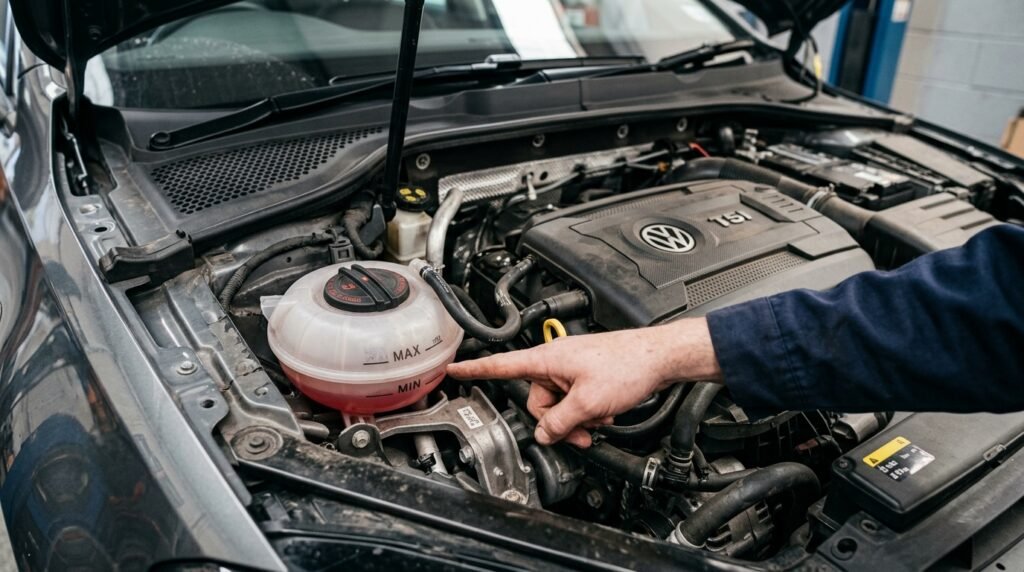
If your coolant level is low, your car is either losing coolant, has recently had its cooling system serviced, or is experiencing another problem that needs investigation. Coolant doesn’t normally disappear from a properly sealed cooling system.
A slightly different reading between hot and cold conditions can be normal because coolant expands as it heats up. But if the level keeps falling when you check it with the engine cold, don’t treat it as something the car simply “uses.” There is usually an underlying reason.
Low coolant can eventually cause engine overheating, which may lead to expensive engine damage. Here’s what to check first and when the problem requires immediate attention.
What Should Your Coolant Level Be?
Check the coolant level with the engine completely cold. Most vehicles have a translucent coolant reservoir with markings such as MIN/MAX, LOW/FULL, or similar indicators.
The coolant should generally sit between the manufacturer’s specified marks when cold. Your owner’s manual is the best reference because reservoir designs and recommended levels vary between vehicles.
Don’t compare a hot reading with a cold reading. Coolant expands as it heats up, so the level in the reservoir can rise after driving and fall again as the engine cools.
For a broader guide to checking vehicle fluids, see our article on how to check your coolant level.
Why Is My Coolant Level Low? 7 Common Causes
1. External Coolant Leak
An external leak is one of the first things to investigate when the coolant level keeps dropping.
Coolant can escape from:
- Radiator hoses
- Hose connections and clamps
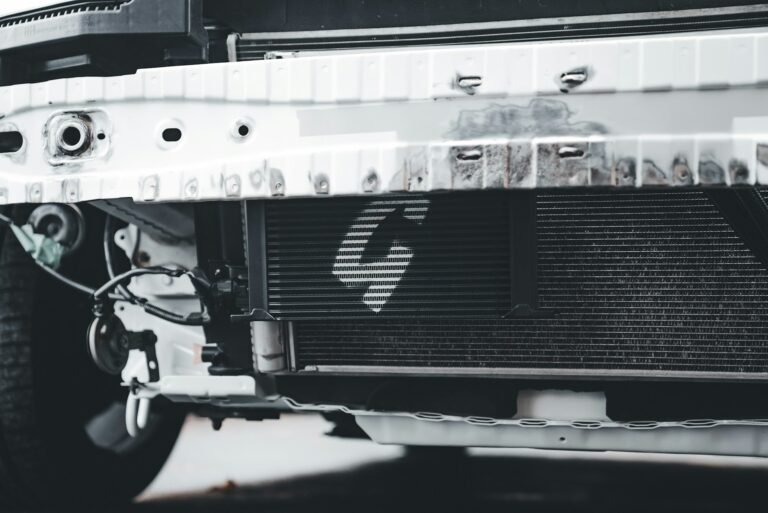
- The radiator
- Expansion tank
- Radiator or reservoir cap
- Thermostat housing
- Water pump
- Other cooling-system seals and fittings
A large leak is usually easy to spot because it leaves a puddle underneath the vehicle. A small leak can be much harder to find. It may only occur when the engine reaches operating temperature and the cooling system becomes pressurised.
Coolant can also land on a hot engine component and evaporate before it reaches the ground.
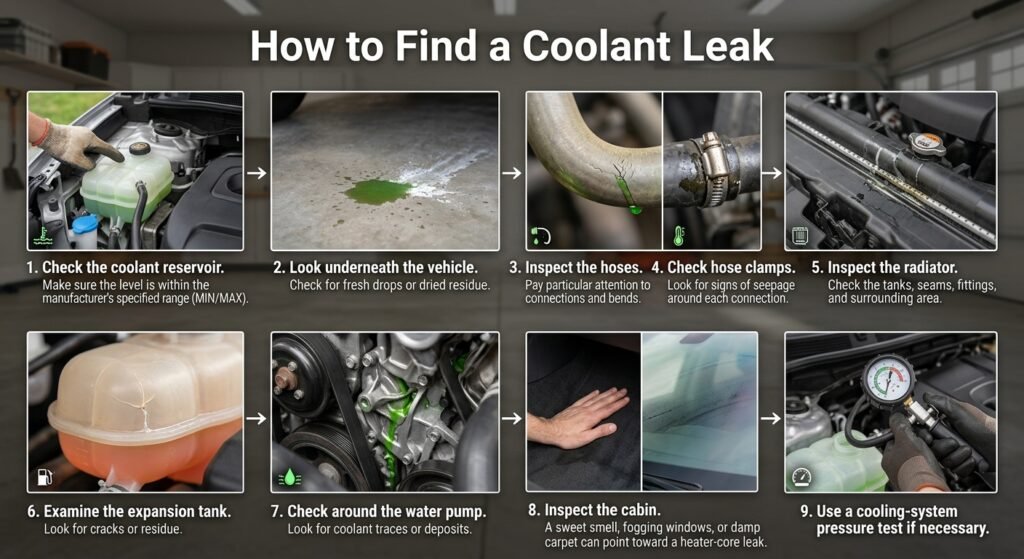
If you’re seeing signs of an actual leak, our guide explains how to find a coolant leak.
2. Faulty Radiator or Expansion-Tank Cap
The cap on a pressurised cooling system is designed to maintain a specific pressure. If its seal or pressure-control mechanism fails, coolant can escape or be pushed into the overflow system incorrectly.
This can produce coolant loss without an obvious large puddle.
A damaged cap is relatively inexpensive compared with many other cooling-system components, so it’s worth checking if the coolant level keeps dropping and no obvious leak can be found.
Always use the correct replacement cap specified for the vehicle. A cap with the wrong pressure rating can create additional cooling-system problems.
3. Failing Water Pump
The water pump circulates coolant through the engine and cooling system. A damaged seal can allow coolant to escape, while a failing bearing or other pump problem can affect coolant circulation.
Possible signs include:
- Coolant residue around the pump
- Coolant dripping from the pump area
- Grinding or whining noises
- Engine overheating
- Temperature fluctuations
If you’re also hearing unusual noises from the engine bay or experiencing overheating, look at the signs of a failing water pump.
4. Coolant Leak From the Heater Core
The heater core is essentially a small heat exchanger inside the passenger compartment. Hot engine coolant flows through it, allowing the cabin heater to produce warm air.
When the heater core leaks, coolant may not appear on the ground. Instead, it can enter the vehicle’s interior.
Possible clues include:
- A sweet coolant smell inside the cabin
- Windshield fogging that is difficult to clear
- An oily or unusual film on the inside of the windshield
- Damp carpet, often near the passenger side
- Unexplained coolant loss
- Problems with cabin heating
A heater-core leak can be difficult to repair because the component is usually located behind or underneath the dashboard.
5. Internal Coolant Leak
Sometimes coolant leaves the cooling system without leaking onto the outside of the vehicle.
An internal leak can occur because of a failed head gasket, cracked cylinder head, cracked engine block, or certain engine designs where cooling-system components are located internally.
Potential warning signs include:
- Persistent white exhaust smoke or steam
- Unexplained coolant loss
- Repeated overheating
- Engine misfires
- Contaminated engine oil
- Abnormal pressure in the cooling system
These symptoms don’t automatically mean the head gasket has failed. Several different problems can produce similar symptoms, so proper diagnostic testing is needed before assuming the engine requires a major repair.
6. Air Trapped in the Cooling System
If the cooling system was recently opened for a repair or coolant change, trapped air can affect the coolant level.
An air pocket may move through the system as the engine runs, allowing coolant to redistribute between the engine, radiator, and expansion reservoir. The reservoir level can then change after the system has been properly filled and circulated.
This is why a coolant level that changes after recent cooling-system work doesn’t necessarily mean there’s a new leak.
If air wasn’t properly removed during servicing, the system may require the manufacturer’s specified bleeding or air-purging procedure.
7. Deteriorated Cooling-System Components
Coolant contains additives that help protect the cooling system against corrosion and deposits. Those additives don’t remain effective forever.
Old or contaminated coolant can contribute to corrosion and deterioration of cooling-system components. Over time, hoses, seals, radiators, water pumps, and other parts can become more susceptible to failure.
The solution isn’t simply adding more coolant. If the coolant is old, contaminated, or the system has visible corrosion, the cooling system should be inspected and serviced according to the vehicle manufacturer’s recommendations.
Is It Normal for Coolant Level to Drop?
A small change between hot and cold readings is normal. A consistently falling coolant level when checked cold is not.
The key is to compare readings under similar conditions. For example, if you check the reservoir every few days after the engine has completely cooled and the level continues moving from MAX toward MIN, the system should be investigated.
You shouldn’t need to repeatedly add coolant to maintain the correct level in a healthy, properly sealed system.
Low Coolant but No Visible Leak: What Does It Mean?
If the coolant level is dropping but there’s no puddle under the car, the leak may simply be difficult to see.
Possible explanations include:
- A very small external leak
- A leak that occurs only when the system is hot and pressurised
- Coolant evaporating from a hot engine component
- A leaking heater core
- A faulty pressure cap
- An internal engine leak
Look for dried or crusty coolant residue around hoses, clamps, the radiator, reservoir, thermostat housing, and water pump.
If the visual inspection doesn’t reveal anything, a cooling-system pressure test can help. The test pressurises the system while the engine is off, making some leaks easier to identify.
If an external leak still can’t be found, further testing may be necessary to determine whether coolant is entering the engine.
What Should You Check When the Coolant Level Is Low?
Don’t start inspecting a hot cooling system. Allow the engine to cool completely first.
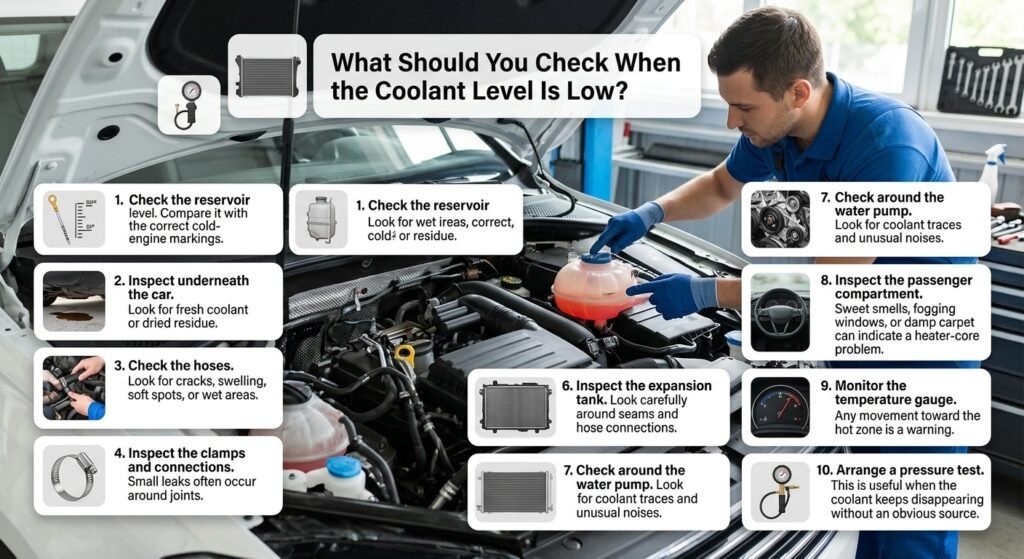
Then work through this checklist:
- Check the reservoir level. Compare it with the correct cold-engine markings.
- Inspect underneath the car. Look for fresh coolant or dried residue.
- Check the hoses. Look for cracks, swelling, soft spots, or wet areas.
- Inspect the clamps and connections. Small leaks often occur around joints.
- Check the radiator. Look for wet areas, corrosion, cracks, or residue.
- Inspect the expansion tank. Look carefully around seams and hose connections.
- Check around the water pump. Look for coolant traces and unusual noises.
- Inspect the passenger compartment. Sweet smells, fogging windows, or damp carpet can indicate a heater-core problem.
- Monitor the temperature gauge. Any movement toward the hot zone is a warning.
- Arrange a pressure test. This is useful when the coolant keeps disappearing without an obvious source.
If you’re unsure which fluid you’re seeing under the vehicle, our guide can help you identify the fluid leaking under your car.
Can You Just Add More Coolant?
You can top up the coolant if the level is slightly below the manufacturer’s specified cold level and the engine isn’t overheating. Use the correct coolant specified for your vehicle.
However, topping up isn’t a repair.
If the reservoir keeps going from FULL to LOW, or you have to add coolant repeatedly, the cause needs to be found. Constantly adding coolant can hide a developing problem until the cooling system loses enough fluid to cause overheating.
Never open a hot radiator cap or pressurised coolant reservoir. Hot coolant can be under significant pressure and may cause serious burns if released suddenly.
What Happens If You Drive With Low Coolant?
Low coolant can eventually lead to overheating.
The basic sequence is straightforward:
Low coolant → reduced cooling capacity → rising engine temperature → overheating → possible engine damage.
Depending on how severe the coolant loss is, continued driving can contribute to:
- Severe overheating
- Head-gasket failure
- Cylinder-head warping
- Damage to engine components
- Complete engine failure in extreme cases
A car that is already overheating shouldn’t be driven simply because you can add coolant and continue. The underlying problem needs to be addressed.
Low Coolant vs. Overheating: Are They the Same Problem?
No.
Low coolant describes the amount of coolant in the system. Overheating describes the engine operating above its intended temperature range.
Low coolant can cause overheating, but an engine can also overheat while the coolant level is correct.
Other possible causes include:
- Failed thermostat
- Radiator fan failure
- Blocked radiator
- Failing water pump
- Cooling-system circulation problems
- Electrical or control-system faults
So if your engine overheats, don’t assume that adding coolant will solve the problem. The entire cooling system may need to be checked.
When Should You Stop Driving?
Stop driving if you notice any sign that the engine is overheating or the cooling system has suffered a major failure.
Pull over and shut the engine down if:
- The temperature gauge reaches the red zone
- A coolant-temperature warning appears
- Steam comes from under the hood
- Coolant is leaking rapidly
- The engine begins running abnormally
- You smell a strong coolant odour accompanied by rising temperature
Allow the engine to cool completely before checking the coolant level.
Never remove a hot pressurised radiator cap to “see how much coolant is left.” Wait until the system is cold.
How to Prevent Repeated Low Coolant Levels
Regular checks can catch cooling-system problems before they become major repairs.
Check the coolant level periodically with the engine cold and pay attention to gradual changes. Inspect hoses, clamps, the reservoir, and other visible components during routine maintenance.
Use the coolant specified by the vehicle manufacturer and follow its recommended service interval.
Most importantly, don’t ignore repeated coolant top-ups. If you’re adding coolant every few days or weeks, the vehicle needs to be inspected.
A properly maintained cooling system shouldn’t require constant refilling.
FAQ
Why is my coolant level low but there is no leak?
A small leak may only occur when the cooling system is hot and pressurised. Coolant can also evaporate from a hot component, leak from the heater core, escape through a faulty cap, or be lost through an internal engine leak.
Is it normal for coolant level to drop?
The level can move slightly as coolant expands and contracts with temperature. However, a coolant level that repeatedly falls when checked with the engine cold isn’t normal and should be investigated.
How often should I check coolant?
Check the coolant level according to your vehicle manufacturer’s recommendations and whenever you inspect the engine bay. It’s particularly useful to check it before a long trip and whenever you notice signs of coolant loss or overheating.
Can low coolant cause overheating?
Yes. Insufficient coolant can reduce the cooling system’s ability to transfer heat away from the engine, potentially causing overheating.
Can I drive with low coolant?
If the level is only slightly below the specified cold mark and the engine temperature is normal, you may be able to top it up with the correct coolant and have the system checked. Don’t drive if the engine is overheating, steam is present, or coolant is leaking rapidly.
Should I add coolant when the engine is hot?
No. Wait until the engine and cooling system have cooled completely. Opening a hot pressurised cooling system can release scalding coolant or steam.
Why does my coolant reservoir keep going empty?
A reservoir that repeatedly becomes empty indicates significant coolant loss or another cooling-system problem. Possible causes include an external leak, water pump failure, heater-core leak, faulty cap, trapped air after servicing, or an internal engine leak.
Can a bad radiator cap cause low coolant?
Yes. A faulty cap may fail to maintain the specified cooling-system pressure and allow coolant to escape or behave incorrectly within the expansion system.
Can a blown head gasket cause low coolant?
Yes. A failed head gasket can allow coolant to enter the combustion chamber, engine oil, or another part of the engine’s internal systems. Persistent coolant loss without an obvious external leak should be professionally diagnosed.


2 Comments