
Synthetic vs. conventional oil is a common question when it’s time for an oil change. Synthetic oil generally offers better performance under extreme temperatures, better resistance to oxidation, and stronger protection against deposits. But that doesn’t mean conventional oil is automatically the wrong choice.
Your engine manufacturer decides what oil your car needs. The correct viscosity, performance specification, and manufacturer approval matter more than whether the bottle says synthetic or conventional.
If you’re already wondering whether your oil needs changing, these 7 signs your car needs an oil change can help you spot common warning signs.
Synthetic vs. Conventional Oil: What’s the Difference?
Both synthetic and conventional motor oils lubricate the engine, reduce friction, carry heat away from internal components, and help suspend contaminants until they’re captured by the oil filter.
The main difference is how the base oil is produced and refined.
Conventional oil is made from crude petroleum that is refined and blended with additives. It’s been used in engines for decades and remains suitable for many vehicles when it meets the manufacturer’s requirements.
Synthetic oil uses highly refined or chemically engineered base oils designed to provide more controlled and consistent properties. Modern synthetic formulations are built to perform under demanding temperature and operating conditions.
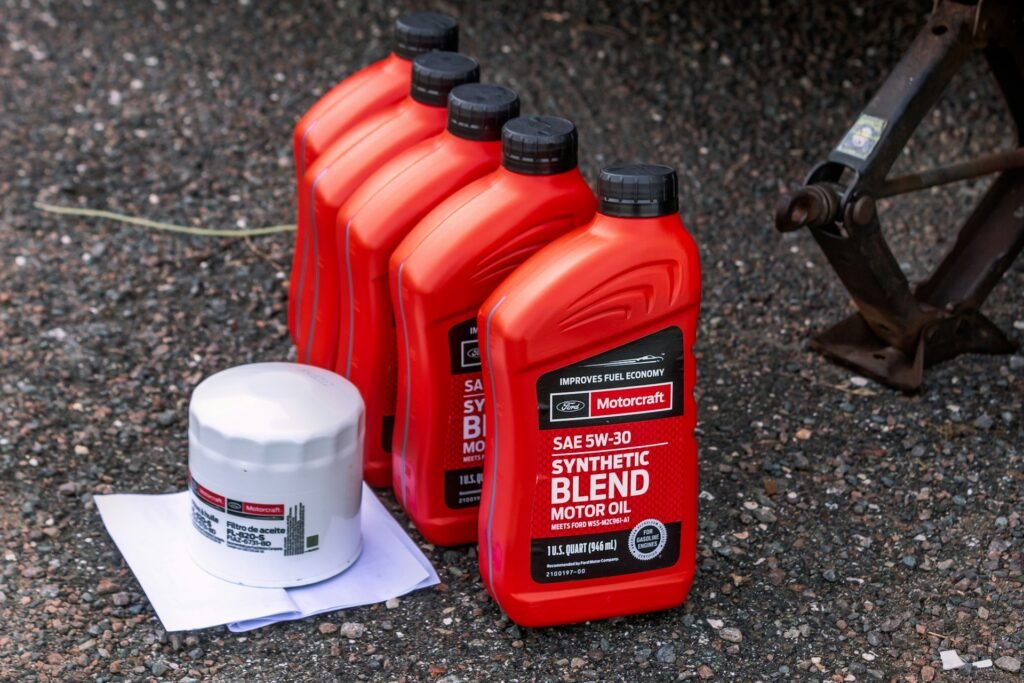
There’s also synthetic blend oil, which combines conventional and synthetic base oils.
The label alone isn’t enough to determine whether an oil is suitable for your engine. API advises vehicle owners to check the owner’s manual for the required oil specification before choosing a product.
Synthetic Oil vs. Conventional Oil: Key Differences
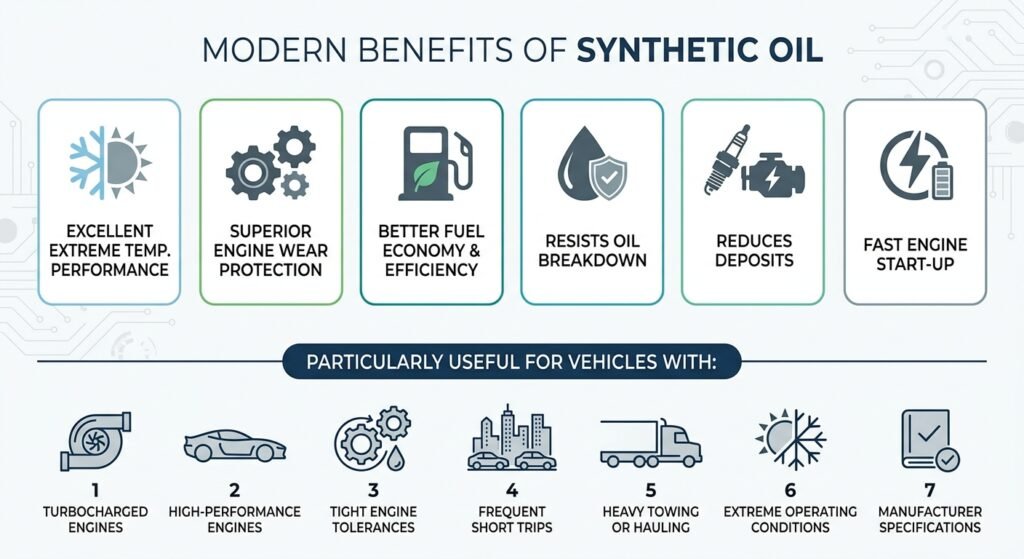
Synthetic oil has several performance advantages, particularly when an engine operates under demanding conditions.
High-temperature stability
Engine oil can become extremely hot, especially around turbochargers, pistons, and other heavily loaded components.
Synthetic formulations generally resist oxidation and thermal breakdown better than conventional oils. That can help the oil maintain its protective properties for longer under high-temperature conditions.
This matters more on a modern turbocharged engine than on a simple naturally aspirated engine used for relaxed highway driving.
Cold-weather performance
Oil becomes thicker as temperatures fall.
Synthetic oils can be formulated to flow effectively at very low temperatures, which can make cold starts easier and help oil circulate through the engine sooner.
This is one reason low-viscosity synthetic oils are common in newer vehicles designed to operate in cold climates.
The actual viscosity still has to match the manufacturer’s specification. A thinner oil isn’t automatically better.
Resistance to oxidation and deposits
Heat and oxygen gradually change engine oil. As oil ages, oxidation and contamination can contribute to deposits and sludge.
Modern synthetic formulations can provide strong resistance to oxidation and deposit formation. API’s current gasoline-engine specifications include tests for sludge and varnish control, high-temperature deposits, and turbocharger protection.
Wear protection
Synthetic oil doesn’t magically prevent engine wear, but the right formulation can provide strong protection during demanding conditions such as cold starts, high temperatures, and heavy loads.
The specification matters here. An oil that meets the correct API, ILSAC, or manufacturer approval is more relevant to your engine than simply choosing the most expensive product on the shelf.
Is Synthetic Oil Better for Your Car?
For many modern engines, synthetic oil is the better choice because it handles demanding operating conditions well.
It’s particularly useful for vehicles with:
- Turbocharged engines
- High-performance engines
- Tight engine tolerances
- Frequent short trips
- Heavy towing or hauling
- Very hot or cold operating conditions
- Manufacturer-specified synthetic oil requirements
Modern engine-oil standards are also designed around specific engine technologies. For example, API SP includes requirements related to low-speed pre-ignition, timing-chain wear, high-temperature deposits, sludge and varnish control, and turbocharger protection.
That doesn’t mean every older engine needs synthetic oil. It means you should match the oil to the engine rather than choosing based on a simple “synthetic is always better” rule.
When Does Conventional Oil Still Make Sense?
Conventional oil can still be a reasonable choice when the vehicle manufacturer allows it.
Older engines with relatively simple designs may not require a synthetic formulation. If the owner’s manual specifies a conventional oil or allows multiple oil types that meet the same requirements, there’s no technical reason to buy synthetic solely because it’s marketed as a premium product.
Cost can also matter.
Conventional oil is generally less expensive, so it can make sense for an older vehicle that allows it and doesn’t benefit substantially from synthetic oil’s additional performance characteristics.
The key is meeting the specification.
For example, if your owner’s manual calls for a particular SAE viscosity and API service category, an oil that meets those requirements is the right starting point. API notes that vehicle owners should consult the owner’s manual before using its oil-category charts.
Can You Switch From Conventional to Synthetic Oil?
Yes. Switching from conventional oil to synthetic oil is generally straightforward when the synthetic product meets the requirements for your engine.
You don’t normally need a special conversion procedure.
At the next oil change, drain the old oil, replace the oil filter, and refill the engine with the correct synthetic oil at the specified quantity.
There’s also no general rule that says an engine needs to be “flushed” before switching from conventional to synthetic oil. The important part is choosing a product with the correct viscosity and performance specification.
The reverse is also true: switching from synthetic to conventional oil doesn’t automatically damage an engine, provided the conventional oil is approved for that engine.
The owner’s manual remains the deciding reference.
Does Synthetic Oil Let You Go Longer Between Oil Changes?
Not automatically.
This is one of the most common mistakes people make when switching to synthetic oil.
Synthetic oil can be designed for longer drain intervals, and some products have specific extended-service claims. But the maximum interval for the oil doesn’t automatically become the recommended interval for your vehicle.
Your manufacturer’s maintenance schedule comes first.
For example, a vehicle manufacturer might specify an oil change every 7,500 miles regardless of whether you use an approved synthetic oil with a longer advertised service capability.
In that situation, changing the oil at 15,000 miles because the bottle says it can last that long would be the wrong approach.
Your driving conditions matter too. Frequent short trips, stop-and-go traffic, towing, heavy loads, extreme temperatures, and extended idling can affect the recommended service schedule. For a detailed breakdown, see our guide on how often you should change your engine oil.
How to Choose the Right Oil for Your Car
Don’t start by choosing between “synthetic” and “conventional.”
Start with the owner’s manual.
Look for four things:
SAE viscosity
You’ll see something such as 0W-20, 5W-30, or 5W-40.
The first number describes how the oil behaves at low temperatures, while the second describes its viscosity at operating temperature.
Use the viscosity specified by the manufacturer. Don’t change from 5W-30 to 0W-20 simply because the thinner oil is marketed as more fuel-efficient.
API or ILSAC specification
Gasoline engines may require an API or ILSAC performance category.
API’s current gasoline category is SP, while ILSAC GF-6A and GF-6B are current standards for applicable passenger-car oils. GF-6B applies specifically to 0W-16 oils.
Your vehicle may require a different specification depending on its age and engine.
Manufacturer approval
Some engines require an oil carrying a specific manufacturer approval.
This is particularly common with European vehicles and engines with specialized lubrication requirements.
If the manual specifies an approval, look for that exact approval on the product rather than assuming that any full synthetic oil will work.
Correct oil quantity
Using the correct oil isn’t enough if you put too much or too little in the engine.
Check the owner’s manual for the specified capacity, including whether the figure includes the oil filter.
After filling, check the level according to the manufacturer’s procedure.
Synthetic vs. Conventional Oil: Which Should You Buy?
For most newer vehicles that require or recommend synthetic oil, the answer is simple: use synthetic.
For older vehicles that allow conventional oil, conventional can still be a perfectly reasonable option.
| Situation | Best approach |
|---|---|
| Manufacturer requires synthetic oil | Use synthetic |
| Manufacturer specifies a particular approval | Use oil with that approval |
| Modern turbocharged engine | Synthetic is usually the better choice |
| Very cold or hot climate | Synthetic often has an advantage |
| Heavy towing or demanding use | Synthetic often makes sense |
| Older engine that allows conventional oil | Either, according to specifications |
| Lowest maintenance cost | Conventional, if approved |
| Maximum performance under demanding conditions | Synthetic |
The right oil isn’t necessarily the most expensive oil. It’s the one that meets the requirements of your engine and fits the way you use the car.
Is Synthetic Oil Worth the Extra Cost?
For a modern engine, usually yes, particularly if the manufacturer specifies it.
The price difference between conventional and synthetic oil is small compared with the cost of repairing an engine that has suffered from poor lubrication or incorrect maintenance.
Synthetic oil also makes more sense when you regularly drive in conditions that put extra stress on the engine, such as extreme temperatures, heavy traffic, frequent short trips, or towing.
If your older car specifically allows conventional oil and you drive it under normal conditions, spending extra on synthetic may provide fewer practical benefits.
The deciding factor should be the engine’s requirements, not the assumption that more expensive oil is always better.
Synthetic vs. Conventional Oil FAQ
Is synthetic oil better than conventional oil?
Synthetic oil generally offers better resistance to heat, oxidation, and deposits, along with strong low-temperature performance. Whether you need those advantages depends on your engine and driving conditions.
Can I switch from conventional to synthetic oil?
Yes. In most cases, you can switch at the next oil change as long as the synthetic oil meets the viscosity and performance requirements for your engine.
Can synthetic oil damage an older engine?
Synthetic oil doesn’t inherently damage older engines. The important question is whether the oil meets the engine manufacturer’s requirements. If the vehicle permits synthetic oil of the correct specification, it’s generally suitable.
Does synthetic oil last longer?
Some synthetic oils are designed for extended drain intervals, but that doesn’t mean you should automatically extend your vehicle’s oil-change interval. Follow the manufacturer’s schedule.
Is synthetic oil worth the extra money?
It often is for modern, turbocharged, high-performance, or heavily used engines. For an older engine that permits conventional oil, conventional may be sufficient.
Can you mix synthetic and conventional oil?
Synthetic and conventional motor oils can generally be mixed when necessary, but that doesn’t mean mixing is the best maintenance practice. Use the correct oil specified for your engine and change the oil at the recommended interval.