A radiator fan not working can cause your engine to overheat, especially when the car is sitting in traffic or idling. At higher speeds, air flowing through the grille helps cool the radiator naturally. When the vehicle stops, the cooling fan has to provide much of that airflow.
If the fan doesn’t operate when the vehicle’s cooling system commands it to, engine temperature can rise quickly. The fan motor itself may be faulty, but a blown fuse, bad relay, wiring problem, temperature sensor, or fan-control module can cause exactly the same symptom.
What Does the Radiator Fan Do?
The radiator removes heat from the engine coolant. For this to work effectively, air needs to pass through the radiator’s fins.
When you’re driving, the vehicle’s forward motion produces natural airflow through the radiator. At low speeds or while stopped, that airflow is greatly reduced. The radiator fan compensates by pulling or pushing air through the radiator.
This is why a cooling fan problem may remain hidden on the highway but become obvious at a red light or during stop-and-go traffic.
Some vehicles use one electric fan, while others use multiple fans or variable fan speeds. Older vehicles may use a mechanically driven fan with a viscous fan clutch instead.
7 Symptoms of a Radiator Fan Problem
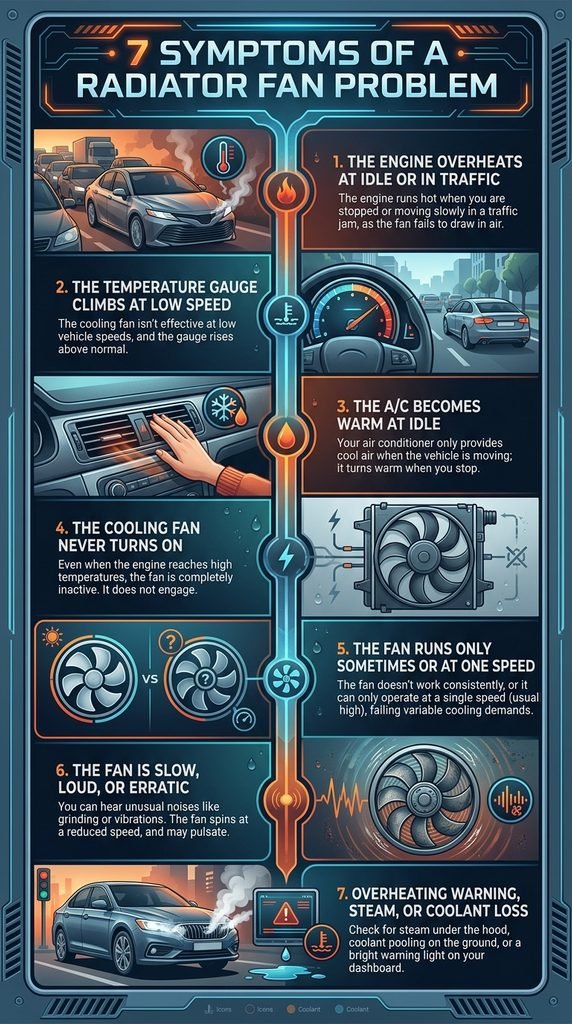
1. The Engine Overheats at Idle or in Traffic
This is the classic symptom.
If the temperature stays normal while driving but climbs when you’re stopped, insufficient airflow deserves immediate attention. A failed cooling fan is a common explanation because the car loses the natural airflow provided by road speed.
This symptom also connects directly with our guide on car overheating at idle but not while driving.
Don’t assume the fan is automatically defective, though. Low coolant, a restricted radiator, thermostat problems, or poor coolant circulation can create a similar pattern.
2. The Temperature Gauge Climbs at Low Speed
Another common sign is a temperature gauge that starts moving higher while you’re waiting in traffic.
A small change within the normal operating range isn’t necessarily a problem. The concern is when the gauge moves significantly higher than its usual position, approaches the hot or red zone, or continues climbing while the vehicle is stationary.
If the gauge returns toward normal shortly after you start driving, the extra airflow may be compensating for a low-speed cooling problem.
3. The A/C Becomes Warm at Idle
A radiator fan problem can sometimes affect A/C performance at low speeds as well.
The A/C condenser is located at the front of the vehicle and also needs airflow to reject heat. Many vehicles use their cooling-fan system to provide airflow when the car isn’t moving fast enough to generate it naturally.
As a result, a vehicle with inadequate fan operation may show two symptoms together:
Engine temperature rises at idle + A/C becomes less effective while stationary.
That doesn’t prove the fan is defective. A/C refrigerant, compressor, condenser, or control-system problems can also cause poor cooling.
4. The Cooling Fan Never Turns On
A fan that never operates can indicate a problem, but there’s an important qualification: the fan isn’t supposed to run continuously on every vehicle.
Most systems switch the fan on according to coolant temperature and other operating conditions. Some also use different fan speeds.
Therefore, seeing a stationary fan immediately after starting a cold engine isn’t enough to diagnose a failure.
The correct question is whether the fan operates when the vehicle’s control system commands it to.
5. The Fan Runs Only Sometimes or at One Speed
A cooling fan doesn’t necessarily have to be completely dead to have a fault.
Vehicles with multiple speeds or electronically controlled fans can develop problems affecting only part of the system. For example, the fan may operate under some conditions but fail to provide sufficient airflow when higher cooling capacity is required.
Possible causes include a failed fan motor, resistor, relay, control module, wiring fault, or control signal problem.
6. The Fan Is Slow, Loud, or Erratic
A healthy cooling fan should operate without excessive vibration or unusual mechanical noise.
A worn fan motor can become noisy, rotate slowly, stop intermittently, or develop an electrical problem. Physically damaged blades can also cause vibration or prevent the assembly from turning correctly.
If the fan is spinning but appears unusually slow, don’t automatically assume it’s working well enough. A weak motor can provide insufficient airflow even though the blades are moving.
7. Overheating Warning, Steam, or Coolant Loss
A serious fan failure can eventually cause the engine to overheat enough to trigger a temperature warning or produce steam.
Once that happens, the issue has moved beyond a simple fan diagnosis. Continued operation of an overheating engine can cause serious damage.
Stop driving if the temperature reaches the red zone, steam comes from under the hood, or coolant is being expelled.
Never remove a radiator cap or pressurised coolant reservoir cap while the engine is hot.
Why Is My Radiator Fan Not Working? 8 Common Causes
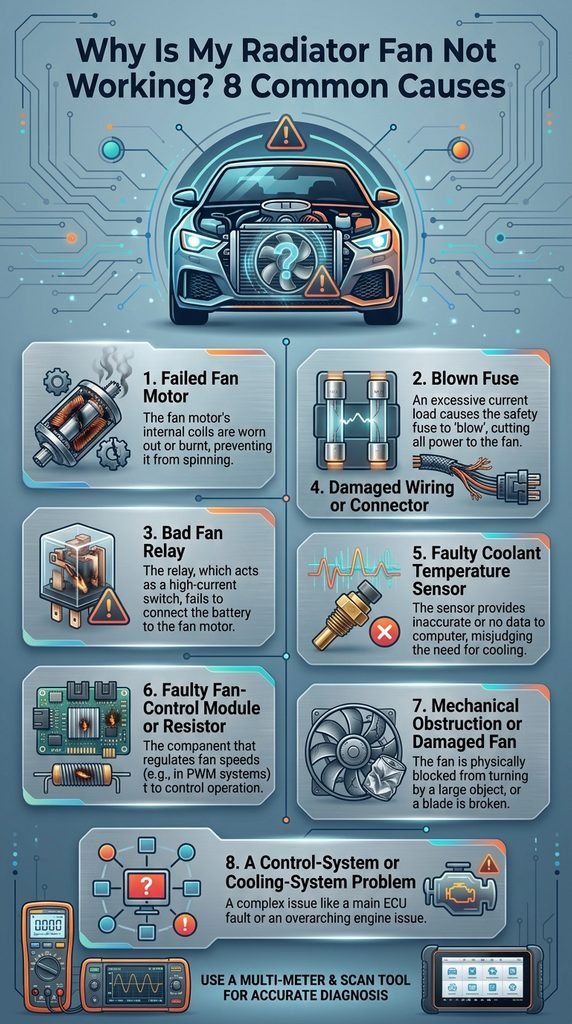
1. Failed Fan Motor
The electric motor that drives the fan can fail from age, electrical faults, worn internal components, or excessive heat.
If the motor receives the correct power and ground but doesn’t operate properly, the motor or fan assembly may need replacement.
Don’t replace it simply because the fan isn’t turning. First confirm that power is actually reaching the motor.
2. Blown Fuse
The fan circuit is protected by a fuse. If that fuse fails, electrical power to the fan can be interrupted. A blown fuse can result from an overload, short circuit, or another electrical problem.
Replace a blown fuse only with the correct type and rating specified for the vehicle.
If the replacement fuse blows again, don’t keep installing new fuses. The underlying electrical problem needs to be diagnosed.
3. Bad Fan Relay
Some cooling-fan circuits use a relay to switch electrical power to the fan.
A failed relay can prevent the fan from receiving power even when the fan motor itself is perfectly functional.
Depending on the vehicle, relay diagnosis can involve electrical testing or comparison with an identical, known-good relay where the manufacturer permits that method.
4. Damaged Wiring or Connector
A cooling fan depends on a complete electrical circuit. Broken wires, corroded terminals, loose connectors, damaged grounds, or heat-related wiring problems can interrupt either the power or control side.
Intermittent fan operation can be particularly difficult to diagnose because a damaged connection may work under some conditions and fail under others.
5. Faulty Coolant Temperature Sensor
The engine computer needs temperature information to determine when additional cooling is required.
If the coolant-temperature sensor sends an incorrect signal, the control system may fail to request fan operation when it should.
A sensor problem can also cause the opposite behaviour, with the fan operating when it shouldn’t.
Because sensor faults can affect other engine functions as well, diagnostic scan data can be useful before replacing the sensor.
6. Faulty Fan-Control Module or Resistor
Modern vehicles don’t always use a simple on/off fan circuit.
Some systems use a dedicated fan-control module, resistor, electronic controller, or computer-controlled variable-speed strategy. A fault in one of these components can affect one or more fan speeds.
This is particularly relevant when the fan works under some conditions but not others.
7. Mechanical Obstruction or Damaged Fan
Physical problems can also prevent proper fan operation.
Check for:
- Broken fan blades
- Foreign objects
- Damaged fan shroud
- Debris interfering with rotation
- Signs of excessive vibration
A damaged blade can also create an imbalance that puts additional stress on the fan motor.
8. A Control-System or Cooling-System Problem
Sometimes the fan is fine, but the system isn’t commanding it correctly.
The problem may involve an ECU/PCM control signal, sensor data, A/C-related control logic, or another cooling-system fault.
Conversely, the fan may operate correctly while the engine still overheats because of low coolant, a restricted radiator, thermostat failure, or a water-pump problem.
That distinction matters. Replacing a functioning fan won’t fix an unrelated cooling-system problem.
Should the Radiator Fan Run All the Time?
No.
Many cooling fans are electronically controlled and turn on only when additional airflow is required. The exact strategy varies by vehicle.
Fan activation can depend on:
- Coolant temperature
- Vehicle speed
- A/C operation
- Outside temperature
- Engine-control strategy
- Fan speed requirements
Some vehicles have more than one fan or multiple fan speeds, so simply checking whether the fan spins immediately after starting the engine isn’t a reliable test.
A cold engine with a stationary fan can be completely normal.
How to Check if Your Radiator Fan Is Working
Start with a safe observation rather than immediately replacing parts.
1. Start With a Cold Engine
Park the vehicle safely and make sure your hands, clothing, and tools are nowhere near the fan assembly.
2. Observe the Fan as the Engine Warms
Watch for fan operation as the engine reaches normal operating temperature. The exact activation point varies by vehicle, so consult the owner’s manual or manufacturer service information.
3. Monitor the Temperature Gauge
If the gauge starts moving significantly above its normal position while the vehicle is stationary, pay attention. Don’t wait until the engine reaches the red zone to investigate.
4. Check the Fan Fuse
Locate the appropriate fuse using the vehicle’s fuse-box diagram or owner’s manual. Check it with the appropriate electrical test method.
Never install a fuse with a higher rating simply to keep the circuit operating.
5. Check the Relay Where Applicable
If your vehicle uses a cooling-fan relay, inspect and test it according to the vehicle’s electrical-system specifications.
6. Inspect Wiring and Connectors
Look for loose connections, corrosion, damaged insulation, or broken wires around the fan assembly and associated circuitry.
7. Check for Physical Obstructions
With the engine off and the system safe, inspect the fan and shroud for obvious damage or debris.
8. Use Diagnostic Equipment When Necessary
A scan tool can provide useful information about coolant temperature and fan-command data on vehicles that support those functions.
Testing voltage, ground, continuity, and fan-control signals can help identify whether the fault is in the motor, power supply, or control circuit.
Never put your hands near a cooling fan simply because the engine is off. Electric cooling fans can start automatically.
How to Test a Radiator Fan Fuse and Relay
The fuse is the first electrical component worth checking because it’s easy to access and protects the fan circuit.
Find the correct fuse using the vehicle’s documentation. If the fuse is open, install the exact replacement specified by the manufacturer.
If it immediately fails again, stop replacing fuses. A repeated fuse failure indicates an electrical problem that needs diagnosis.
The relay can be tested in several ways depending on the vehicle. Some systems allow an identical relay to be swapped temporarily for diagnostic purposes, while others require voltage and control-circuit testing.
Don’t assume that a new relay will solve the problem without confirming that the fan circuit is actually receiving the required power and command signal.
Can a Bad Radiator Fan Cause Overheating?
Yes.
The relationship is straightforward:
Fan failure → reduced airflow at low speed → reduced radiator cooling → rising coolant temperature → possible overheating.
This is why a failed fan is especially noticeable in traffic, at red lights, or while idling for extended periods. At highway speed, natural airflow can temporarily compensate for the missing fan assistance.
If the engine overheats both at idle and at highway speed, look beyond the fan. Low coolant, radiator restriction, thermostat problems, water-pump failure, or another cooling-system fault may also be involved.
For radiator-related symptoms, see our guide to signs of a failing radiator.
Radiator Fan vs. Radiator Problem vs. Thermostat
Several cooling-system faults can produce similar symptoms.
| Symptom | Radiator Fan | Radiator | Thermostat |
|---|---|---|---|
| Overheats mainly at idle | Strong possibility | Possible | Possible |
| Overheats at highway speed | Possible | Stronger possibility | Possible |
| Fan doesn’t operate | Strong evidence | No | No |
| Coolant leak | No | Strong possibility | Possible |
| Blocked radiator fins | No | Strong evidence | No |
| Restricted coolant circulation | No | Possible | Strong possibility |
The table is a starting point, not a substitute for diagnosis.
For example, if the fan doesn’t operate and the vehicle overheats in traffic, the fan circuit deserves immediate attention. But if the fan works normally and the engine still overheats, another part of the cooling system may be responsible.
Can You Drive With a Radiator Fan That Isn’t Working?
A failed fan doesn’t necessarily cause immediate overheating under every condition. Cold ambient temperatures and highway driving can provide enough natural airflow to keep engine temperature under control temporarily.
That doesn’t make the vehicle safe for normal use.
The risk becomes much higher when:
- You’re sitting in heavy traffic
- The engine is idling for a long time
- Outside temperatures are high
- The A/C is operating heavily
- You’re towing or carrying a heavy load
If the temperature begins rising above normal, stop driving and diagnose the problem.
Don’t rely on driving faster to keep the engine cool. The additional airflow may temporarily hide the failure without fixing it.
What Should You Do If the Radiator Fan Isn’t Working?
Start by determining whether the fan actually fails to operate when required.
If the fan doesn’t run but the engine remains at normal temperature, arrange a diagnosis before using the vehicle extensively.
If the fan doesn’t run and the temperature rises at idle, treat the problem as an urgent cooling-system fault.
If the temperature reaches the red zone or steam appears, stop driving as soon as it is safe and shut the engine down.
Allow the system to cool completely before checking coolant or opening any component of the cooling system.
If the cause isn’t obvious after checking the basic fuse, wiring, and fan condition, professional electrical and cooling-system diagnosis is preferable to replacing parts based on guesswork.
FAQ
Why is my radiator fan not working?
Possible causes include a failed fan motor, blown fuse, bad relay, damaged wiring, faulty coolant-temperature sensor, fan-control module failure, or a mechanical problem with the fan assembly.
Should the radiator fan run all the time?
No. Fan operation is normally controlled according to coolant temperature and other vehicle conditions. A stationary fan with a cold engine isn’t necessarily a problem.
How do I know if my radiator fan is bad?
Look for a fan that fails to operate when required, overheating at idle or in traffic, slow or erratic fan operation, unusual fan noise, or related electrical faults. Confirm the fan motor, power supply, control circuit, and sensor inputs before replacing it.
Why does my car overheat when idling but not driving?
The vehicle gets much more natural airflow through the radiator while moving. A failed or weak cooling fan can therefore cause overheating at idle while the engine temperature drops again at higher road speeds.
Can a blown fuse cause the radiator fan to stop working?
Yes. If the fan circuit’s fuse is open, electrical power to the fan can be interrupted. A fuse that blows repeatedly indicates an underlying electrical problem that needs to be diagnosed.
Can a bad thermostat prevent the radiator fan from turning on?
A thermostat and fan are separate components, but thermostat or cooling-system problems can affect engine temperature and create symptoms that appear similar to a fan-control problem. The actual fan command and temperature data should be checked before replacing either part.
Can a bad coolant temperature sensor cause fan failure?
Yes. The vehicle’s control system may use coolant-temperature information to determine when the fan should operate. An inaccurate sensor signal can therefore affect fan activation.
Does the A/C make the radiator fan turn on?
On many vehicles, A/C operation can influence cooling-fan operation because airflow is also needed across the A/C condenser. The exact strategy differs between vehicles, so A/C behaviour shouldn’t be used as a universal fan test.
How much does it cost to replace a radiator fan?
The cost varies substantially by vehicle and by which component has failed. A fuse or relay can be inexpensive, while a complete fan assembly, control module, or wiring repair can cost considerably more.
Can I drive without a radiator fan?
You may not experience immediate overheating under every driving condition, but driving without a functioning fan increases the risk of overheating, particularly in traffic and at idle. If the engine temperature rises above normal, stop driving and address the problem.