A car heater blowing cold air usually means one of two things: hot coolant isn’t reaching the heater core, or the HVAC system isn’t directing air through the heated core correctly.
In a typical gasoline or diesel vehicle, the heater uses heat produced by the engine. Hot coolant flows through a small radiator called the heater core, and the blower pushes cabin air across it. If coolant flow, engine temperature, airflow, or the HVAC controls have a problem, you can end up with cold air from the vents.
Some causes are easy to check. Others, such as a restricted heater core or failed blend-door actuator, can require professional diagnosis.
How Does a Car Heater Work?
Your car’s heating system is closely connected to the engine cooling system.
As the engine runs, coolant absorbs heat from the engine. Some of that hot coolant is routed through the heater core, which sits inside the dashboard area. The blower motor pushes air across the heater core, warming the air before it enters the cabin.
The temperature controls then determine how much air passes through or around the heater core. Modern vehicles may use electronically controlled blend doors and actuators to manage this process.
That gives you two basic areas to investigate:
No hot coolant at the heater core → cooling-system problem.
Hot coolant reaches the heater core, but the cabin stays cold → HVAC or airflow problem.
8 Common Causes of a Car Heater Blowing Cold Air
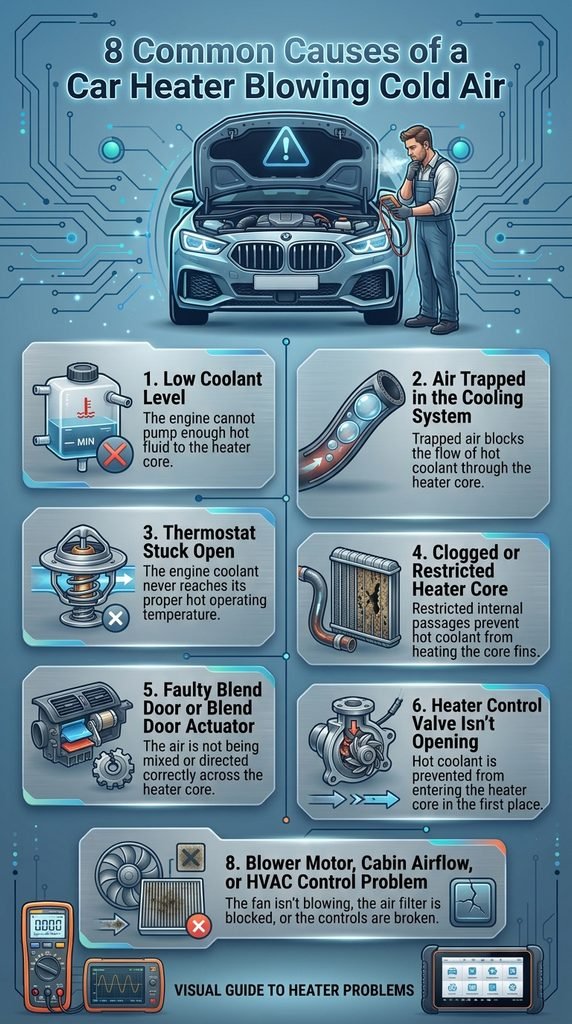
1. Low Coolant Level
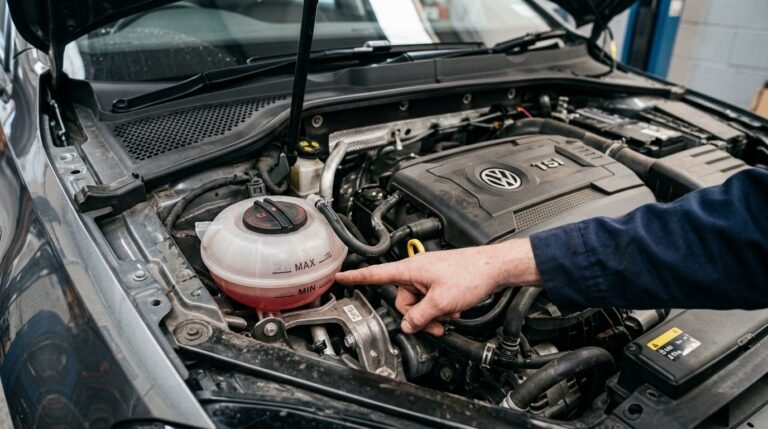
Low coolant is one of the first things to check when your heater suddenly stops producing heat.
The heater core needs a sufficient supply of hot coolant. If the coolant level is too low, circulation through the heater core can be reduced or interrupted. A low coolant level can also indicate an underlying leak elsewhere in the cooling system.
Check the coolant reservoir only when the engine is completely cold. If the level is below the manufacturer’s specified range, find out why before simply adding more.
Common clues include:
- Heater suddenly becomes cold
- Coolant reservoir is below MIN
- Sweet coolant smell
- Visible coolant residue
- Engine temperature fluctuations
- Repeated need to top up coolant
If your coolant level keeps falling, see our guide on why it keeps dropping.
2. Air Trapped in the Cooling System
Air inside the cooling system can interfere with coolant circulation through the heater core.
This can happen after:
- A coolant change
- Radiator replacement
- Hose or water-pump replacement
- A cooling-system repair
- A coolant leak
An air pocket can prevent hot coolant from flowing normally through the heater core, resulting in little or no cabin heat.
This is particularly worth considering if the heater stopped working shortly after cooling-system maintenance.
Removing trapped air generally requires following the vehicle manufacturer’s bleeding procedure. Some cooling systems are more sensitive to trapped air than others, so simply filling the reservoir may not solve the problem.
3. Thermostat Stuck Open
The thermostat regulates coolant flow as the engine warms up. When the engine is cold, it limits coolant circulation through the radiator so the engine can reach its normal operating temperature. Once the coolant reaches the appropriate temperature, the thermostat opens and allows greater flow through the radiator.
If the thermostat becomes stuck open, coolant can circulate through the radiator too early. The engine may take much longer to reach operating temperature, particularly in cold weather.
Possible clues include:
- Temperature gauge stays unusually low
- Engine takes a long time to warm up
- Heater produces lukewarm air
- Cabin heat improves only after extended driving
- Fuel economy may decrease
A thermostat problem doesn’t always cause completely cold air. Sometimes the heater simply never gets properly hot.
4. Clogged or Restricted Heater Core
The heater core is a small radiator, and its narrow passages can become restricted by deposits, corrosion, rust, or contaminated coolant.
If coolant can’t flow properly through the heater core, it can’t transfer enough heat into the cabin.
One useful diagnostic clue is the temperature of the two heater hoses that connect the engine cooling system to the heater core.
When the engine is fully warm:
- Both hoses are hot: coolant is reaching the heater core, so an HVAC airflow or blend-door problem becomes more likely.
- One hose is hot, and the other is significantly cooler: restricted heater-core flow or a heater control valve becomes more likely.
- Both hoses are relatively cool: investigate coolant level, thermostat, circulation, or another cooling-system issue.
Heater hoses can become extremely hot, so don’t handle them casually.
5. Faulty Blend Door or Blend Door Actuator
If the engine is at normal temperature and hot coolant is reaching the heater core, but the vents still blow cold air, the problem may be inside the HVAC system.
A blend door controls how much air passes through the heater core versus bypassing it. The door may be controlled mechanically or by an electric actuator.
If the blend door becomes stuck in the wrong position, the heater core can be hot while the air reaching the cabin remains cold.
Possible clues include:
- Temperature setting has little effect
- Air remains cold regardless of the selected temperature
- Clicking or knocking behind the dashboard
- Temperature changes unpredictably
- One side of the cabin is hot while the other stays cold on dual-zone systems
Blend-door problems can be difficult to access because the components are often located deep inside the dashboard.
6. Heater Control Valve Isn’t Opening
Some vehicles use a heater control valve to regulate coolant flow into the heater core. Not every vehicle has one.
If the valve remains closed when it should open, hot coolant can’t reach the heater core.
The valve may be operated by:
- Cable
- Vacuum
- Electrical actuator
A faulty actuator, broken cable, damaged vacuum line, or failed valve can therefore produce cold air even when the engine itself reaches its normal operating temperature.
Before replacing the valve, the actual control mechanism should be checked. The valve itself may be fine while the component responsible for operating it has failed.
7. Water Pump or Coolant Circulation Problem
The water pump circulates coolant through the engine and cooling system. A problem with the pump can reduce coolant flow and affect both engine cooling and cabin heating.
Other symptoms may include:
- Engine overheating
- Coolant leakage
- Unusual grinding or whining noises
- Temperature fluctuations
- Poor heater performance
A heater that becomes hotter when engine speed increases can sometimes point toward a coolant-circulation problem.
If you also have overheating or coolant loss, check our guide to the signs of a failing water pump.
8. Blower Motor, Cabin Airflow, or HVAC Control Problem
Sometimes the problem isn’t the temperature of the air at all. The problem is that there isn’t enough air coming through the vents.
If airflow is weak whether the system is set to hot or cold, investigate:
- Blower motor
- Blower resistor or control module
- Cabin air filter
- Blocked air intake
- Closed or obstructed vents
- HVAC control problems
A clogged cabin air filter can restrict airflow, while a failed blower motor can leave you with little or no air from the vents.
This distinction is useful:
Strong airflow + cold air → investigate heating/coolant/HVAC temperature control.
Weak airflow + cold air → investigate blower and airflow first.
Heater Blows Cold Air, but Engine Temperature Is Normal
If the temperature gauge reaches its normal operating position but the heater stays cold, the engine itself may be warming correctly.
At this point, focus on:
- Low coolant
- Air trapped in the cooling system
- Restricted heater core
- Heater control valve
- Blend door
- Blend-door actuator
- HVAC control problem
Normal engine temperature doesn’t automatically mean hot coolant is reaching the heater core. The heater circuit can have a flow restriction or control problem even while the engine maintains its normal temperature.
The heater-hose comparison can help narrow this down.
If both heater hoses are hot, coolant is reaching the heater core and the HVAC air-routing system becomes a stronger suspect.
If one hose is much cooler, investigate coolant flow through the heater core or the heater control valve.
Heater Blows Cold at Idle but Warm While Driving
A heater that produces cold air while idling but becomes warm when driving can point toward a coolant-flow problem.
Increasing engine speed can increase coolant circulation. If the heater suddenly becomes hotter when you accelerate, possible causes include:
- Low coolant
- Air trapped in the system
- Restricted heater core
- Weak coolant circulation
- Water-pump problems
This situation is different from a car that overheats at idle but not while driving. That pattern usually points toward insufficient airflow through the radiator, while cold cabin heat at idle is more directly related to coolant flow through the heater circuit.
If your engine itself is getting hotter while stopped, see our guide on car overheating at idle but not while driving.
How to Check Why Your Car Heater Is Blowing Cold Air
Start with the simple checks before assuming an expensive component has failed.
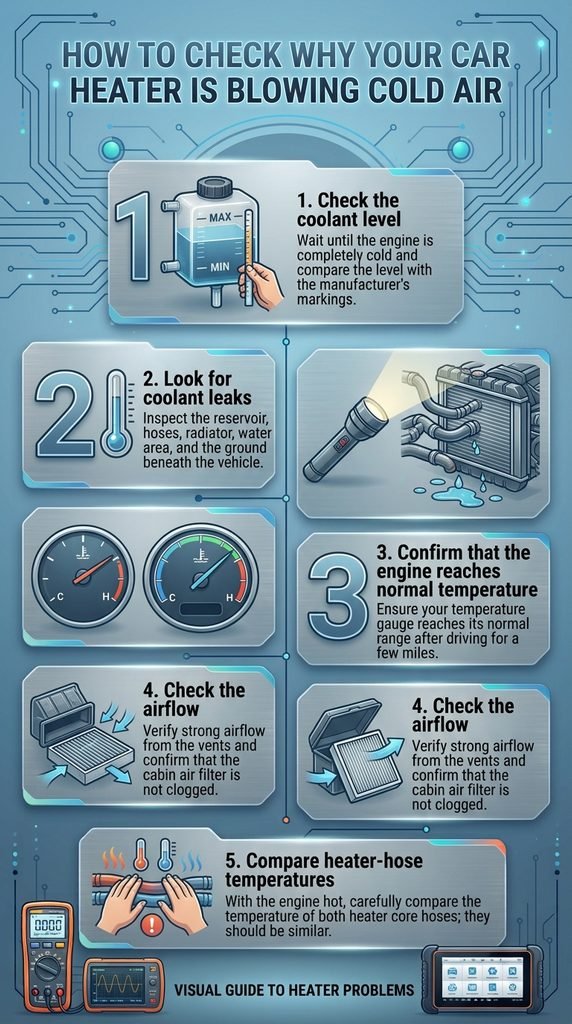
1. Check the coolant level
Let the engine cool completely and check the reservoir against the manufacturer’s markings.
A low level needs further investigation because coolant loss can indicate a leak.
2. Look for coolant leaks
Check for wet areas, dried coolant residue, damaged hoses, loose connections, and puddles under the vehicle.
Our guide explains how to find a coolant leak.
3. Confirm that the engine reaches normal temperature
Watch the temperature gauge during normal driving.
If it stays unusually low for an extended period, a thermostat stuck open becomes a possibility.
If it climbs too high, stop investigating the heater and address the overheating problem first.
4. Check the airflow
Set the blower to a high setting.
If very little air comes from the vents, investigate the blower motor, cabin filter, intake, and HVAC airflow controls.
5. Compare heater-hose temperatures
After the engine reaches operating temperature, locate the two heater hoses entering the firewall.
If you can safely inspect them without touching hot components:
- Both hot → look toward blend doors and HVAC controls.
- One hot, one much cooler → restricted heater-core flow or control valve.
- Both cool → investigate coolant level, thermostat, circulation, or system problems.
Because these components can become extremely hot, professional inspection is safer if you’re not comfortable working around a hot engine.
How to Tell if the Heater Core Is Clogged
A clogged heater core restricts coolant flow through the small passages that transfer heat to the cabin.
One of the more useful clues is a temperature difference between the inlet and outlet heater hoses.
If one hose is hot while the other is substantially cooler, coolant may not be flowing through the heater core correctly. A heater control valve that isn’t opening can create a similar symptom, so the heater core should not automatically be blamed.
If both hoses are hot but the cabin stays cold, the heater core is receiving hot coolant. At that point, the blend door or HVAC controls become more likely causes.
A proper diagnosis may require temperature measurements, cooling-system testing, or inspection of the HVAC assembly.
Can a Bad Heater Cause Engine Overheating?
A faulty blend door or HVAC control generally won’t cause the engine itself to overheat.
However, some problems can affect both the heater and the engine cooling system.
For example:
- Low coolant can cause poor cabin heat and overheating.
- A coolant leak can cause both symptoms.
- A failing water pump can affect heater performance and engine cooling.
- Trapped air can interfere with coolant circulation.
That makes cold heater output potentially useful as an early warning when it appears together with rising engine temperature.
A heater that simply blows cold because of a failed blend-door actuator is a different situation. The cabin may be uncomfortable, but the engine can still be operating at the correct temperature.
Can You Drive With a Car Heater Blowing Cold Air?
Sometimes, but you shouldn’t ignore the reason the heater stopped working.
If the problem is a blend-door actuator or another HVAC-only fault and the engine maintains its normal operating temperature, the vehicle may continue to operate normally from an engine standpoint.
The situation is different if the cold air is caused by:
- Low coolant
- Coolant leak
- Water-pump failure
- Poor coolant circulation
- Engine overheating
In those cases, continuing to drive can lead to engine damage.
There’s also a visibility issue. The heater and defroster help clear condensation, frost, and ice from the windshield. A heating or HVAC problem can therefore become a safety issue in cold or humid weather.
What Should You Check First?
The fastest way to narrow down the problem is to follow the symptom rather than replace parts at random.
Cold air + low coolant
→ Investigate coolant loss or a leak.
Cold air + engine never reaches normal temperature
→ Thermostat is a strong possibility.
Cold air + one heater hose hot and the other cooler
→ Investigate heater-core flow or the heater control valve.
Cold air + both heater hoses hot
→ Blend door or HVAC control becomes more likely.
Strong airflow but no heat
→ Focus on coolant circulation and temperature-control components.
Weak or no airflow
→ Check the blower motor, cabin filter, vents, and HVAC airflow controls.
This approach helps separate an engine cooling-system problem from an HVAC problem.
When Should You Stop Driving?
Cold air from the heater isn’t necessarily an emergency by itself.
It becomes much more serious when it’s accompanied by signs of a cooling-system failure.
Stop driving if you notice:
- Rising engine temperature
- Temperature gauge entering the red zone
- Coolant-temperature warning
- Steam from under the hood
- Rapid coolant loss
- Strong coolant smell combined with overheating
- Engine running poorly
Never remove a radiator cap or pressurised coolant reservoir cap while the engine is hot. Wait until the cooling system has cooled completely.
How to Prevent Heater Problems
The best way to reduce heater problems is to maintain the cooling system that supplies the heater core.
Keep coolant at the correct level, investigate unexplained coolant loss, and use the coolant specified by the manufacturer.
Follow the recommended coolant service intervals and don’t ignore repeated overheating. Corrosion and contamination can contribute to heater-core and cooling-system problems over time.
It’s also worth maintaining the cabin air filter and checking that the HVAC air intake and vents aren’t obstructed.
A change in heater performance can sometimes be the first sign that something is wrong with the cooling system, so don’t dismiss it as simply an HVAC inconvenience.
FAQ
Why is my car heater blowing cold air?
The most common possibilities are low coolant, trapped air, a thermostat problem, restricted heater-core flow, a heater control valve, a blend-door problem, a water-pump issue, or an HVAC airflow fault.
Can low coolant cause cold air from the heater?
Yes. Low coolant can prevent enough hot coolant from reaching the heater core. Because low coolant can also cause engine overheating, the reason for the low level should be investigated.
Why does my heater blow cold air at idle but warm air while driving?
This can indicate a coolant-flow problem. Increased engine speed while driving may improve coolant circulation, making the heater warmer. Low coolant, air in the cooling system, heater-core restriction, or water-pump problems are possible causes.
Why is my heater cold when the engine is warm?
If the engine reaches normal operating temperature but the cabin remains cold, investigate coolant flow through the heater core and the HVAC temperature controls. A heater control valve or blend door can prevent proper heating even when the engine is fully warm.
Can a bad thermostat cause no heat?
Yes. A thermostat stuck open can prevent the engine from reaching its normal operating temperature, which can leave the heater producing weak or lukewarm air.
How do I know if my heater core is clogged?
One clue is a significant temperature difference between the two heater hoses after the engine reaches operating temperature. A hot inlet hose and much cooler outlet hose can indicate restricted flow, although a heater control valve can create a similar symptom.
What does it mean if one heater hose is hot and the other is cold?
It can indicate restricted coolant flow through the heater core or a heater control valve that isn’t opening correctly. The heater hoses can become extremely hot, so inspection should be performed carefully.
Can a bad water pump cause no heat?
Yes. A water pump that isn’t circulating coolant properly can reduce coolant flow through the heater core and may also cause engine overheating or other cooling-system symptoms.
Can a bad blend door cause cold air?
Yes. If the blend door remains in a position that bypasses the heater core, cold air can reach the cabin even when the heater core itself is hot. A faulty blend-door actuator can produce clicking noises or inconsistent temperature control.
Is it safe to drive with no heat in the car?
It depends on the cause. An HVAC-only fault may not affect engine operation, but cold air caused by low coolant, a coolant leak, water-pump failure, or overheating can indicate a serious cooling-system problem. Lack of effective defrosting can also reduce visibility in cold or humid conditions.