Radiator problems can cause anything from a small coolant leak to serious engine overheating. Because the radiator is responsible for removing heat from engine coolant, a damaged, clogged, or poorly ventilated radiator can eventually prevent the cooling system from keeping the engine at a safe operating temperature.
Common warning signs include overheating, low coolant, coolant leaks, corrosion, damaged radiator fins, and unusual steam or hissing sounds. However, these symptoms don’t always mean the radiator itself has failed. A thermostat, water pump, cooling fan, or another component can produce similar problems.
Knowing the difference can help you avoid replacing an expensive part when the actual fault is somewhere else.
What Does a Car Radiator Do?
The radiator removes heat from the coolant after the coolant has absorbed heat from the engine.
The basic process works like this:
- Coolant absorbs heat as it circulates through the engine.
- Hot coolant flows into the radiator.
- Coolant passes through narrow tubes inside the radiator.
- Air flowing across the radiator fins removes heat.
- The cooled coolant returns to the engine.
The system needs both adequate coolant flow and sufficient airflow. A radiator with restricted internal passages may struggle to circulate coolant, while blocked or damaged fins can reduce the amount of heat transferred to the surrounding air.
7 Signs Your Car’s Radiator Is Failing
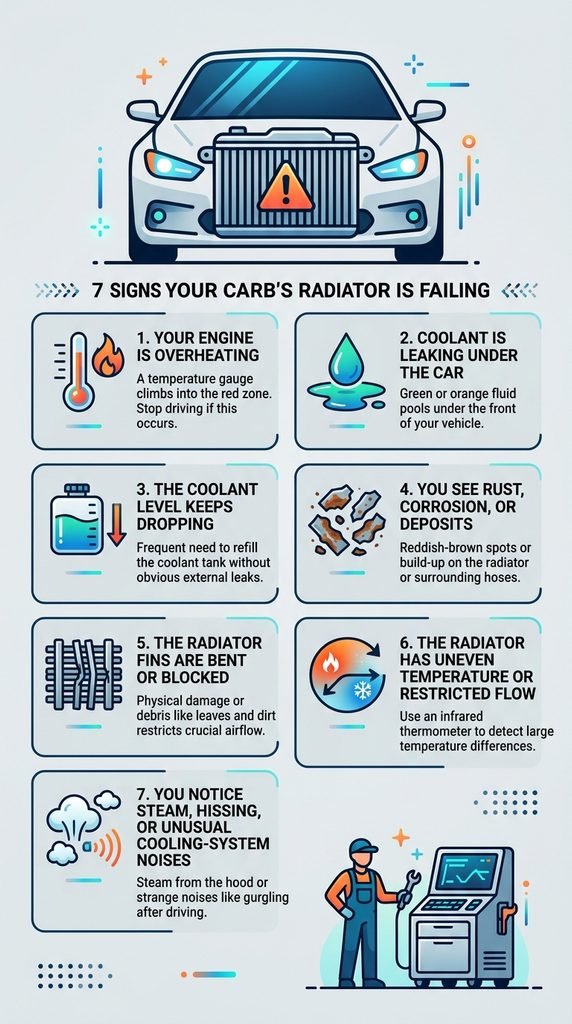
1. Your Engine Is Overheating
Overheating is one of the most serious symptoms associated with radiator problems.
A radiator may cause overheating when it has a significant leak, restricted internal passages, damaged fins, or insufficient ability to transfer heat from the coolant to the surrounding air.
However, overheating alone doesn’t prove that the radiator is bad.
A failed thermostat, water pump, cooling fan, low coolant level, blocked hose, or other cooling-system problem can produce the same symptom.
The conditions under which overheating occurs can provide useful clues. For example, an engine that overheats mainly at idle or in traffic may have an airflow or cooling-fan problem rather than a defective radiator.
If your car is overheating, don’t continue driving simply because the temperature drops again after you start moving. Repeated overheating can cause expensive engine damage.
2. Coolant Is Leaking Under the Car
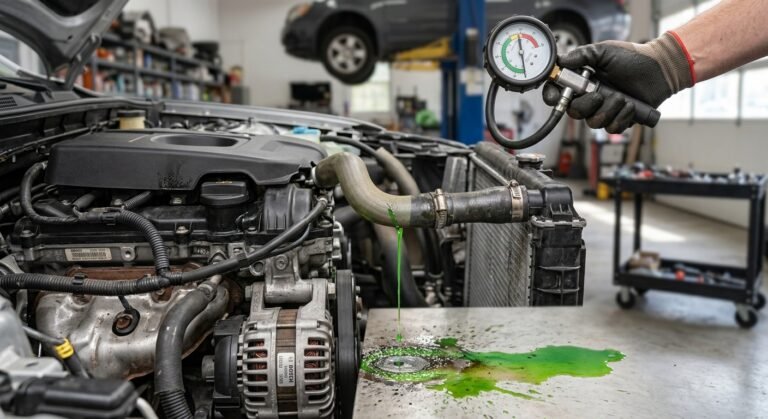
A leaking radiator can leave coolant underneath the vehicle, particularly toward the front of the engine compartment.
Potential leak points include:
- Radiator end tanks
- Seams between the radiator tank and core
- Radiator fittings
- Drain area
- Damaged tubes
- Hose connections
The location of a puddle can provide a clue, but it doesn’t automatically identify the radiator as the source. Coolant can travel along other components before reaching the ground.
The liquid may also appear only after driving because coolant pressure increases as the engine reaches operating temperature.
If you find coolant under your vehicle, our guide explains how to find a coolant leak and determine where it may be coming from.
3. The Coolant Level Keeps Dropping
A damaged radiator can gradually lose coolant, causing the expansion reservoir level to fall.
If you repeatedly need to add coolant, don’t assume the vehicle simply needs more fluid. A properly functioning cooling system shouldn’t continually consume coolant.
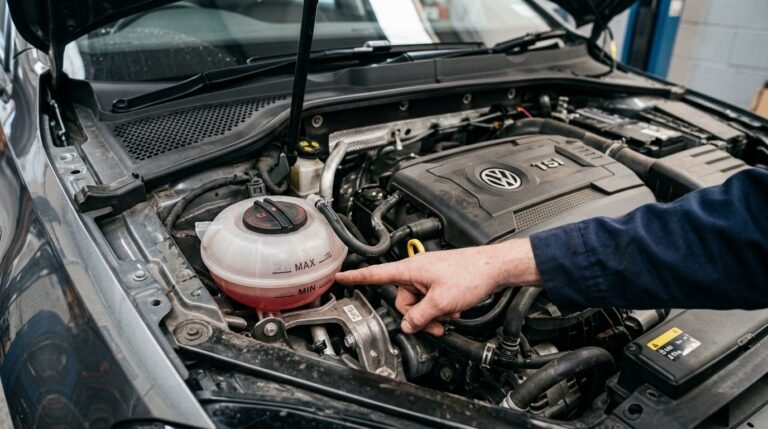
Check the level with the engine completely cold and compare it with the manufacturer’s specified markings.
Other components can also cause coolant loss, including hoses, the water pump, the heater core, and the reservoir. That’s why low coolant is a symptom, not a diagnosis.
If your reservoir repeatedly drops below the recommended level, see our guide to why your coolant level keeps dropping.
4. You See Rust, Corrosion, or Deposits
Corrosion can weaken radiator materials and eventually create leaks.
Internal deposits can also restrict coolant flow through the radiator’s narrow passages. External corrosion may damage the radiator’s tanks, tubes, or connections.
Signs of deterioration can include:
- Rust or corrosion around the radiator
- Crusty deposits
- Visible residue around seams
- Contaminated or degraded coolant
- Damaged fittings
The appearance of coolant alone isn’t enough to diagnose a radiator problem. Coolant colors vary between formulations, and discolored coolant can indicate broader cooling-system contamination rather than radiator failure specifically.
If corrosion is widespread or internal passages are heavily restricted, replacement may be more practical than attempting to clean or repair the radiator.
5. The Radiator Fins Are Bent or Blocked
Radiator fins provide the surface area needed to transfer heat from the coolant to the air.
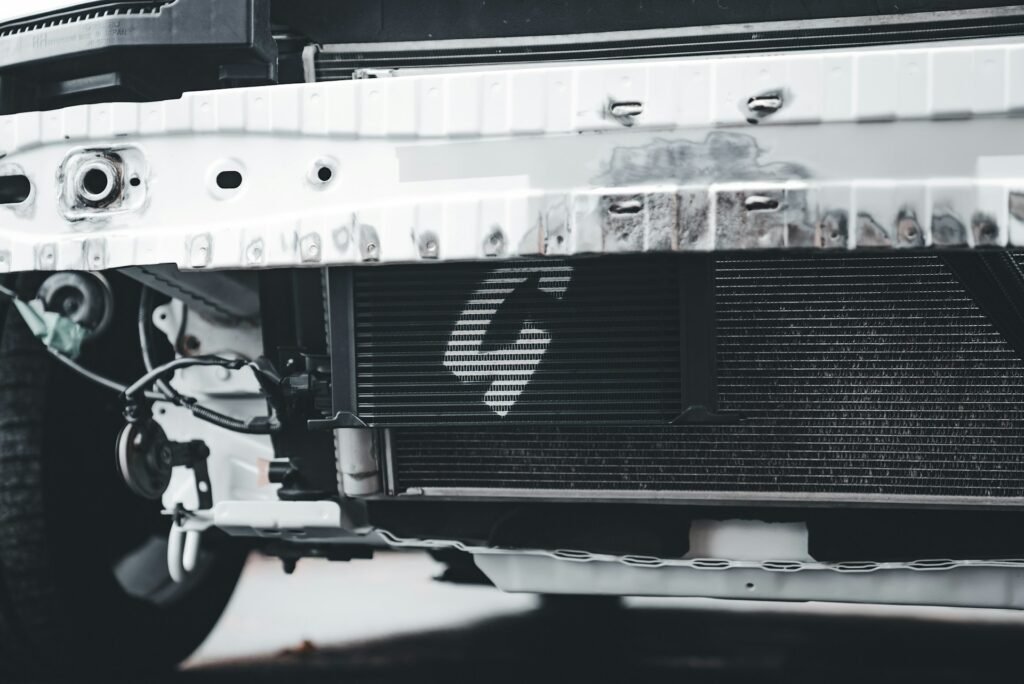
If the fins are packed with dirt, leaves, insects, mud, or other debris, airflow can be restricted. Bent or crushed fins can have the same effect.
This is particularly relevant to vehicles that regularly travel on gravel roads, in dusty conditions, or through areas with heavy debris.
Inspect the radiator from the front of the vehicle when the engine is cold. Look for obvious obstructions or areas where the fins have been severely crushed.
Minor debris can sometimes be removed carefully. Avoid using excessive water pressure, which can bend delicate fins and make the problem worse.
Severe physical damage may require radiator replacement.
6. The Radiator Has Uneven Temperature or Restricted Flow
A partially blocked radiator may not distribute coolant evenly through its internal tubes.
As a result, some sections can remain considerably cooler than others while other areas become excessively hot.
Temperature differences can sometimes be investigated with an infrared thermometer. However, interpreting these readings isn’t as simple as finding one “correct” radiator temperature. Coolant temperature naturally changes as it moves through the radiator, and vehicle design affects the expected readings.
A professional technician can combine temperature measurements with other tests to determine whether the radiator has restricted flow.
Don’t attempt to diagnose a hot radiator by touching its components or hoses with your bare hands.
7. You Notice Steam, Hissing, or Unusual Cooling-System Noises
Steam from the engine bay can indicate that coolant is escaping onto a hot component or that the engine is overheating.
A hissing sound may occur when hot coolant or pressurized vapor escapes from a leak.
You may also hear bubbling or gurgling from the cooling system. This can sometimes be associated with trapped air, low coolant, or coolant boiling because of overheating.
These sounds don’t automatically mean the radiator has failed. A leaking hose, faulty cap, water pump problem, or another cooling-system fault can create similar symptoms.
If steam is coming from under the hood or the temperature gauge is entering the red zone, stop driving as soon as it’s safe to do so.
Never remove a radiator cap or pressurised coolant reservoir cap while the engine is hot.
What Causes Radiator Problems?
Radiators can fail for several different reasons.
Corrosion can weaken the metal or other radiator materials and eventually create leaks. It can also contribute to deterioration around seams and connections.
Internal deposits and contamination can restrict the narrow passages through which coolant flows, reducing circulation and heat transfer.
External debris can block airflow through the fins. Dirt, insects, mud, leaves, and other material can prevent air from passing efficiently through the radiator.
Physical damage is another common cause. A stone or other road debris can damage radiator fins or puncture the core. Front-end collisions can cause much more extensive damage.
Incorrect or degraded coolant can contribute to corrosion and deposits over time. The cooling system should use the coolant specified by the vehicle manufacturer.
Excessive cooling-system pressure can also place additional stress on radiator tanks, seals, and other components.
A radiator problem can therefore develop gradually through corrosion and contamination or occur suddenly after physical damage.
How to Check if Your Radiator Is Bad
You can perform several basic checks yourself, but more advanced diagnosis may require professional equipment.
Start with a completely cold engine.
- Check the coolant reservoir. Confirm that the level is within the specified range.
- Inspect the radiator area. Look for wet spots or dried coolant residue.
- Check the radiator tanks and seams. Cracks and leaks can develop around these areas.
- Inspect the fins. Look for heavy debris, corrosion, and crushed sections.
- Check visible hose connections. A leaking hose can be mistaken for a leaking radiator.
- Inspect the coolant condition. Look for obvious contamination or deposits.
- Check the cooling fan. If the vehicle overheats mainly at idle, fan operation deserves attention.
- Consider a pressure test. A cooling-system pressure test can help identify leaks that aren’t obvious during a visual inspection.
- Test for restricted flow if necessary. Temperature measurements and other diagnostic procedures can help determine whether the radiator is internally blocked.
Don’t replace the radiator based on a single symptom. Confirm the failure first whenever possible.
Radiator vs. Thermostat vs. Radiator Fan: What’s the Difference?
Several cooling-system components can produce similar symptoms.
| Symptom | Radiator | Thermostat | Cooling fan |
|---|---|---|---|
| Overheats at highway speed | Possible | Possible | Less typical |
| Overheats mainly at idle | Possible | Possible | Strong possibility |
| Coolant leak | Common possibility | Possible | Unlikely |
| Blocked airflow | Possible | No | Fan-related |
| Restricted coolant flow | Strong possibility | Strong possibility | No |
| Fan doesn’t operate | No | No | Strong possibility |
This isn’t a substitute for diagnosis, but the pattern can help narrow down the possibilities.
For example, if the engine stays at a normal temperature while driving at highway speed but overheats when sitting in traffic, insufficient airflow through the radiator is worth investigating. The radiator itself may be fine, while the electric cooling fan or its control system has failed.
Likewise, a coolant leak around the radiator doesn’t rule out other nearby components. The leak needs to be traced to its actual source.
Can You Drive With a Bad Radiator?
You shouldn’t continue driving if the radiator has a significant leak or the engine is overheating.
A radiator problem can quickly progress from reduced cooling performance to severe overheating:
Radiator problem → coolant loss or poor heat transfer → rising engine temperature → overheating → potential engine damage.
If the temperature gauge reaches the red zone, a temperature warning appears, or steam comes from under the hood, stop driving as soon as it’s safe.
Continuing to drive an overheating engine can damage the head gasket, cylinder head, pistons, or other internal engine components.
Adding coolant may temporarily restore the level after a leak, but it doesn’t make a damaged radiator safe to use.
Can a Radiator Be Repaired or Does It Need to Be Replaced?
The answer depends on the type and extent of damage.
A minor problem with a hose connection or certain external components may be repairable. Some minor fin damage may also have little effect on cooling performance.
Replacement is generally more appropriate when:
- The radiator core is badly damaged
- Plastic tanks are cracked
- Corrosion is widespread
- Internal passages are severely restricted
- Multiple leaks are present
- Structural damage is extensive
- A repair would be unreliable or uneconomical
Be cautious about treating radiator stop-leak products as a permanent solution. Blocking a leak temporarily doesn’t address why the radiator failed and may introduce additional contamination into the cooling system.
How Long Does a Car Radiator Last?
There isn’t one universal replacement interval for a car radiator.
Radiator lifespan depends on factors such as:
- Vehicle design
- Coolant maintenance
- Corrosion
- Climate
- Road conditions
- Debris exposure
- Physical damage
- Cooling-system pressure
- Overall maintenance
Unlike engine oil, a radiator typically isn’t replaced at a fixed mileage simply because it has reached a certain age.
Instead, it should be inspected periodically and replaced when it develops a significant leak, severe corrosion, restricted flow, or other damage that affects cooling performance.
How to Prevent Radiator Problems
You can reduce the risk of radiator failure with regular cooling-system maintenance.
Keep the coolant at the correct level and use the manufacturer’s specified coolant. Follow the recommended coolant service interval rather than waiting until the fluid becomes heavily contaminated.
Inspect the radiator and surrounding area periodically. Remove visible debris that could restrict airflow, and check for corrosion, residue, or signs of coolant leakage.
Don’t ignore repeated overheating or unexplained coolant loss. Small cooling-system problems are generally easier and cheaper to address before they cause engine damage.
If you’re checking the vehicle yourself, our guide on how to check your coolant level covers the correct way to inspect the reservoir and other important vehicle fluids.
FAQ
What are the most common radiator problems?
The most common problems include coolant leaks, corrosion, blocked or damaged fins, restricted internal coolant flow, physical damage, and overheating caused by reduced cooling performance.
How do I know if my radiator is failing?
Look for coolant leaks, repeated low coolant levels, overheating, corrosion, damaged fins, and signs of restricted coolant flow. Because other cooling-system components can cause similar symptoms, proper diagnosis is important.
Can a bad radiator cause overheating?
Yes. A radiator that leaks, has restricted coolant flow, or can’t transfer heat effectively can cause the engine to overheat.
Why is my radiator leaking coolant?
Common causes include corrosion, cracked radiator tanks, damaged tubes, deteriorated seals, physical impact, and excessive system pressure. However, coolant leaking near the radiator can also come from a hose or another nearby component.
Can a clogged radiator cause overheating?
Yes. Internal deposits or contamination can restrict coolant flow and reduce the radiator’s ability to remove heat from the coolant.
Can I drive with a bad radiator?
It’s not advisable if the radiator is leaking significantly or the engine is overheating. Continuing to drive an overheating vehicle can cause severe engine damage.
How do I check a radiator for blockage?
Visual inspection can reveal external problems, but internal blockage is harder to confirm. Temperature measurements, coolant-flow testing, and professional cooling-system diagnostics may be needed.
Should I repair or replace my radiator?
A minor issue may be repairable, but a radiator with extensive corrosion, cracked tanks, severe internal blockage, or major structural damage usually makes replacement the better option.
How long does a car radiator last?
Radiator lifespan varies by vehicle and operating conditions. There is no universal replacement mileage. A radiator is generally replaced when it develops significant deterioration or fails.
Can low coolant damage the radiator?
Low coolant itself doesn’t necessarily damage the radiator, but it indicates a cooling-system problem that needs attention. Running the engine with insufficient coolant can cause overheating, which can damage multiple engine and cooling-system components.