You turn the key or press the start button and the engine barely cranks. Maybe you hear rapid clicking, the dashboard lights look unusually dim, or the car doesn’t respond at all. These are common signs of a weak battery, but they don’t automatically mean the battery itself has failed.
A car battery can be weak without being completely dead, and a starting problem can also come from the alternator, starter, battery terminals, ground connections, or a parasitic electrical drain. Knowing the difference can save you from replacing a battery that wasn’t the real problem. Here’s how to recognize the symptoms, test a battery, and decide when replacement makes sense.
What Does a Car Battery Actually Do?
The battery supplies the high electrical current needed to start the engine and helps stabilize the vehicle’s electrical system. Once the engine is running, the alternator supplies electrical power to the vehicle and replenishes the battery’s charge.
That relationship explains why a battery problem and a charging-system problem can look similar. A weak battery may struggle to start the engine, while a failing alternator may leave a perfectly good battery discharged.
7 Signs of a Bad or Failing Car Battery
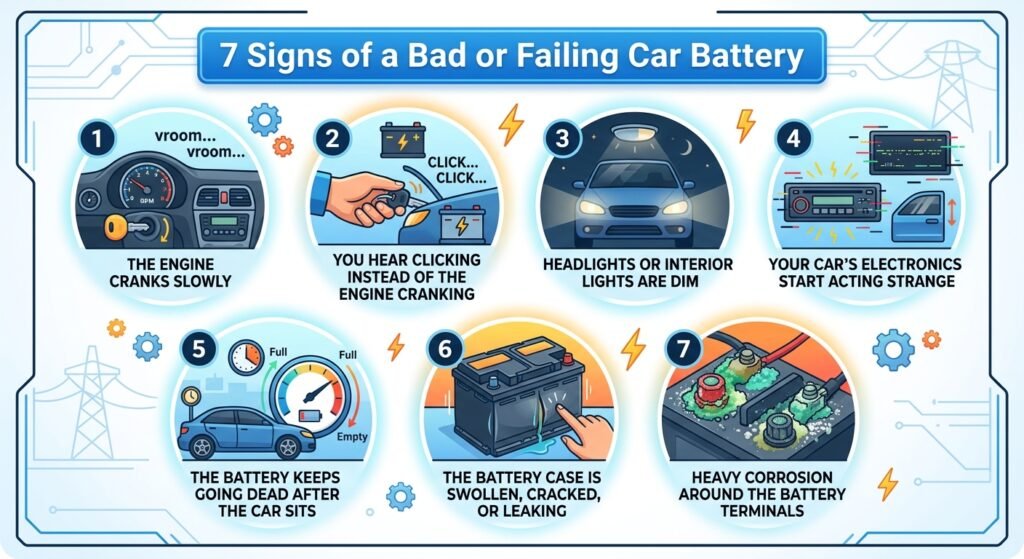
1. The Engine Cranks Slowly
A healthy battery should produce quick, consistent engine cranking. If the starter sounds slower than usual, or the engine turns over with a dragging, hesitant sound, a weak battery is one possible cause.
The problem may become more obvious after the car sits overnight, during cold weather, or when the battery is several years old. Low temperatures reduce the battery’s ability to deliver starting current, while the engine can also require more effort to crank.
If your car still starts, the battery can already have reduced capacity. A battery may retain enough charge for occasional starts while no longer delivering the same cranking performance it had when new. Cold Cranking Amps (CCA) are used to describe a battery’s ability to provide starting current under cold conditions.
Before replacing it, check the battery voltage, terminals, and charging system. A starter motor or poor electrical connection can also produce slow cranking.
2. You Hear Clicking Instead of the Engine Cranking
You turn the key or press the start button and hear a click, but the engine doesn’t crank normally. A weak battery can cause this because the starter requires a large amount of current, and the battery may not be able to supply it.
But clicking alone doesn’t prove that the battery is bad.
Other possible causes include:
- Corroded battery terminals
- A loose battery connection
- A poor ground connection
- A faulty starter or starter solenoid
- A damaged battery cable
If the car only clicks, inspect the battery connections and test the battery rather than immediately buying a replacement.
3. Headlights or Interior Lights Are Dim
Dim lights with the engine off can be consistent with a discharged or weak battery. If the battery has insufficient charge, headlights and interior lights may appear weaker than usual.
The situation is different with the engine running. Headlights or dashboard lighting that dims, flickers, or changes brightness while driving can point toward a charging-system problem, including an alternator fault.
Heavy electrical loads can make an existing charging problem more noticeable. This can include systems such as the car air conditioning system, heated seats, rear-window defroster, and other high-draw accessories.
Don’t treat dim lights as a definitive battery diagnosis. Check the charging voltage and battery condition.
4. Your Car’s Electronics Start Acting Strange
Modern vehicles rely on stable electrical voltage for everything from infotainment systems to electronic control modules. A weak or poorly charged battery can sometimes cause:
- Infotainment system resets
- Dashboard flickering
- Slow power windows
- Lost electronic settings
- Intermittent warning messages
- Automatic start/stop system deactivation
These symptoms can occur when voltage drops during starting or when the charging system isn’t maintaining the correct supply.
Electrical glitches can also have causes unrelated to the battery. Poor grounds, damaged wiring, failing electronic components, and charging-system faults can create similar behavior. If several electrical systems begin acting unpredictably, testing the battery and charging system is more useful than guessing which component has failed.
5. The Battery Keeps Going Dead After the Car Sits
A common scenario is simple: the car starts with a jump, you drive it for a while, park overnight, and the battery is dead again the next morning.
That doesn’t automatically mean you need a new battery.
Possible causes include:
- The battery can no longer hold a charge.
- A parasitic electrical drain is consuming power while the vehicle is parked.
- The alternator isn’t charging the battery correctly.
- The vehicle is mainly used for short trips.
- Lights or accessories were left running.
- The car has been parked for an extended period.
A repeatedly dead battery is evidence of a problem, but not proof that the battery itself is defective. If the battery is relatively new, test the charging system and look for an abnormal electrical drain before replacing it.
6. The Battery Case Is Swollen, Cracked, or Leaking
Physical damage is a more direct warning sign. Look for a battery case that is visibly swollen or bulging, cracks, signs of leakage, excessive heat damage, or a strong sulfur-like or rotten-egg smell.
A physically damaged battery shouldn’t simply be recharged and returned to service. Avoid unnecessary contact with leaking battery material and have the battery inspected or replaced using appropriate safety procedures.
A swollen battery can indicate internal damage or an electrical/charging problem. If the case has changed shape, don’t continue using the battery just because the car still starts.
7. Heavy Corrosion Around the Battery Terminals
White, blue, or greenish corrosion around the battery terminals can interfere with the electrical connection. Increased resistance at the terminals can cause difficult starting, intermittent electrical problems, and charging issues.
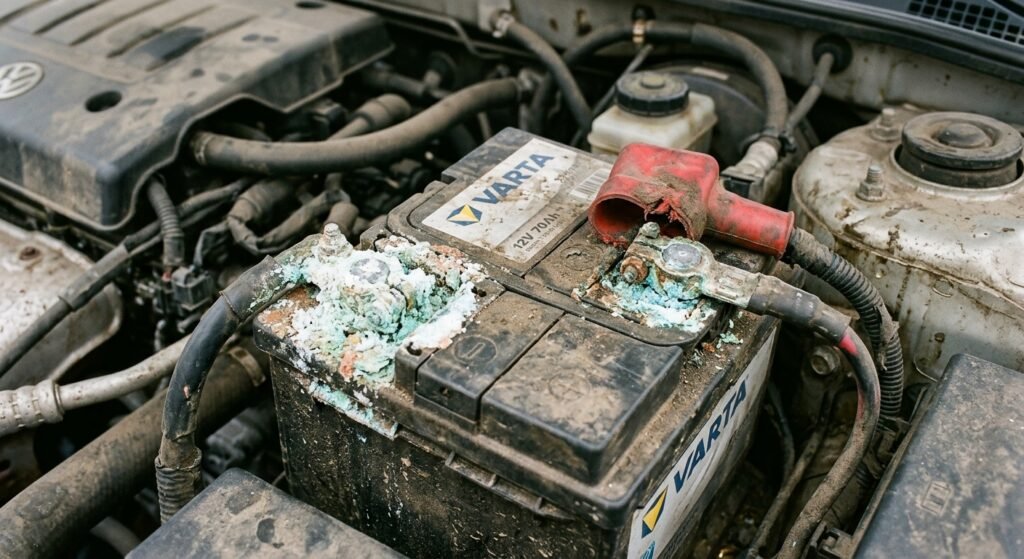
Corroded terminals don’t automatically mean the battery itself is bad.
A poor connection can produce symptoms that look almost identical to a weak battery. Inspect the terminals, clamps, cables, and grounds before deciding on battery replacement. If you’re cleaning battery connections, use appropriate protective equipment and avoid creating a short circuit across the terminals.
How Do You Know If It’s the Battery or the Alternator?
Battery and alternator problems often overlap, so symptoms should be treated as clues rather than definitive diagnoses.
| Symptom | More likely battery | More likely alternator / charging system |
| Won’t start after sitting overnight | Yes | Possible |
| Slow cranking | Yes | Possible |
| Starts normally after a jump-start | Yes | Possible |
| Battery repeatedly goes dead | Possible | Yes |
| Vehicle dies shortly after starting | Possible | Yes |
| Battery/charging warning light while driving | Less likely | More likely |
| Lights dim or flicker while engine runs | Possible | More likely |
| New battery repeatedly loses charge | Possible | Yes / parasitic drain |
These patterns can point toward one system, but they don’t replace an actual battery and charging-system test.
For example, if the car starts normally after a jump but repeatedly becomes dead while parked, the battery may be unable to hold a charge. A parasitic drain could also be responsible. If the battery warning light appears while you’re driving, the charging system deserves closer attention.
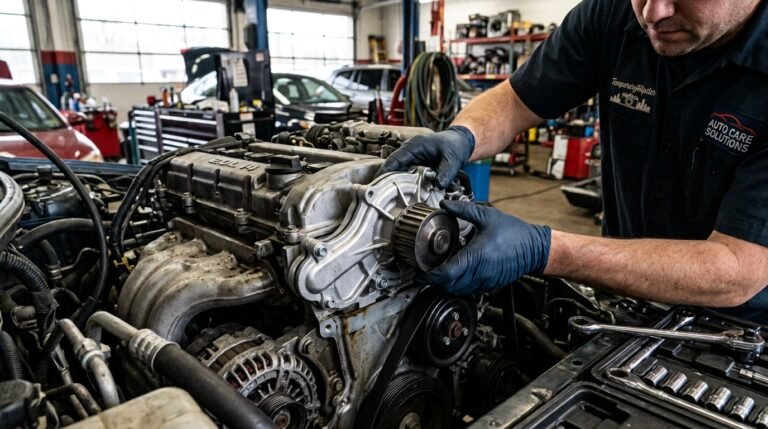
On many engines, the alternator is driven by the serpentine or accessory belt. A belt problem can therefore stop the alternator from charging the battery and, depending on the vehicle’s design, can also affect other engine accessories. If a belt failure occurs, understanding what can cause a car to overheat can also be useful because some engines use the accessory belt to drive the water pump.
How to Test a Car Battery at Home
Start With a Visual Inspection
Before reaching for a multimeter, inspect the battery and its connections.
Check for:
- Cracks or swelling in the battery case
- Visible leakage
- Corrosion around the terminals
- Loose terminal clamps
- Damaged cables
- Poor ground connections
- A visible battery date or manufacturing label
If the battery is physically damaged, don’t attempt to diagnose it by repeatedly charging or using it.
Test the Resting Battery Voltage
A digital multimeter can provide a useful first check. With the vehicle switched off and the probes connected to the battery terminals, a fully charged conventional 12-volt battery may show approximately 12.6-12.7 volts at rest under suitable conditions.
That number isn’t a pass/fail test for battery health.
Resting voltage primarily indicates the battery’s state of charge. The reading can also be affected by temperature, recent charging, and the vehicle’s operating conditions.
This is why a battery showing 12.6 volts can still fail to start a car.
Why a “Good” Voltage Reading Doesn’t Always Mean a Good Battery
If your battery shows 12.6 volts but the car won’t start, the battery may still be unable to provide enough current when the starter places it under heavy load.
Starting an engine requires much more current than powering a few interior lights. A battery can therefore appear adequately charged at rest while having poor starting performance.
This is where CCA becomes relevant. Cold Cranking Amps describe the battery’s ability to provide high starting current under specified cold-temperature testing conditions.
Load Testing Is More Informative
A proper battery test evaluates how the battery performs under load rather than looking only at its resting voltage. Many modern battery testers use conductance testing to estimate battery condition without applying the same type of load used by traditional testers.
The practical takeaway is simple: a battery can have normal resting voltage and still fail a proper load or conductance test.
If the voltage reading looks normal but the car continues to crank slowly or fail to start, have the battery tested professionally. The charging system should be tested at the same time if the battery keeps losing charge.
How Long Does a Car Battery Usually Last?
A conventional car battery commonly lasts around 3-5 years, although actual service life varies.
Factors that can shorten battery life include:
- Extreme heat
- Cold temperatures
- Frequent short trips
- Long periods of inactivity
- Heavy electrical loads
- Vehicle-specific charging strategies
- Battery type and quality
Battery age is a useful risk indicator, not a diagnosis. A two-year-old battery can fail, while a five-year-old battery can still pass a proper test.
When Should You Replace a Car Battery?
Battery replacement makes sense when the battery repeatedly fails testing, can’t hold a charge, or has clearly deteriorating cranking performance.
Replacement is also appropriate when the case is swollen or cracked, the battery is leaking, or testing shows that an older battery has lost substantial capacity.
Don’t replace a battery simply because it has reached an arbitrary age. At the same time, an older battery that is showing reduced performance deserves closer attention, especially before periods of extreme cold.
If the battery repeatedly discharges, find out why before installing another one. Otherwise, you may end up replacing good batteries while the actual fault remains in the vehicle.
How to Choose the Right Replacement Battery
The replacement battery needs to match the vehicle’s specifications. Check the owner’s manual or the manufacturer’s requirements for:
- Battery group or size
- Physical dimensions
- Terminal orientation
- Voltage
- Cold Cranking Amps (CCA)
- Reserve capacity, where applicable
- Battery technology
Battery technology matters on vehicles equipped with start-stop systems. Depending on the vehicle, the correct replacement may be an EFB (Enhanced Flooded Battery) or AGM (Absorbent Glass Mat) rather than a conventional flooded battery.
Some vehicles also use a battery-management system that requires battery registration, coding, or a reset after replacement. This isn’t necessary on every vehicle, so follow the manufacturer’s specified procedure for your particular model.
Installing a battery with the wrong size, technology, or electrical specification can create new problems even if the physical fit looks correct.
What If a New Battery Doesn’t Fix the Problem?
If a new battery doesn’t solve the starting problem, stop replacing parts and test the rest of the starting and charging system.
Possible causes include:
- Failing alternator
- Parasitic electrical drain
- Poor battery-terminal connection
- Bad ground
- Faulty starter
- Damaged battery cable
- Incorrect battery specification
- Defective replacement battery
A car that still won’t start with a new battery needs diagnosis, not another battery.
If the battery tests fine but the problem happens intermittently, electrical connections and the starter deserve attention. An intermittent charging fault or parasitic drain can also explain why the vehicle works normally on some days and fails on others.
Can a Car Battery Die While Driving?
The battery itself normally isn’t responsible for powering the vehicle continuously once the engine is running. The alternator supplies electrical power and recharges the battery.
If the alternator or another part of the charging system fails, the vehicle can continue operating temporarily using energy stored in the battery. Eventually, voltage can fall far enough that electrical systems stop working and the engine may shut down.
There’s no reliable universal estimate for how long this can take. It depends on battery condition, electrical load, vehicle design, and the nature of the charging-system fault.
A battery or charging warning light that appears while driving should therefore be treated as a reason to diagnose the charging system rather than simply replacing the battery.
Remember that a battery-shaped warning light and a check engine light indicate different systems. Don’t use them interchangeably.
How to Prevent an Unexpected Battery Failure
A few simple checks can reduce the chance of being caught by a weak battery:
- Inspect battery terminals periodically.
- Keep connections clean and secure.
- Test an ageing battery before winter.
- Don’t leave lights or accessories operating with the engine off.
- Investigate repeated battery discharge.
- Test the charging system when battery problems return.
A healthy battery is also only one part of routine vehicle maintenance. Other systems still need attention, including brake pad wear when maintenance or inspection requires it.
Frequently Asked Questions
How do I know if my car battery is bad?
Slow cranking, repeated no-starts, clicking, a battery that won’t hold a charge, and poor performance during cold weather can indicate a weak battery. However, alternator, starter, cable, ground, and terminal problems can produce similar symptoms. A voltage check followed by a proper battery test is a better way to confirm the diagnosis.
Can a car battery be bad even if it shows 12.6 volts?
Yes. Around 12.6-12.7 volts can indicate a reasonably charged conventional 12V battery under suitable resting conditions, but it doesn’t prove the battery is healthy. A battery can have acceptable resting voltage while failing to deliver enough current under starting load.
Is it the battery or alternator?
A battery is more likely when the car struggles to start after sitting, particularly if the battery is old. An alternator or charging-system fault becomes more likely when the battery repeatedly loses charge, the charging warning light appears while driving, or lights flicker with the engine running. Testing both systems provides a more reliable answer.
How long does a car battery last?
Many conventional batteries last approximately 3-5 years, but climate, driving habits, vehicle design, battery type, and electrical demand can shorten or extend that period. Age alone doesn’t determine whether replacement is necessary.
Can a dead battery be recharged instead of replaced?
Sometimes. A healthy battery can simply be discharged because of lights being left on, short trips, or prolonged inactivity and may recover after proper charging. A battery that has reached the end of its service life may not hold that charge. If it repeatedly goes dead, the vehicle should also be checked for charging problems or parasitic drain.
Why does my car keep killing new batteries?
A failing alternator, parasitic electrical drain, poor wiring or ground connections, an incorrect battery, or a defective replacement battery can all cause repeated failures. If multiple new batteries discharge, diagnose the vehicle rather than continuing to replace batteries.
Can I drive with a weak car battery?
The immediate risk is unexpected starting failure. If the underlying problem is actually a charging-system fault, the vehicle can also lose electrical power while driving. There isn’t a universal safe driving period for a weak battery, so recurring symptoms should be diagnosed before relying on the vehicle.