
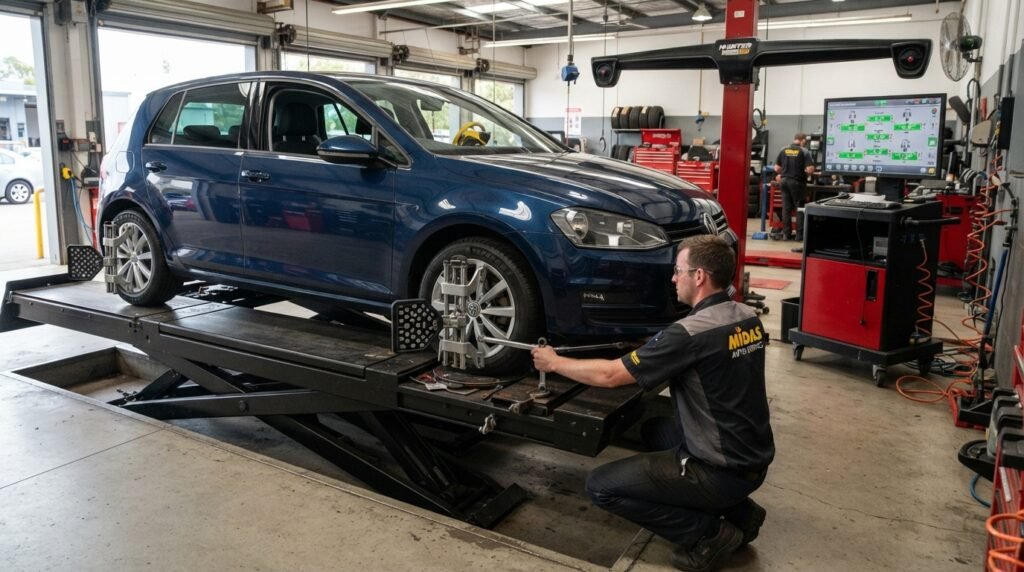
Wheel alignment is the measurement and adjustment of your vehicle’s steering and suspension geometry so the wheels operate within the manufacturer’s specified ranges. When those angles are incorrect, the car may pull to one side, the steering wheel may sit off-centre, or the tyres may develop uneven wear.
Alignment problems aren’t always obvious. A car can feel almost normal while one tyre is quietly wearing faster than the others. That’s why an alignment check is useful when handling changes, uneven tread wear, or a significant pothole or curb impact gives you a reason to suspect the geometry.
This guide explains what alignment actually changes, how to recognise a problem, what happens during an alignment, and what an alignment machine can and cannot fix.
Technical note: Alignment specifications vary by vehicle. Always use the manufacturer’s specifications for the exact year, make, model, trim, suspension configuration, and required load condition rather than a generic camber or toe number.
What Is Wheel Alignment?
Wheel alignment is the process of measuring and, where the vehicle design allows it, adjusting the angles that determine how the wheels sit relative to the road, each other, and the vehicle.
The three primary measurements are camber, caster, and toe. Hunter Engineering, a major manufacturer of alignment equipment, states that these angles should be evaluated against the original equipment manufacturer’s specifications.
Camber
Camber is the inward or outward tilt of the wheel when viewed from the front of the vehicle.
Too much positive or negative camber changes the tyre’s contact with the road and can contribute to uneven tread wear. The exact acceptable range depends on the vehicle.
Caster
Caster is the angle of the steering axis when viewed from the side of the vehicle.
It affects steering stability, steering response, and how readily the steering returns toward centre after a turn.
Caster is not adjustable on every vehicle, so an alignment measurement that’s outside specification may sometimes point toward a worn, bent, or damaged suspension component rather than a simple adjustment.
Toe
Toe describes the direction the wheels point relative to each other when viewed from above.
Incorrect toe is particularly relevant to tyre wear because the tyre can scrub against the road instead of rolling cleanly forward.
Even a small toe error can produce noticeable tread wear over time, depending on the vehicle and the amount of misalignment.
6 Signs Your Car Needs a Wheel Alignment
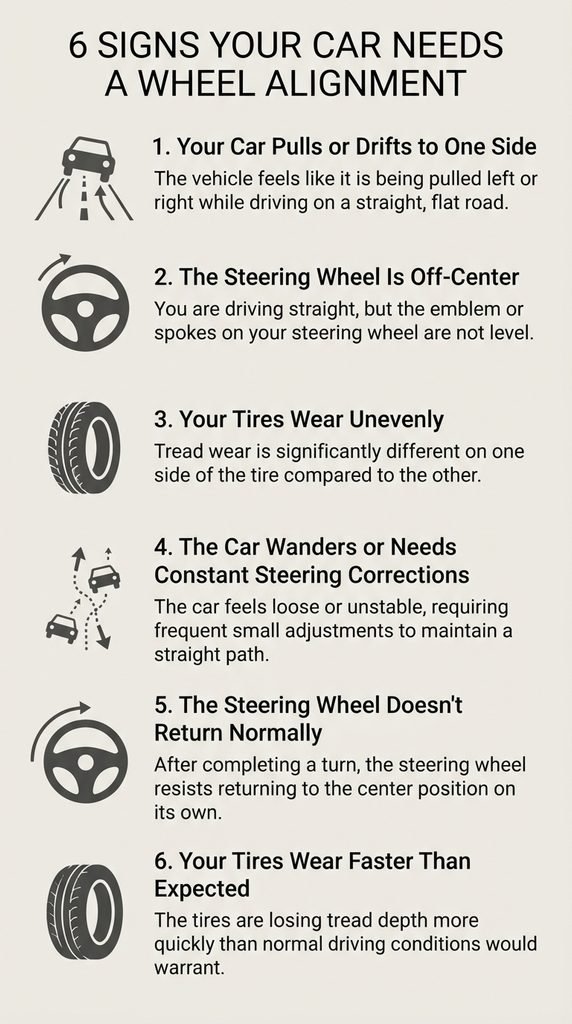
1. Your Car Pulls or Drifts to One Side
A vehicle that consistently drifts left or right on a reasonably flat road may need an alignment check.
There is an important qualification: roads aren’t perfectly flat. Road crown can naturally make a vehicle move slightly toward one side, and crosswinds can have a similar effect.
Check tyre pressure first and don’t perform aggressive hands-off-road tests. The driver should always maintain control of the vehicle.
If the car pulls specifically when you press the brake pedal, investigate the braking system as well. A sticking calliper or uneven braking force can cause that pattern. Our guide explains why your car pulls to one side when braking.
2. The Steering Wheel Is Off-Center
If the vehicle travels straight but the steering wheel sits noticeably to one side, alignment may be incorrect.
An off-centre steering wheel can also appear after steering or suspension work, particularly if the steering wheel wasn’t properly centred during the alignment procedure.
Simply removing and repositioning the steering wheel isn’t the correct way to repair the underlying alignment. The actual wheel geometry needs to be measured.
3. Your Tires Wear Unevenly
Uneven tread wear is one of the strongest reasons to inspect alignment.
Common patterns can provide clues:
- One-edge wear: can be associated with incorrect camber or toe.
- Feathered tread: can point toward toe-related geometry problems.
- Scalloping or cupping: can also involve suspension, wheel balance, tyre pressure, or other issues.
Tire wear patterns are clues, not proof of a specific alignment fault. Michelin identifies uneven wear and changes in handling as reasons to investigate alignment.
4. The Car Wanders or Needs Constant Steering Corrections
A vehicle with incorrect geometry may require frequent steering input to maintain a straight path.
You might notice that the car:
- Wanders on straight roads
- Feels less settled
- Requires constant small corrections
- Reacts differently after bumps
Alignment can cause these symptoms, but worn suspension or steering components can create very similar behaviour.
5. The Steering Wheel Doesn’t Return Normally
After turning, the steering should generally return toward its centred position as the vehicle moves forward.
Caster influences this self-centring behaviour, but an alignment problem isn’t the only possible explanation. Worn steering components, suspension damage, binding, or other mechanical problems can also affect steering return.
A sudden change in steering behaviour deserves inspection rather than an automatic alignment appointment.
6. Your Tires Wear Faster Than Expected
Incorrect alignment can cause tyres to scrub against the road and concentrate wear on a smaller part of the tread.
This can shorten the useful life of an otherwise healthy tyre.
The sequence is simple:
Incorrect geometry → uneven tyre contact → accelerated wear → shorter tyre life.
An alignment can stop the abnormal wear from continuing, but it cannot restore rubber that has already worn away.
What Causes Wheel Alignment to Go Out?
Alignment geometry can change after impacts, component wear, or certain repairs.
Common causes include:
- Pothole impacts
- Curb strikes
- Collision damage
- Worn suspension components
- Worn steering components
- Replacement of steering or suspension parts
- Incorrect adjustment or installation
A pothole doesn’t automatically mean your alignment is damaged. The more useful clue is what happens afterwards.
If the steering wheel suddenly becomes off-centre, the vehicle begins pulling, or a tyre develops abnormal wear following an impact, an alignment inspection makes sense. Michelin also identifies impact-related handling changes and irregular tyre wear as reasons to check the vehicle.
Wheel Alignment vs. Wheel Balancing
Alignment and balancing solve different problems.
| Wheel alignment | Wheel balancing |
|---|---|
| Measures and adjusts wheel geometry | Corrects uneven mass distribution |
| Can cause pulling | Can cause vibration |
| Can cause irregular tyre wear | Can contribute to vibration at speed |
| Involves camber, caster, toe and related geometry | Uses balancing equipment and wheel weights |
| Affects how the vehicle tracks | Affects how smoothly the wheel/tire assembly rotates |
A useful rule:
Alignment controls where the wheels point.
Balancing controls how smoothly they rotate.
A car can require one service without requiring the other. Hunter’s current alignment systems measure wheel position and orientation and compare the results with vehicle-specific specifications.
For example, a car that vibrates at 65 mph even when you aren’t braking may need a tyre or wheel inspection rather than an alignment. A car that consistently drifts and has abnormal tread wear is a different case.
Front-Wheel Alignment vs. Four-Wheel Alignment
Not every vehicle uses the same alignment procedure.
A front-end alignment focuses primarily on the front geometry when the vehicle’s design and service procedure call for it.
A four-wheel alignment measures the geometry of all four wheels and accounts for rear suspension angles where applicable.
Modern vehicles may have adjustable rear camber or toe, so the rear axle can affect vehicle tracking even though the steering wheel is connected to the front steering system.
Hunter’s alignment systems measure all four wheels and provide vehicle-specific alignment data where supported.
The correct service should therefore be based on the vehicle’s suspension design, not simply the shop’s preferred package.
How to Know if Your Car Is Out of Alignment
Start with basic checks before paying for an alignment.
1. Check tyre pressure
Unequal tyre pressure can cause pulling or unusual wear even when alignment is correct.
Use the vehicle manufacturer’s recommended cold pressure, not the maximum pressure printed on the tire sidewall.
2. Inspect the tread
Look for:
- One-edge wear
- Feathering
- Scalloping
- Uneven wear between left and right tyres
Take photographs if you see a pattern. The wear can help a technician understand how the problem developed.
3. Pay attention to vehicle tracking
Notice whether the vehicle consistently drifts on a reasonably flat road.
Don’t use a public road to perform deliberate steering experiments. Normal driving observations are sufficient.
4. Check steering-wheel position
An off-centre steering wheel is a useful clue, particularly if the vehicle otherwise tracks reasonably straight.
5. Consider what happened before the symptom appeared
A sudden change after a pothole, curb impact, accident, or suspension repair provides useful diagnostic context.
6. Get the actual alignment measured
A road test can identify symptoms, but it can’t accurately measure camber, caster, toe, or related geometry.
An alignment machine measures the current angles and compares them against the vehicle’s specifications. Modern systems use cameras, sensors, or reflective targets to determine wheel position and orientation.
What Happens During a Wheel Alignment?
A proper alignment starts with inspection.
The technician typically:
- Checks tyre condition and pressure.
- Inspects steering and suspension components.
- Mounts alignment sensors or targets.
- Measures the vehicle’s existing alignment angles.
- Compares the results with OEM specifications.
- Adjusts the angles that the vehicle allows to be adjusted.
- Measures the vehicle again.
- Produces before-and-after results where the equipment supports reporting.
- Road-tests the vehicle when appropriate.
Hunter’s current workflow describes the process as selecting the vehicle, measuring angles, making the permitted adjustments, and presenting the results.
What Does an Alignment Printout Tell You?
A useful alignment report normally shows the measured geometry before and after adjustment.
Look for values such as:
- Left and right camber
- Left and right caster
- Left and right toe
- Total toe
- Steering-angle or thrust-related measurements where applicable
- Manufacturer specification ranges
- Final readings after adjustment
The most useful report isn’t simply one that says “green” or “OK.” It shows the actual measurements and the specifications they were compared against.
This is also why generic alignment numbers found online aren’t reliable for every car. Hunter’s systems use vehicle-specific specification databases, and OEM tolerances can differ significantly between models.
What Can a Wheel Alignment Fix?
Alignment can correct geometry that is adjustable and currently outside the manufacturer’s specifications.
Depending on the vehicle, that can include adjustments to:
- Toe
- Camber
- Caster
- Rear alignment angles
The exact adjustment range depends on the suspension design.
Alignment cannot repair a bent or worn mechanical component.
What Can’t a Wheel Alignment Fix?
This distinction is often missing from generic alignment articles.
An alignment cannot repair:
- Bent control arms
- Bent steering knuckles
- Worn ball joints
- Worn tie rods
- Damaged bushings
- Bent wheels
- Defective tires
- Damaged wheel bearings
If an alignment machine shows an angle substantially outside specification and the vehicle doesn’t provide enough adjustment to correct it, the technician needs to determine why.
For example, a bent control arm may be the actual cause of an abnormal camber reading. Adjusting toe around a damaged component doesn’t make the suspension healthy.
Hunter’s collision-alignment systems specifically use additional measurements to help identify hidden structural and suspension damage after crashes.
How Often Do You Need a Wheel Alignment?
There isn’t one universal mileage interval that applies to every vehicle.
Instead, an alignment check makes sense when:
- The car starts pulling
- The steering wheel becomes off-centre
- Tires develop uneven wear
- Handling changes noticeably
- The vehicle hits a significant pothole or curb
- The vehicle is involved in a collision
- Relevant steering or suspension components are replaced
Some manufacturers and service providers include periodic alignment checks in maintenance recommendations, but vehicle-specific guidance should take priority.
Alignment is a measurement, not a consumable service like engine oil. There is no reason to adjust it merely because the odometer has reached an arbitrary number if the geometry remains within specification.
Can Bad Wheel Alignment Damage Tires?
Yes.
Incorrect alignment can increase tyre scrub and concentrate wear on particular parts of the tread.
One-edge wear is especially useful as a warning sign. Once that wear has become severe, an alignment won’t restore the damaged tread.
The correct sequence is:
Find the geometry problem → correct it → inspect the tyre → replace the tyre if its condition is no longer safe or serviceable.
Replacing a worn tyre without correcting the underlying alignment problem can simply start the same wear pattern on the replacement.
Michelin specifically identifies uneven tire wear as a reason to investigate alignment.
Can Bad Alignment Affect Fuel Economy?
It can, although the effect varies.
Misaligned wheels can increase tyre scrub and rolling resistance, which means the vehicle may require more energy to maintain speed. Hunter lists fuel economy among the potential benefits of maintaining alignment within specifications.
Don’t expect a dramatic fuel-economy improvement from every alignment correction. Tire pressure, tyre condition, vehicle weight, speed, weather, and driving style can have much larger effects.
For most drivers, tyre wear and handling are the more noticeable consequences of a significant alignment problem.
Can You Drive With Bad Wheel Alignment?
A mildly misaligned vehicle may remain drivable, but continued driving can accelerate tyre wear and change handling.
Arrange an inspection promptly when:
- The vehicle pulls noticeably
- The steering wheel suddenly becomes off-centre
- One tyre is wearing rapidly
- Handling changes after a pothole or curb impact
- Steering feels loose or unstable
A small alignment deviation isn’t the same as a damaged suspension component. If the vehicle suddenly becomes difficult to control, don’t continue driving normally while waiting to see whether an alignment solves it.
How Much Does a Wheel Alignment Cost?
The price varies by vehicle, location, alignment type, shop, and whether additional repairs are required.
The alignment itself may be straightforward. The bill can increase when the technician finds:
- Seized adjustment points
- Worn suspension parts
- Bent steering components
- Damaged wheels
- Other problems that prevent the vehicle from holding correct geometry
Before approving an alignment, ask whether the shop has inspected the steering and suspension components.
An alignment should not be used as a substitute for repairing a damaged suspension part.
How to Prevent Alignment Problems
You can’t prevent every change in wheel geometry, but you can reduce the risk of major problems.
Avoid potholes and curb impacts where possible. Maintain the correct tyre pressure and inspect tread wear regularly.
After a significant impact, don’t wait for the tyres to become visibly damaged before considering an inspection. A vehicle can develop a handling problem before the tread pattern becomes obvious.
It’s also sensible to check alignment after relevant steering or suspension repairs. Changing components can alter wheel geometry, and the final settings should be verified against the correct vehicle specifications.
Regularly checking tyre condition gives you another early-warning system. Uneven tread wear is often easier to spot than a small change in steering feel.
A Practical Alignment Example
Consider a vehicle that arrives at a workshop with three complaints:
- The steering wheel sits slightly to the right.
- The car drifts on straight roads.
- The inside edge of one front tyre is wearing faster than the rest.
The correct diagnostic process isn’t to immediately adjust the wheels.
The technician should first check tyre pressure, inspect the steering and suspension, and confirm there is no bent or excessively worn component. The vehicle can then be placed on an alignment machine, where the actual camber, caster, and toe measurements are compared with the manufacturer’s specifications.
If the relevant angles are adjustable and outside specification, the technician can make the required corrections and generate a before-and-after report.
If an angle remains outside specification despite the available adjustment, that is a reason to investigate the suspension rather than simply declaring the alignment complete.
The value of the alignment report is that it shows what was actually measured, rather than relying on a vague statement that the car “needed an alignment.” Modern alignment equipment can capture the vehicle’s pre-adjustment measurements and provide final results after adjustment.
FAQ
What is wheel alignment?
Wheel alignment is the measurement and adjustment of steering and suspension geometry so the wheels operate within the vehicle manufacturer’s specifications. The primary alignment angles are camber, caster, and toe.
What are the signs of bad wheel alignment?
Common signs include pulling or drifting, an off-centre steering wheel, uneven tyre wear, wandering, and changes in steering response.
How do I know if my car needs an alignment?
Check tyre pressure and inspect the tread first. An alignment inspection makes sense when the car pulls, the steering wheel becomes off-centre, tyres wear unevenly, handling changes, or the vehicle has experienced a significant impact.
What causes wheel alignment to go out?
Potholes, curb impacts, collisions, worn suspension or steering components, and some repairs can change alignment geometry. A significant impact or a new handling problem is a good reason to have the vehicle checked.
What are camber, caster, and toe?
Camber is the wheel’s inward or outward tilt viewed from the front. Caster is the steering-axis angle viewed from the side. Toe describes the direction the wheels point relative to each other when viewed from above.
What’s the difference between wheel alignment and balancing?
Alignment deals with steering and suspension geometry. Balancing corrects uneven mass distribution in the wheel and tyre assembly. Alignment problems are more associated with pulling and abnormal tyre wear, while imbalance is more commonly associated with vibration.
How often should you get a wheel alignment?
There is no universal interval for every vehicle. Follow the manufacturer’s maintenance guidance and have alignment checked when pulling, uneven tyre wear, an off-centre steering wheel, major impacts, or handling changes occur.
Does wheel alignment affect tyre wear?
Yes. Incorrect geometry can make tyres scrub against the road and wear unevenly, particularly along one edge of the tread.
Can bad alignment damage tyres?
Yes. Continued misalignment can accelerate tread wear and shorten tyre life. Correcting the alignment won’t restore tread that has already worn away.
Can bad alignment cause a car to pull?
Yes. Incorrect alignment can cause a vehicle to pull or drift, although tyre pressure, tyre condition, brakes, steering, and suspension can produce similar symptoms.
Can you drive with bad wheel alignment?
A mildly misaligned vehicle may remain drivable, but continued driving can increase tyre wear and affect handling. Strong pulling or sudden changes in vehicle control should be investigated promptly.
How much does a wheel alignment cost?
The price depends on the vehicle, alignment type, location, required adjustments, and whether worn or damaged suspension components also need repair.
Do I need a four-wheel alignment?
It depends on the vehicle. Many modern vehicles have rear alignment angles that should be measured, making a four-wheel alignment appropriate. The correct procedure depends on the suspension design and manufacturer specifications.
Does changing tyres require an alignment?
Installing new tyres does not automatically mean an alignment is required. However, an alignment check is useful when the old tyres showed uneven wear, or the vehicle has pulling, handling, or steering-wheel symptoms.
How We Researched This Guide
This article was checked against current technical information from Hunter Engineering, Michelin, and vehicle-service documentation. Hunter’s current alignment systems describe the measurement of camber, caster, toe, vehicle-specific specifications, and before-and-after alignment results, while Michelin’s guidance connects handling changes and irregular tyre wear with alignment inspection.
Vehicle-specific measurements and adjustment limits should always take precedence over generic numbers published online.
For a production version of this article, add a named author and, where available, a qualified technical reviewer with their actual automotive credentials and experience. A real alignment printout or original tire-wear photograph would also provide stronger first-hand evidence than stock imagery.