If your temperature gauge is climbing, an overheating warning light has appeared, or steam is coming from under the hood, the first question is usually: why is my car overheating?
Low coolant is one possibility, but it is far from the only one. An engine can overheat because coolant is not circulating properly, the radiator cannot remove enough heat, the cooling fan is not working, or an internal engine problem is allowing excessive heat to build up.
The useful clue is often when and how the car overheats. An engine that gets hot only in traffic points you toward a different problem than one that overheats on the highway.
What Does It Mean When a Car Overheats?
A running engine produces a large amount of heat. The cooling system is designed to carry that heat away before engine temperatures become excessive.
The basic process is:
Engine → coolant → water pump → radiator → airflow → heat removal
Overheating can occur when:
- The system does not have enough coolant.
- Coolant cannot circulate correctly.
- The radiator cannot transfer enough heat.
- Airflow through the radiator is insufficient.
- The cooling system cannot maintain the correct pressure.
- The engine is generating abnormal amounts of heat.
That means a full coolant reservoir does not necessarily mean the cooling system is working correctly.
The Most Common Causes of an Overheating Car
Low Coolant or a Coolant Leak
Low coolant is one of the simplest explanations for an overheating engine. Without enough coolant circulating through the engine and radiator, the system cannot carry heat away effectively.
A leak can occur in several places, including:
- Radiator hoses
- Radiator
- Expansion tank
- Thermostat housing
- Radiator cap
- Water-pump area
Leaks are not always obvious. A small leak may only become apparent when the cooling system is hot and pressurized. Coolant can also escape onto hot engine components and evaporate before leaving an obvious puddle.
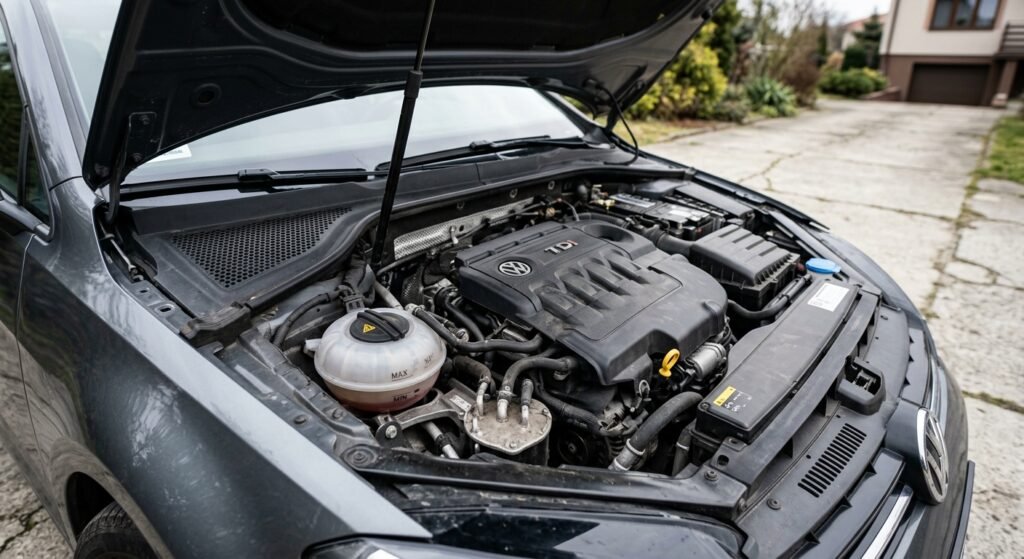
If the coolant level keeps dropping, topping it up is not a permanent repair. The cause of the coolant loss needs to be identified.
Faulty or Stuck Thermostat
The thermostat controls when coolant is allowed to circulate through the radiator. If it becomes stuck closed, coolant circulation can be restricted and engine temperature can rise rapidly.
Possible signs include:
- Temperature rising unusually quickly
- Temperature fluctuations
- Overheating despite an adequate coolant level
A thermostat problem can sometimes resemble other cooling-system faults, so the symptoms should be considered together rather than treated as a confirmed diagnosis.
If the thermostat is suspected, see our guide on how to diagnose a faulty thermostat for more detail.
Cooling Fan Isn’t Working
The cooling fan becomes especially important when the car is stationary. While driving, air naturally moves through the radiator. At idle or in slow traffic, the fan helps provide that airflow.
This explains a common question: why does my car overheat when idling but cool down when I start driving?
A faulty cooling fan can be caused by:
- Fan motor failure
- Blown fuse
- Faulty relay
- Wiring problems
- Temperature sensor failure
- Fan-control system problems
If the car stays at a normal temperature while moving but overheats in traffic, the cooling fan and its control system are worth investigating.
Use caution when checking the fan. Electric cooling fans can start unexpectedly, and both the fan and surrounding engine components may be hot.
Failing Water Pump
The water pump circulates coolant through the engine and cooling system. If it cannot maintain adequate coolant flow, the engine may overheat even when the coolant level appears normal.
Possible symptoms include:
- Repeated overheating
- Coolant leakage near the pump
- Whining or grinding noises
- Weak or inconsistent cabin heat
- Overheating despite sufficient coolant
Water-pump symptoms vary considerably between vehicle designs. A proper diagnosis may require additional testing rather than relying on one symptom.
Clogged or Damaged Radiator
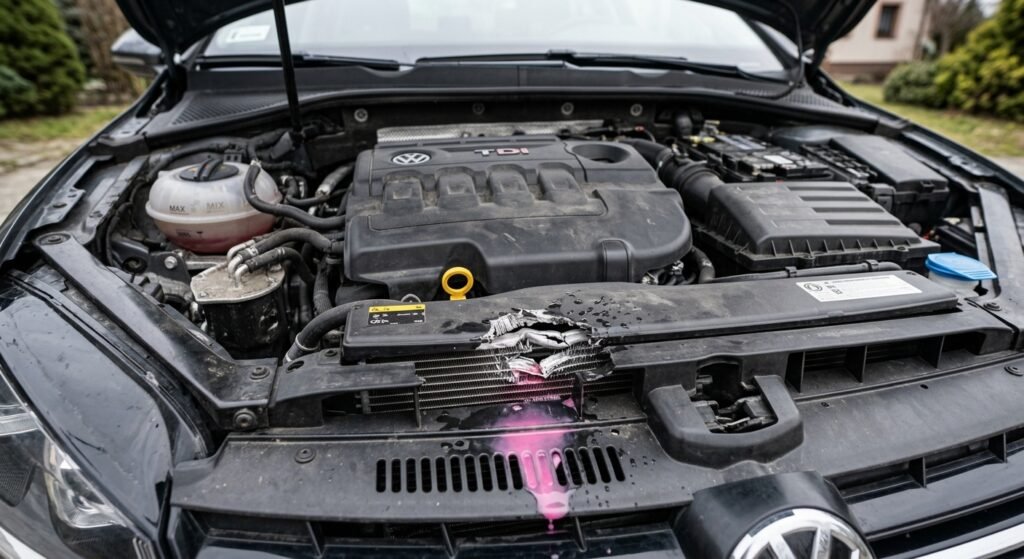
The radiator removes heat from the coolant. It can have sufficient coolant inside and still fail to cool the engine effectively.
Internal radiator problems can include:
- Deposits
- Corrosion
- Restricted coolant passages
External problems can include:
- Dirt
- Bugs
- Road debris
- Bent or damaged cooling fins
The radiator cap also matters because the cooling system relies on maintaining the correct pressure. A problem with system pressure can affect coolant performance and contribute to overheating.
Trapped Air in the Cooling System
Air pockets can interfere with coolant circulation and prevent parts of the cooling system from operating correctly.
This can happen after:
- Coolant replacement
- Radiator replacement
- Thermostat replacement
- Hose replacement
- Other cooling-system repairs
Common signs include fluctuating temperature, inconsistent cabin heat, gurgling sounds, or overheating that begins after recent cooling-system work.
Some vehicles require a specific procedure to remove trapped air. Because cooling-system bleeding procedures vary, avoid applying a generic procedure without knowing the vehicle’s design.
Blown Head Gasket or Other Internal Engine Problem
A blown head gasket is a serious possibility, but it should not automatically be blamed whenever a car overheats.
Potential warning signs include:
- Persistent white exhaust smoke
- Unexplained coolant loss
- Continuous bubbling in the coolant reservoir
- Contaminated or milky engine oil
- Misfires or rough running
- Repeated overheating
These symptoms can have other causes, so one symptom alone does not prove a head-gasket failure.
If you notice persistent white smoke, our guide to what different exhaust smoke colors can mean can help explain what the smoke may indicate.
Low Engine Oil
Engine oil lubricates moving components and helps manage heat inside the engine. If the oil level is significantly low, increased friction can contribute to higher engine temperatures.
However, low oil is not the only explanation for overheating. If the temperature gauge is above normal, the cooling system should still be investigated.
Why Is My Car Overheating in Specific Situations?
The conditions under which overheating occurs can provide useful diagnostic clues. They do not identify the failed component by themselves, but they can help narrow down where to look.
| Situation | Likely areas to investigate |
| Overheats at idle or in traffic | Cooling fan, fan control, airflow |
| Overheats while driving | Coolant circulation, thermostat, radiator, water pump |
| Overheats on the highway | Cooling capacity, coolant flow, radiator, water pump |
| Overheats with AC running | Cooling fan, airflow, marginal cooling capacity |
| Overheats after coolant was changed | Trapped air, incorrect bleeding, leak |
| Overheats even though coolant is full | Thermostat, fan, water pump, radiator, trapped air, internal engine issue |
| Temperature suddenly rises and falls | Thermostat, air pocket, coolant circulation, sensor issue |
For example, a vehicle that overheats primarily while sitting in traffic may have an airflow problem. A vehicle that overheats at highway speeds may point more toward coolant circulation or insufficient cooling capacity.
The timing matters.
What to Check When Your Car Is Overheating
If your car begins overheating, work through the problem safely rather than immediately replacing parts.
Step 1: Stop Safely and Let the Engine Cool
If the temperature is above normal, pull over somewhere safe and switch the engine off.
Do not remove the radiator cap while the engine is hot.
The cooling system can be pressurized, and hot coolant or steam can cause severe burns.
Step 2: Check the Coolant Level When the Engine Is Cold
Once the engine has cooled, check the coolant reservoir and compare the level with the markings on the tank.
If the coolant is low, that is useful information, but it does not explain why the level dropped. Look for evidence of a leak rather than treating repeated top-ups as the solution.
Step 3: Look for Obvious Leaks
With the engine cold, inspect areas around:
- Coolant hoses
- Radiator
- Expansion tank
- Thermostat housing
- Water-pump area
- Ground underneath the vehicle
A visible leak can significantly narrow down the diagnosis.
Step 4: Check Whether the Cooling Fan Operates
If overheating happens primarily while idling or sitting in traffic, the cooling fan is an important suspect.
Do not put your hands near the fan or attempt to inspect moving components with the engine running. Electric fans can activate unexpectedly.
Step 5: Check the Engine-Oil Level
Check the oil level according to the vehicle manufacturer’s procedure. Significantly low oil should be addressed, although it does not automatically explain an overheating problem.
Step 6: Identify the Overheating Pattern
Think about exactly when the problem occurs:
- At idle?
- In traffic?
- At highway speeds?
- With the AC running?
- Shortly after a cold start?
- After recent coolant-system work?
This information can be more useful to a mechanic than simply saying that the car “gets hot.”
Step 7: Know When Professional Testing Is Required
Some overheating problems cannot be diagnosed reliably through visual inspection.
A mechanic may use:
- A cooling-system pressure test
- A combustion-gas or block test
- Scan-tool diagnostics
- Cooling-system temperature testing
The objective should be diagnosis before parts replacement. Replacing a thermostat, radiator, water pump, or fan without identifying the underlying problem can become an expensive process of trial and error.
Can You Keep Driving an Overheating Car?
Generally, no.
Continuing to drive while the engine is overheating can turn a relatively contained cooling-system problem into major engine damage.
Excessive heat can contribute to:
- Warped cylinder heads
- Head-gasket failure
- Internal engine damage
If the temperature is above normal, pull over safely, switch the engine off, and allow it to cool. Do not repeatedly drive the vehicle while it is overheating simply to see whether the temperature returns to normal.
When Should You Take the Car to a Mechanic?
Professional diagnosis is appropriate when:
- Coolant repeatedly disappears.
- The engine overheats again after coolant is added.
- You cannot find an obvious external leak.
- The cooling fan does not operate.
- The vehicle repeatedly overheats.
- Persistent white exhaust smoke is present.
- The engine runs roughly or misfires.
- Coolant continuously bubbles in the reservoir.
- The problem started immediately after cooling-system work.
- Multiple components have already been replaced without fixing the problem.
The key principle is simple: diagnose before replacing parts.
Several different cooling-system problems can produce similar symptoms. Replacing components based only on a guess can waste both time and money.
Frequently Asked Questions
Can a car overheat if the coolant is full?
Yes. A full coolant reservoir does not guarantee proper coolant circulation or heat removal. A faulty thermostat, water pump, cooling fan, radiator, trapped air, or internal engine problem can still cause overheating.
Why does my car overheat when idling but not while driving?
A common suspect is the cooling fan or its control system. When the car is moving, natural airflow through the radiator can temporarily compensate for a fan that is not operating correctly.
Can low oil cause a car to overheat?
Low engine oil can contribute to increased heat and friction, but it is not the only possible cause. If the temperature gauge is rising, the cooling system should also be checked.
Can a bad thermostat cause overheating?
Yes. A thermostat stuck in the closed position can restrict coolant circulation and cause engine temperature to rise. However, other cooling-system faults can produce similar symptoms.
Can I drive my car if it is overheating?
It is generally not safe to continue driving an overheating car. Stop safely, switch the engine off, and allow it to cool. Continuing to drive can cause serious engine damage.